
For most slab, footing, and column rebar on commercial concrete jobs, a portable hydraulic electric rebar cutter rated 4-25 mm (3/20" to 1") at roughly 1700 W delivers a 3-5.5 second cut cycle on mild steel rebar, with a working weight near 70 lbs [S2]. That single capacity window covers #3 through #8 imperial bar, which is the everyday range in cast-in-place concrete.
Larger structural pours push the requirement up. Electric rebar cutters and benders built around 42 mm capacity are positioned for bridge, high-rise, and heavy civil work where #10 and #11 bar show up in pile caps and transfer beams [S4]. Choosing below the bar size on site is the most common specification mistake; choosing too far above wastes money and adds weight crews will not carry up rebar cages.
Cutting Capacity and Bar Diameter Mapping
Rebar cutter capacity is rated by the largest nominal rebar diameter the machine can sever in one stroke, and the practical limit lines up with imperial bar sizes. The VEVOR RC-25, a representative portable hydraulic electric unit, lists 4-25 mm rebar with a 3-5.5 second cycle on a 1700 W pure-copper motor and a 70 lb shipping weight [S2]. For context on the heavier end, distributor-stocked electric bar cutters covering 10-42 mm rebar are the standard offering for jobs that need #3 through #11 bar processed on site [S4].
Implied bar mapping from the data: 4-25 mm covers #3 (10 mm) through #8 (25 mm); 10-42 mm coverage adds #10 (32 mm) and #11 (36 mm) and reaches into #14 (43 mm) territory. For slab-on-grade, footings, and most columns, the 25 mm ceiling is sufficient. For pile caps, mat foundations, and bridge piers, size up to the 32-42 mm class. Read the rebar cutter reference page for the broader machine taxonomy, including manual, hydraulic-electric, and battery-cordless variants.
Power Source, Motor Rating, and Cycle Time
Portable hydraulic electric cutters in the 4-25 mm class draw about 1500-1800 W from a 110-120 V single-phase supply and finish a cut in 3-5.5 seconds on grade 60 rebar [S2]. Heavier 10-42 mm electric cutters sit in a higher power bracket and run on three-phase or higher-voltage single-phase at the jobsite distribution panel. Across both classes, the cycle time scales with bar diameter, so a 25 mm cut takes noticeably longer than a 10 mm cut on the same machine.
For pure speed on repetitive #4 and #5 bar, a higher-amperage hydraulic unit pays back the cost. For mixed-diameter work on a single pour, match motor power to the largest bar on the cut list, not the average. Battery-cordless rebar cutters exist but still trail plug-in units on continuous-cycle duty; a concrete groove cutter is a different tool class and is not interchangeable for rebar severance.
Blade Sets, Replacement Parts, and Operating Cost
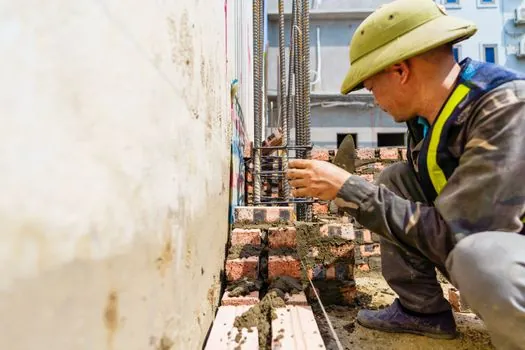
Rebar cutter blades are consumable, and the cost line is real. Replacement blade sets for the common electric-hydraulic models are catalogued from $0.75 to $195 per set, with the upper end tied to 1-1/4" (32 mm) capacity units [S5]. Mounting hardware is sometimes included, sometimes sold separately, so the headline price is not the landed price on consumables.
Two practical signals from the catalog data: a 3/4" (19 mm, #6) blade set for B&C/BNC machines runs $1.75-$75, and a 1" (25 mm, #8) set runs $1.85-$85, both with mounting hardware included [S5]. For an Edwards No. 15 cutter, the same #5 (5/8", 16 mm) blade set is listed at $8.95-$140 with hardware sold separately [S5]. Match the blade set to the cutter model code, not just the bar size; a wrong-fit blade chews the holder and is the most common cause of hydraulic-electric cutter failure on site.
Selection Criteria: Power, Weight, and Site Logistics
Three criteria drive the right pick: bar diameter, cycle count per shift, and how far the operator must carry the machine. For a slab pour with 200-400 cuts per day on #4 and #5 bar, a 4-25 mm portable unit at roughly 70 lb is the workhorse; one operator can carry it, a crew of one can stage it [S2]. For a bridge deck with 800+ cuts per day on #6 through #8 bar, step up to a wheeled 10-32 mm or 10-42 mm machine, or pair two portable units to keep cycle time up.
Weight and power trade against each other. The 4-25 mm class is single-person portable; the 10-42 mm class is two-person or cart-mounted and usually runs on site three-phase [S4]. Battery-cordless units trade continuous-cycle runtime for portability, and on long shifts the swap-battery count becomes the throughput bottleneck. For shop pre-cut work, a stationary electric bar cutter with a foot-pedal hydraulic head is faster than any portable unit and feeds rebar cages more cleanly.
Comparison: Portable vs Stationary vs Cordless
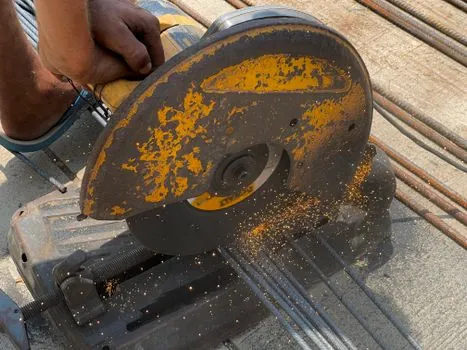
Three options show up in real bids. The portable hydraulic-electric 4-25 mm class is the default for slab and column work, at roughly 1700 W, 70 lb, and 3-5.5 seconds per cut [S2]. The stationary heavy electric class at 10-42 mm capacity is built for pre-cut yards and high-cycle bridge work, with distributor-stocked spare parts and on-site repair service in markets like the Philippines [S4]. The battery-cordless class is sized for small-diameter bar, low cycle counts, and sites without power, and it costs more per cut.
Decision grid on four criteria. Capacity: portable 4-25 mm, stationary 10-42 mm, cordless typically up to 20 mm. Cycle time: portable 3-5.5 s on 25 mm, stationary 2-4 s, cordless 4-8 s. Portability: portable single-operator, stationary cart or fixed, cordless single-operator. Spare parts: portable blades stocked at $1.75-$195 per set [S5], stationary parts and repair service through regional distributors [S4], cordless batteries and motors through OEM channels only.
Concrete Work Use Cases and Where Cutters Fit
On commercial concrete pours, the rebar cutter shows up at three stations. First, the staging area, where full-length bars are cut to the cut list before placement. Second, the column-foundation interface, where dowels and starter bars are trimmed in place to a clean height before formwork closes. Third, the mat-foundation perimeter, where bent bars are trimmed to length after the mat is tied but before the pour. Each station stresses a different cutter characteristic, and the same portable 4-25 mm unit can cover all three on a typical mid-rise job [S2].
For masonry and restoration work on existing buildings, cut counts are lower and bar sizes smaller, so a lighter portable unit or a manual cutter is often enough [S3]. For agricultural concrete work such as barns, bunker silos, and feed-pad slabs, rebar runs are repetitive and bar sizes cluster around #4 and #5, again well within the 4-25 mm class [S6]. Specialty work like tunnel segment cages is a different problem, and the rebar bender spec gate for tunnel segments discussion is the right reference there. For masonry detailing and bend-angle requirements, see the rebar bender selection guide.
Limits, Failure Modes, and Sourcing Standards

Two failure modes dominate. First, undersizing the cutter for the largest bar on site, which forces the operator to make multiple partial cuts and chews the blade. Second, mismatched replacement blades, which damage the holder and cause hydraulic leaks. Both are preventable by reading the model code on the cutter and matching it to the blade-set listing, not just to the bar diameter [S5].
Standards that govern rebar cutting in concrete work are the rebar material standards (ASTM A615 / A706 grade 60 for U.S. deformed bars, and the equivalent local grade 60 spec in Asia-Pacific markets), and the machine safety standards for portable hydraulic tools. On the operator side, follow the OEM's lockout and PPE guidance; on the consumable side, keep at least one full blade set per cutter model on the shelf, because a $1.75-$195 spare set beats a half-day jobsite stop [S5]. For procurement through regional distributors who stock both machines and spares, a single-vendor relationship cuts downtime; one such distributor, CNB Machinery, lists 10-42 mm electric rebar cutter and bender inventory plus an in-house repair service [S4].
Track two signals through 2026: portable hydraulic-electric 4-25 mm cutter pricing in the $400-$500 retail band [S2] and replacement blade set availability for legacy models like Edwards No. 15 [S5]. If either moves sharply, the spec gates shift for the next bid cycle. A related selection track is the electric rebar bender picks for electrical installation work, which pairs naturally with cutter selection on a concrete rebar package.
The underlying component specifications are covered under aerial work platform.