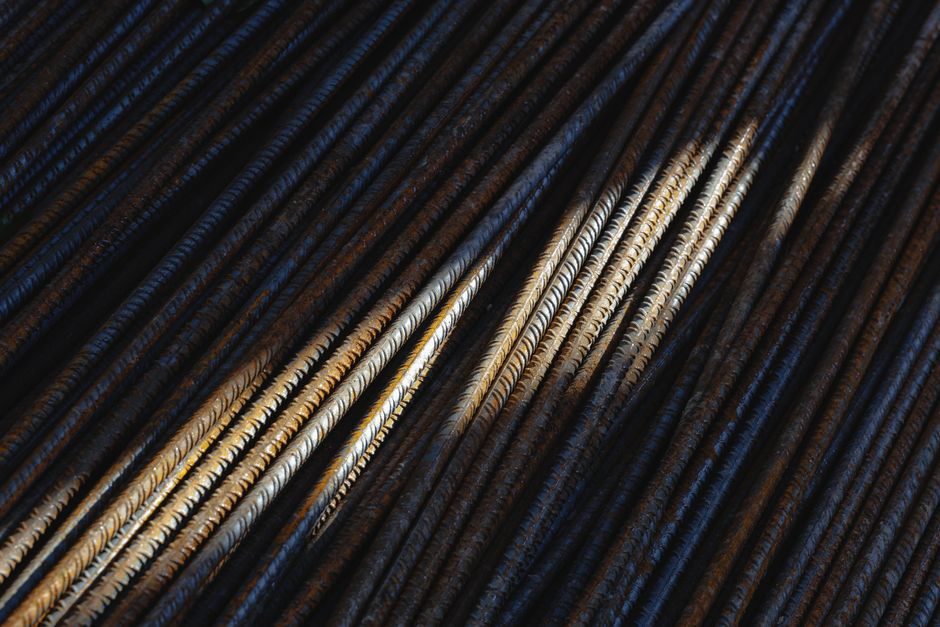
Hydraulic and cordless Li-ion rebar cutters routinely handle 4-32 mm rebar diameters across manual, electric, and battery-powered form factors, with cut-cycle times of 2-5 seconds per bar on common 16-25 mm sizes [S2].
Selection is governed by three physical inputs — bar grade (Grade 40 / 60 / 75 per ASTM A615), daily cut volume, and site power — rather than by brand, with cordless models dominating the 4-20 mm band and hydraulic electric benches taking over above 25 mm [S1][S2].
Four Machine Classes and Their Diameter Bands
Rebar cutters are split into four practical classes: manual hand-cutters for 4-16 mm, electric hydraulic portable units for 4-25 mm, cordless Li-ion cutters for 4-20 mm, and stationary electric benches for 16-32 mm [S2]. The 16-25 mm band is where the most overlap exists, and where most mis-spec'ing happens on site.
Portable hydraulic models from Asian and European OEM lines typically publish 2-4 second cycle times on 20 mm Grade 60 rebar, while cordless 18-36 V Li-ion units cite 2.5-5 second cycles on 16 mm and 4-6 seconds on 20 mm bars [S2]. Stationary electric benches push cycle times down to 1.5-2.5 seconds at 25-32 mm because they use 3-phase 380-415 V drives and larger hydraulic rams [S1].
Drive Type, Voltage, and Power Reality
Cordless rebar cutters are catalogued at 18 V and 36 V Li-ion platforms, with the 36 V class typically rated for up to 20 mm rebar at Grade 60 and the 18 V class limited to 4-16 mm soft-grade bars [S2]. Battery cuts per charge range from 80-150 on 16 mm rebar, dropping to 30-60 on 20 mm depending on ambient temperature and bar grade [S2].
For 25-32 mm capacity, the only realistic option is a single-phase 220-240 V or three-phase 380-415 V electric hydraulic cutter drawing 1.5-3.0 kW continuous [S1]. A 110 V site supply is acceptable for up to 20 mm machines but pushes motor heating on sustained 25 mm cycles; if a site's only available power is a 5-6 kVA genset, a 36 V cordless is the lower-risk path for the 16-20 mm band [S2].
Bar Grade, Hardness, and Cut Force

Rebar grade dictates cutting force more than bar diameter does: Grade 60 (420 MPa yield) needs roughly 30-40% more cutting force than Grade 40 (280 MPa) at the same diameter, and Grade 75 (520 MPa) adds another 20% on top of that [S1]. This is why a 20 mm cordless rated for Grade 60 will bog down on Grade 75 of the same diameter, even though the bar fits the jaw opening [S2].
The second common failure mode is shear-blade wear on rebar with epoxy or galvanized coating. For a rebar processing shop running 200+ cuts per day on coated stock, a stationary bench with replaceable blade inserts is more economical per cut than a portable hydraulic head, even ignoring the labour saving.
Selection Criteria Compared Across the Four Classes
Comparing manual, portable hydraulic, cordless Li-ion, and stationary electric on four decision criteria clarifies the trade-off: maximum bar diameter, daily cut volume tolerance, site power requirement, and per-cut cost. [S1]
Manual cutters win on cost and zero power, but cap at 4-16 mm and roughly 50-80 cuts per shift per operator. Portable hydraulic electric units cover 4-25 mm at 150-300 cuts per shift with 220 V single-phase power. Cordless Li-ion covers 4-20 mm at 100-200 cuts per shift with no power cord — at the trade-off of battery swaps every 60-90 minutes on the 36 V platform [S2]. Stationary electric benches dominate 16-32 mm at 400-800 cuts per shift but require 380 V three-phase and a fixed floor location [S1].
Use Cases Mapped to Class
For a small rebar fabrication shop doing 50-100 cuts per day on 8-16 mm Grade 60 stock, a portable 220 V hydraulic unit is the lowest total-cost path [S1]. For a high-rise slab job with 200-400 cuts per day on 12-25 mm mixed Grade 60/75, two cordless 36 V units plus a stationary 25-32 mm bench at the bending yard is the typical layout.
For bridge and water-treatment work, where 25-32 mm Grade 75 epoxy-coated rebar is common, the stationary bench is mandatory — the coated bar and high grade push blade wear past the point where portable or cordless units stay economical. For occasional 4-10 mm tie-bar work on a remote site with no power, a manual cutter is still the standard tool, and rebar cutter selection logic is the deeper reference for capacity tables and blade service intervals.
Limits, Failure Modes, and Sourcing Notes
The most common on-site failure on cordless units is the hydraulic seal on the cutting head, rated for roughly 10,000-15,000 cuts on 16 mm Grade 60 and dropping sharply on Grade 75 [S2]. The most common failure on stationary benches is the shear pin or relief valve when the operator feeds two bars at once — a failure mode that is operator-driven, not machine-driven.
Supply-side, the cordless rebar cutter segment is dominated by Chinese OEM catalogues with 18 V and 36 V platforms and 4-20 mm capacity [S2], while Philippines and Southeast Asia distribution for the larger 220 V / 380 V hydraulic class is concentrated through regional dealers carrying bench and portable lines [S1]. Lead time for stock cordless units is typically 7-15 days ex-China; for a 25-32 mm bench, allow 30-60 days if not held in regional inventory.
For a contractor running mixed rebar processing across a plant site, the rebar cutter is one tool in a wider set — a gantry crane spec band handles the bar storage and feed side, while the cutter covers cut-to-length. Sizing the cutter first, then the bender, then the lifting gear is the sequence that keeps a rebar yard balanced.
Track three signals going into 2026-Q3: 36 V cordless cut-cycle times at 20 mm Grade 75 (currently 5-7 seconds, target 3-4 seconds), regional bench-model inventory at 25-32 mm, and blade-replacement lead times for coated-bar service.
For component-level specifications, see linear guide, and crossed roller guide.