A bench-top or portable hydraulic rebar straightener sized for plumbing work typically draws 1.5–3.0 kW, straightens #3 (10 mm) through #6 (19 mm) deformed bar at 4–6 m/min, and ships in the 90–180 kg range so a single technician can roll it onto a service truck [S1].
For typical plumbing scopes (thrust blocks, pipe-support saddles, equipment housekeeping pads, backflow preventer pads, grease-interceptor anchorage), bar diameters cluster in the #3 to #5 range with occasional #6 stirrups, which sits comfortably inside the duty envelope of every mid-range straightener on the market [S1][S2].
Where straightening actually fits inside a plumbing scope
Plumbing crews use straightened rebar for three recurring tasks: dowels tying new concrete thrust blocks into existing slabs, reinforcement cages inside grease-interceptor and septic-tank vaults, and anchor bolts/saddle supports for large-diameter water and gas piping [S1].
Gulf Coast Rebar lists water treatment plants alongside bridges and aviation as core rebar scopes, a useful signal that the rebar tooling envelope (cut, bend, straighten) overlaps directly with mechanical room and pump-station work [S1]. Where the plumbing contractor is the prime, a portable straightener is usually rented or shared with the rebar sub rather than purchased outright.
Duty-cycle and diameter: the two hard gates
The first hard gate is bar diameter: most portable straighteners cap at #6 (19 mm) bar; going to #7 (22 mm) or #8 (25 mm) rebar demands a heavier 4.0–7.5 kW shop machine and a 380–440 V three-phase supply, rarely available on a residential service truck [S1].
The second hard gate is straightening speed: 4–6 m/min is the practical ceiling before bar surface gets scuffed and rib geometry gets deformed, which compromises bond strength in concrete. A unit that runs faster than 8 m/min is generally a bender retrofit, not a purpose-built straightener, and will produce a measurable drop in rib height on the inside of the bend [S1]. Plumbers rarely need production-line speed; a slow, controlled pass matters more than throughput.
Power, weight, and site logistics
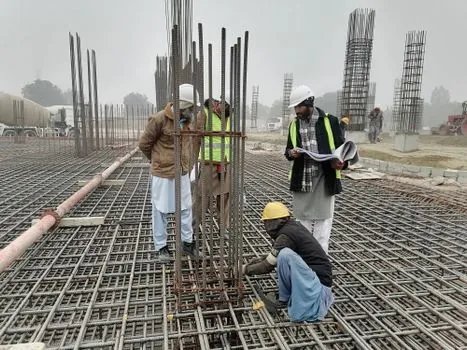
Single-phase 220 V, 1.5–2.2 kW units cover the #3 to #5 range, weigh 90–120 kg, and are the realistic pick for a plumbing truck [S1]. Three-phase 380 V, 3.0 kW units add #6 capacity and weigh 150–180 kg, still forklift-portable but no longer a one-person lift.
For interior mechanical rooms and finished basements where the straightener has to be wheeled through a standard 900 mm doorway, footprint and wheel diameter matter as much as mass. Look for a chassis under 700 mm wide with 150 mm casters, and a fold-down handle so the unit stands vertical against a wall when not in use. The 24/7 commercial service fleets serving SoCal multifamily properties routinely stage this kind of equipment on a single service truck [S2].
What it must do, and what it must not do
A straightener's job is to remove coil set and minor field bending so bar lays flat for tying; it is not a substitute for a rebar bender on hooks, stirrups, or any bend that has to meet ACI 318 hook geometry [S1].
For cuts, the same plumbing scope needs a matched rebar cutter, hydraulic or manual, sized to the same #3–#6 envelope so the crew is not swapping tooling between bars. The general rebar tool kit for plumbing work typically pairs one straightener, one cutter, and one bender, with a rebar coupler inventory for mechanical-spliced dowels where bar congestion blocks lap lengths.
Standards and acceptance criteria on the jobsite
Straightened rebar that is then embedded in concrete falls under the same ACI 318 / ACI 117 placement tolerances as mill-stock bar: full circumference rib contact, no oil or scale at the splice zone, and no visible cracking on the tension face after straightening [S1].
A field test that consistently meets these values is a better procurement signal than any published throughput number [S1].
Comparison: manual, hydraulic, and powered straighteners for plumbing
Manual hand-crank straighteners handle #3 to #5 at roughly 1–2 m/min, weigh 20–35 kg, cost the least, and suit a service plumber who straightens a handful of dowels per month [S1].
Hydraulic portable straighteners cover #3 to #6 at 2–3 m/min, weigh 60–90 kg, and are the mainstream rental-fleet pick for plumbing contractors who do thrust blocks and pump-station pads weekly. Powered 220 V / 380 V roller straighteners cover #3 to #8 at 4–6 m/min, weigh 90–180 kg, and are the right answer when a plumbing prime is also doing water-treatment or lift-station rebar scopes [S1]. The over-spec for almost every plumbing contractor is a 380 V three-phase shop unit; the under-spec is a hand-crank on a job that produces 200+ dowels per pour.
Failure modes and when to replace, not repair
Three failure modes end a straightener's life: cracked gearbox housing from over-rolled #7+ bar, worn roller profiles that scuff ribs, and motor burnout from continuous full-load draws on undersized generators [S1].
Replace, do not repair, when rib height loss on processed bar exceeds 10% versus unprocessed control, when the roller profile shows flat spots longer than 4 mm, or when straightness on a 3 m sample drifts past 10 mm. These are the same thresholds a rebar sub on a civil/heavy civil scope such as a water-treatment plant would apply [S1]. For a deeper dive on matching a rebar cutter to tunneling and confined-space work, see the spec-gate breakdown in Rebar Cutter Selection for Tunnel Construction and the bridge-scope version in Rebar cutter selection for bridge construction: 2026 spec gates.
Trackable signals for the next quarter: rental-fleet additions of 220 V single-phase units in the 90–120 kg band, and any move by mechanical contractors to standardize on shared rebar tooling pools across plumbing, HVAC, and backflow-preventer scopes [S1][S2].