Use 405 nm when fluorescence excitation or a small optical spot is the priority, and use 660 nm when visibility, lower cost, and surface handling dominate.
The two lines differ by 255 nm, so they are not interchangeable: 405 nm excites many fluorescent pigments and organic compounds, while 660 nm is a practical alignment and measurement line with lower photon energy.
Decision Criteria: Spot Size, Fluorescence, and Workpiece
For fluorescence or glowing-material inspection, 405 nm is the functional choice. The violet-and-UV category covers 395–425 nm, and the catalog entry for 405 nm identifies it as a direct-diode wavelength suited to making fluorescent materials glow [S4]. Fluorescence is material-specific rather than universal: dark synthetic blue spinel did not fluoresce in one gemological test, whereas light blue synthetic spinel fluoresced brightly [S7].
For precision, shorter illumination gives a smaller diffraction-limited spot. The diffraction-limited diameter scales with wavelength, and Raman guidance gives the relation as 1.22 times λ divided by 4 [S3]. All else equal, a 405 nm beam can therefore resolve finer features than a 660 nm beam. This advantage matters for fluorescence imaging, dense marking, and inspection of small defects.
For general alignment and positioning, 660 nm has practical advantages. Red diode sources are common in alignment, positioning, and barcode scanning, while 660 nm light can also be generated with frequency-doubled Nd:YAG systems [S5]. Commercial red-module families span 638–660 nm, and 660 nm is specified as deep red and visually dimmer than 638 nm at equal output [S4].
405 nm Versus 660 nm: Criteria-Based Comparison
Against fluorescence response, 405 nm wins because it can excite visible fluorescence, while 660 nm is less useful for direct fluorescent excitation. Against spatial resolution, 405 nm wins because the diffraction-limited spot scales with wavelength [S3]. Against general-purpose visibility, 660 nm is easier to work with, whereas 405 nm appears violet and can look dim against bright backgrounds [S4].
Against cost and availability, 660 nm is generally the stronger economic choice. The cited red-module family starts at $63.99, compared with $74.99 for the 395–425 nm violet-and-UV family, although actual module pricing varies with output and specifications [S4]. This is relevant to animal or tissue studies, not to noncontact industrial surface inspection.
Against Raman-style spectroscopy, 660 nm reduces fluorescence background but sacrifices signal intensity. Raman scattering varies inversely with the fourth power of illumination wavelength, so longer excitation produces a rapidly declining Raman signal [S3]. A 660 nm line is therefore defensible for fluorescence-suppressed spectroscopy, whereas 405 nm is preferable where spatial resolution and fluorescence imaging are the primary objectives.
Organic Surfaces and Fluorescent Materials
On organic surfaces, wavelength selection must follow the absorption and fluorescence spectrum of the specific material. A 405 nm beam can reveal fluorescence on suitable pigments, coatings, inks, gemstones, and biological markers, but a non-fluorescent specimen will provide little benefit despite the higher photon energy. [S3]
In a mouse dermal-abrasion study, biological responses varied by wavelength under a common fluence of 4 J/cm² and fluence rate of 10 mW/cm²: 635 nm and 810 nm promoted healing, while 730 nm and 980 nm did not in that model [S1]. That experiment does not establish 405 nm as a wound-treatment option, but it demonstrates that biological response is wavelength-dependent.
For fluorescence inspection, specify the excitation wavelength from the material supplier or measured emission spectrum, then verify detector sensitivity and optical filtering. If the fluorescence is weak or the workpiece has strong ambient reflection, a laser profiler or 3D scanner is more appropriate only if geometric measurement, rather than fluorescence contrast, is the actual requirement.
Where 660 nm Remains the Better Choice
Choose 660 nm for alignment, positioning, barcode scanning, and general inspection where a visible red beam is more convenient than violet. The red family covers 638–660 nm, with six listed models and listed outputs from 200 to 1,600 in the cited catalog [S4]. These figures describe that catalog rather than every available 660 nm source.
Choose 660 nm when the target is matte and non-reflective, the task does not require fluorescence excitation, and spot-size demands are moderate. It is also the better line for a moving production target when a fast visible reference point matters; red diode systems are established in positioning and scanning applications [S5]. A laser tracker should be selected by measurement accuracy and target capability, not by beam color alone.
Do not choose 660 nm merely because its beam looks less energetic. Photon energy increases as wavelength decreases, but useful performance depends on absorption, detector response, focus, and the interaction mechanism. Likewise, do not choose 405 nm solely for its shorter wavelength: the additional fluorescence and resolution may be wasted on a surface that neither absorbs nor fluoresces strongly at that line.
Process Risks and Failure Modes
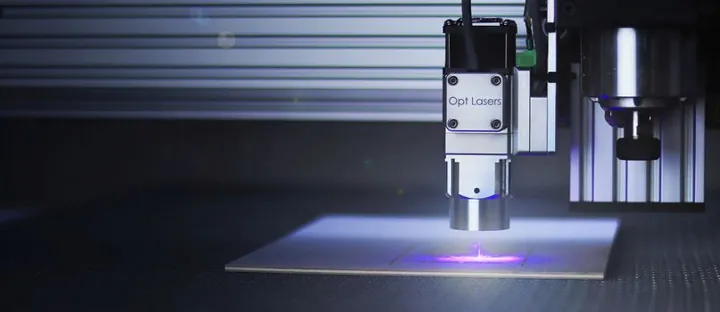
Both wavelengths can cause eye injury, and perceived brightness is not a reliable measure of exposure. A 405 nm beam can conceal its power in a bright environment, while a dim 660 nm spot can still exceed safe exposure limits. The controlling factors remain optical output, beam divergence, exposure time, working distance, and the wavelength-specific optical-density rating of the required eyewear. [S4]
Organic and translucent workpieces introduce a second failure mode: subsurface scattering. A visible beam may not mark the point an operator thinks it marks, and apparent edge sharpness can change with surface finish, depth, and viewing angle. Blue or violet light has a shorter wavelength and can preserve focus and precision on shiny surfaces [S2]. For dimensional acceptance, validate the measured edge against a surface roughness tester or another appropriate reference rather than judging only by visual glow.
Thermal loading must also be separated from optical interaction. 405 nm can excite fluorescence without necessarily causing useful marking, while 660 nm may be absorbed strongly by dark pigments. Measure irradiance at the workpiece, establish the dwell time, and use a defined marking strategy rather than increasing power until visible reaction occurs.
Procurement and Qualification Checklist
For a fluorescence application, qualify 405 nm against the target material, require a documented excitation and emission band, and specify the output power at the workpiece. For an alignment application, qualify 660 nm for beam visibility, stability, safety classification, and speed at the intended working distance. The cited violet-and-UV range of 395–425 nm and red range of 638–660 nm provide useful category boundaries rather than universal suitability [S4].
Compare total installed performance rather than nominal source price. The relevant items are optics, focus stability, cooling, scan speed, detector or camera response, filters, eyewear, and process development. Red lasers are commonly available and usually more affordable for general-purpose work [S2], while 405 nm earns its cost when fluorescence or finer optical resolution creates measurable value.
A practical qualification record should include material grade or formulation, surface finish, working distance, measured irradiance, exposure time, spot size, fluorescence response, and safety controls. Repeat those tests after changes to lens, camera, filter, workpiece lot, or source model, because a wavelength label alone does not define process capability.
Use 405 nm as the default answer for glowing or fluorescent organic surfaces and fine-scale inspection; use 660 nm as the default answer for general alignment and measurement. Final selection should follow a 405 nm versus 660 nm comparison at identical irradiance, focus, detector settings, and acceptance criteria.