
Release agents and admixtures solve different problems on a concrete job and are specified, supplied and dosed as separate product lines: release agents are formwork-applied at the mould face, while admixtures are batched into the wet mix [S1][S3].
Both categories sit inside the same Chinese chemical-supply chain, with release agent and admixture makers each running their own MOQ bands — release agent MRA commonly moves at a 50,000 kg minimum with 100,000 kg/month supply capability [S1], whereas admixture manufacturing machinery (batching plant scope) is quoted per set from US$23,000–25,000 [S2].
Function Boundary: Formwork-Face vs In-Mix
Release agents are applied to the formwork — steel, timber, plywood, plastic — to produce a clean break between mould and hardened concrete, reducing surface damage and improving finish quality on architectural and precast elements [S1]. Admixtures, by contrast, are dosed into the fresh concrete at the concrete batching plant to alter water demand, setting time, workability retention, air entrainment or strength development [S3].
The two chemistries are not interchangeable. A mould release agent cannot replace a concrete admixture because the former works at the form-face interface, while the latter works inside the cement paste matrix. Specifying one where the other is required yields either stuck formwork or off-spec hardened concrete, depending on substitution direction.
Product Family and Chemistry Comparison
Release agents are grouped by base chemistry: neat oils, emulsified oils, wax-based, water-based, and reactive silane/silicone types for premium precast surfaces [S1]. Each chemistry class trades off cost per square metre, staining risk, re-coat interval and whether the film is acceptable on concrete that will receive subsequent coatings or toppings.
Admixtures are split into functional families — water-reducers (lignosulphonate, naphthalene, melamine, polycarboxylate), superplasticizers (PCE-based, dominant in ready-mix), retarders, accelerators, air-entrainers, viscosity modifiers, shrinkage reducers and corrosion inhibitors [S3]. Polycarboxylate (PCE) superplasticizers are the current default high-range water-reducer for ready-mix and precast concrete, supplied by dedicated Chinese chemical makers such as Beijing Jiankai Concrete Admixture Co. [S3].
Decision Criteria Side-by-Side

Buyers should screen the two products against four gates: application point, dosage form, regulatory scope, and storage/transport class. A concrete release agent is a thin film (typically 1–2 g/m² for steel forms, higher for timber) brushed or sprayed at the formwork; a concrete admixture is a liquid or powder dosed at 0.1%–5% by cement weight directly into the mixer [S1][S3].
Decision-criteria comparison: (1) Application point — release agent on form, admixture in mix; (2) Dosage form — g/m² of formwork area vs % by cement mass; (3) Typical active chemistry — fatty-acid/oil/silicone vs PCE/lignosulphonate/naphthalene; (4) Failure mode if misapplied — stained/stuck concrete vs off-spec slump, set or strength [S1][S3].
Supply, MOQ and Sourcing Reality
Release agents in the Chinese trade are commonly offered at industrial MOQs: 50,000 kg minimum order with 100,000 kg/month supply capability is a typical quotation for mould release agent MRA, with TT or LC payment and shipment from China main port [S1]. This is a bulk-liquid/tonnage product line, not a per-pail hardware item.
Admixtures are sourced differently. The chemical itself is sold per kg/tonne from dedicated admixture makers (e.g. Beijing Jiankai, registered in Yongledian Industrial Zone B, Tongzhou, Beijing, offering polycarboxylate acids superplasticizers and broader concrete chemicals) [S3], while the manufacturing plant for the admixture (dosing, mixing, storage tanks) is a separate capital purchase, with entries in the US$23,000–25,000/set range for concrete batching plant-scale admixture lines from Chinese OEM Taian Chenli Construction Machinery [S2].
On-Site Handling and Compatibility
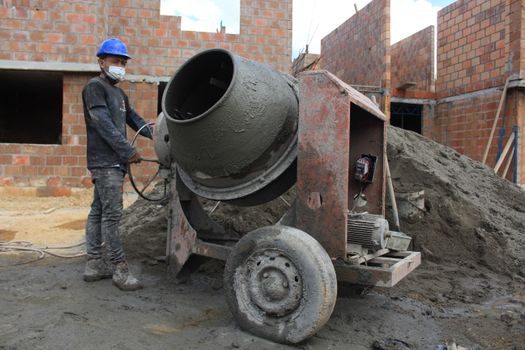
On a precast yard, the release agent is applied to cleaned forms before rebar closure and pour, while the admixture is dosed at the mixer — the two products never physically meet inside the concrete itself. Choosing a release agent that is compatible with the chosen form-face (steel vs plywood vs plastic) and with any subsequent surface treatment is one gate; choosing an admixture that is compatible with the cement, SCMs, ambient temperature and the target EN/ACI exposure class is a separate, larger gate [S1][S3].
For architectural or coloured concrete, a reactive or water-based release agent is preferred to avoid oil staining; for standard structural pours, an emulsified oil at low film weight keeps unit cost down.
Use Cases, Limits and Failure Modes
Release agent typical use: precast mould release, in-situ form release for beams, columns, walls and slabs, and bridge-segment casting where a Class A finish is required [S1]. Limits: over-application causes surface retardation and dust; under-application causes blowholes and form sticking; reactive silane-based grades are more expensive and not justified for buried or non-architectural concrete.
Admixture typical use: water reduction for high-strength mixes, slump retention for long-haul ready-mix, set retardation in hot weather, set acceleration in cold weather, freeze–thaw resistance via air entrainment, and shrinkage control for slabs [S3]. Limits: overdosing PCE causes segregation and bleeding; overdosing retarder delays finishing; chloride-bearing accelerators are banned in reinforced concrete by most international codes, so non-chloride accelerators are the default for rebar-bearing members. Spec-side, an admixture spec also typically cites compliance to ASTM C494 or EN 934-2, while release agents cite form-release performance per ACI 347 or equivalent — separate documents, separate approval paths.
Standards, Documentation and Buying Gates

Documentation for release agents and admixtures travels on different paperwork: release agent TDS lists film weight, base oil, dilution ratio and form material compatibility [S1]; admixture TDS lists active solids, dosage range, specific gravity, chloride content, alkali content, and compliance to ASTM C494 (Type A, B, C, D, E, F, G) or EN 934-2 (T1–T11) [S3]. Buyers should refuse any TDS that conflates the two categories or lists both products under one generic “concrete chemical” line.
A practical buying gate for a ready-mix plant or precaster: confirm the admixture maker publishes per-batch COA with solids, density, and pH; confirm the release agent maker publishes the base oil and recommended film weight per m²; verify both products are sourced from separate, non-overlapping chemical lines, not relabelled drum stock. For spec-driven sourcing of adjacent concrete categories — fibres, curing compounds, batching plant dosing gear — the spec gate logic used in a concrete fiber buying guide carries over, since the supply pattern (bulk chemical MOQ, Chinese OEM base, TT/LC terms) is structurally similar [S1][S3].
Trackable signals to watch next: release agent pricing per tonne out of China main port, and PCE superplasticizer spot pricing per tonne from major Chinese chemical makers — both move with crude and ethylene-oxide feedstock cost, so a divergence in either is a usable procurement trigger [S1][S3].