Renovation-grade steel plate sourcing in 2026 collapses to four decision gates: structural grade, base-metal thickness range, corrosion exposure class, and mill traceability documentation, with the dominant renovation cost driver being the grade-to-thickness mismatch rather than raw plate price [S2].
Mill-certified service centers processing plate up to 88 ft long and 10 ft wide with HD plasma cutting, beveling, rolling, and inorganic primer application define the 2026 processing envelope for retrofit plate work in North America [S2]. For foundational steel plate properties and grade families, engineers should anchor the spec on documented yield and tensile ranges before pricing inquiries.
Grade family shortlist for renovation work
Three plate families cover the bulk of renovation specifications: carbon steel plate for primary load-path retrofit and structural stiffening, alloy steel plate for elevated-temperature or higher-strength service pockets, and stainless steel plate for wet, hygienic, or coastal exposures [S2][S4].
stainless steel plate is a broad metal category that resists acid and alkaline gas, solution, and other corrosive media, while still exhibiting high-temperature oxidation resistance, with oxidation rate affected by exposure environment and product form [S4]. Cold-rolled and hot-rolled stainless plate products span 0.5–4 mm thin plate and 4 mm+ thick plate, and the material remains a non-absolutely-rust-proof alloy rather than a corrosion-immune one [S5].
Thickness and dimensional envelope
For renovation plate procurement, the 0.5–4 mm thin-plate and 4 mm+ thick-plate split governs both forming strategy and weld procedure selection, with cold-rolled stock reserved for surface-critical panels and hot-rolled stock used for structural cores [S5]. Service-center processing capacity sets the practical upper bound: 88 ft length by 10 ft width on downdraft tables, with HD plasma heads carrying 360° rotation for bevel and edge prep [S2].
Plate thickness selection in renovation typically follows a load-path calc that compares existing structure capacity against retrofit demand, with the dominant cost error being over-specifying thickness to avoid calc iterations rather than matching the actual utilization ratio. For a deeper dive on adjacent prefabricated construction plate gates, the same grade-thickness-corrosion logic applies, with renovation adding an as-built survey variable.
Corrosion and environmental exposure gates

Corrosion exposure is the most common renovation plate re-spec trigger, with three exposure classes driving material upgrades: C1–C2 interior dry, C3 urban/mild industrial, and C4–C5 marine/chemical requiring either coated carbon plate or stainless substitution [S2][S4].
For aggressive interior exposures, nano thermal insulation anti-corrosion panels with surface anti-corrosion coating resist moisture, acid, and alkali attack, and are commonly applied to industrial equipment and pipelines where they improve energy efficiency and extend equipment service life [S1]. Patterned, color-coated, and purification-grade plates further extend the renovation menu for architectural, pharmaceutical, food, electronics, and aerospace interior buildouts requiring dust-proof, anti-static, or antibacterial surface performance [S1].
Decision criteria comparison: carbon vs alloy vs stainless plate
Selection across the three plate families against four renovation decision criteria produces a clear ranking for 2026 retrofit specs: (1) Cost per ton: carbon lowest, alloy mid, stainless highest; (2) Weldability and field-fabrication tolerance: carbon best, alloy good with preheat control, stainless good with controlled heat input; (3) Corrosion resistance: carbon poor without coating, alloy fair, stainless best; (4) Traceability and certification burden: carbon and alloy both carry mill test reports, stainless adds chemistry and pickling-passivation documentation [S2][S4].
Mill-certified traceability with 100% process tracking and mill test reports is the documentation floor that all three families must meet for renovation work on commercial, institutional, or industrial occupancies [S2]. ISO 9001:2015 certified service centers provide the audit trail that engineers and code officials look for during renovation sign-off, and inorganic primer systems such as REDI-PLATE pre-abrasive cleaning extend field life before topcoat application [S2].
Process route and fabrication envelope
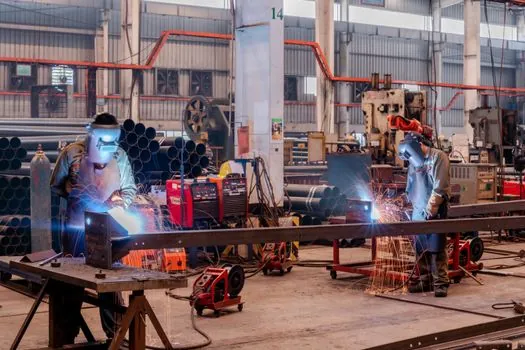
Renovation plate processing in 2026 typically follows a defined route: mill-certified raw plate in, blasting to surface preparation class, optional inorganic primer, HD plasma or laser cut with bevel, roll/form to geometry, then protective high-build coating for harsh-environment service [S2].
HD plasma cutting with 360° rotation head, precision forming, and high-build coating equipment are the three processing capabilities that distinguish a renovation-ready plate service center from a general metal shop, with each capability tied to a specific in-house equipment set rather than subcontracted outsourcing [S2]. For institutional retrofit work, the same plate-supply logic also governs school building and vocational workshop plate gates, where occupancy class drives finish and coating requirements.
Limitations and failure modes
Renovation plate selection fails in three predictable ways: (1) mixing thin cold-rolled stock into a structural load path, (2) substituting coated carbon plate for stainless in C4–C5 exposures where coating breach is likely, and (3) accepting plate without mill test report traceability for code-required renovations [S2][S4][S5].
Stainless plate, despite its corrosion reputation, is not absolutely rust-proof and still requires surface integrity, and even stainless plate exhibits high-temperature oxidation with oxidation rate dependent on the inherent factors of exposure environment and product form [S4]. A 420-grade stainless plate, for instance, shares the broader stainless property envelope of corrosion resistance to acid/alkaline gas, solution, and other media, while remaining a heat-treatable martensitic grade with the same cold-rolled and hot-rolled product split as other stainless families [S5].
Trackable signals for 2026 renovation plate sourcing: monitor service-center capacity disclosures (plate length and width envelope, HD plasma head count, ISO 9001:2015 recertification), inorganic primer system updates, and the nano-insulation panel product line extensions that increasingly blur the line between structural plate and functional building-panel categories [S1][S2].