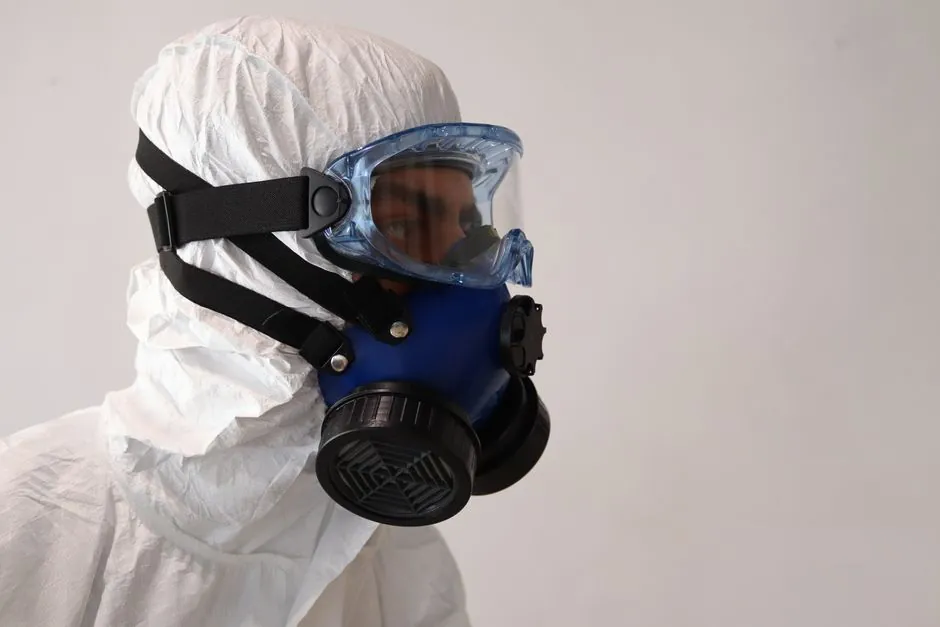
In the US workplace, every respirator that protects against dusts, fumes, mists, vapors, or oxygen-deficient air must carry NIOSH approval, and the assigned protection factor is selected from Table 1 of OSHA's Respiratory Protection standard [S1].
The buying decision is driven by three independent variables: the contaminant chemistry (particle, gas/vapor, or both), the airborne concentration relative to the occupational exposure limit, and the fit of the facepiece on the actual wearer, all of which are reflected in the hierarchy of controls that NIOSH publishes as the framework for selecting respiratory protection [S1][S2].
Two Respirator Families and Where Each Fits
NIOSH groups certified respirators into air-purifying respirators (APR) and atmosphere-supplying respirators (ASR), and each APR or ASR is further classified into one of five approval types for chemical, biological, radiological, and nuclear protection [S1]. APRs clean ambient air through filters, cartridges, or canisters, and the family spans filtering facepiece respirators, elastomeric quarter/half/full facepieces, and powered air-purifying respirators (PAPRs); ASRs instead deliver clean air from a separate source and include supplied-air respirators (SAR), self-contained breathing apparatus (SCBA) in open-circuit and closed-circuit variants, and combination SAR/SCBA units used for entry, escape, and IDLH work such as mining self-rescue [S1]. For most occupational buyers the first branch point is simply this: if the atmosphere has enough oxygen and the hazard is a known particulate or gas/vapor, an APR is acceptable, otherwise the specification must move to an ASR with its own air supply [S1].
Within the APR branch, particulate hazards are typically addressed with a filter while gas and vapor hazards are addressed with a cartridge, and dual hazards call for a combination cartridge on the same respirator [S2]. The selection process always starts with a written exposure assessment, and the respirator type is then matched to the contaminant identity, form, and concentration rather than to worker preference.
Filter Classes, Approval Letters, and What They Actually Mean
NIOSH filter classes describe both efficiency and oil resistance, and the letters mean the same thing whether they appear on a disposable or on a replaceable elastomeric cartridge: N-series (no oil resistance), R-series (resistant to oil for up to 8 hours), and P-series (oil-proof), each followed by 95, 99, or 100 for the 95%, 99%, and 99.97% filtration efficiency levels respectively [S1]. In practice that means an N95 disposable is appropriate for solid and liquid aerosols that do not contain oil, while P100 is the conservative choice when oil aerosols are present or when the highest particulate efficiency is required; for routine smoke and dust exposure in non-occupational settings, the 3M 8210 N95 is a widely available, NIOSH-approved option typically sold at about $1 per mask in 20-packs [S3].
For gas and vapor cartridges the color code on the cartridge is the practical identifier of which contaminant family it absorbs, and the same 3M selection logic recommends a particulate pre-filter stacked on top of a chemical cartridge whenever both hazards coexist [S2]. Buyers should treat the approval label and the printed lot number on every unit as a traceability requirement rather than a sticker, because NIOSH approval is what links the device to the assigned protection factor that OSHA expects to see in the written program [S1].
Disposable, Elastomeric, and PAPR: A Side-by-Side Comparison

Three configurations dominate real purchase orders, and each can be matched against the same four decision criteria: contaminant type, duration of wear, cost per hour of protection, and maintenance burden. [S1]
Disposable filtering facepieces (N95, N99, N100, P95, P100) handle particulates only, are single-shift or single-use, sit at the lowest unit cost (about $1 each for the 3M 8210 in a 20-pack), and require no cartridge changes or cleaning [S3]. Elastomeric half-mask and full-facepiece respirators reuse the same body across shifts, accept replaceable particulate filters and chemical cartridges including combination cartridges for mixed hazards, and are the right answer for routine solvent, pesticide, or paint exposure where long-term cost per hour is much lower than repeatedly buying disposables [S2][S5]. PAPRs add a battery-powered blower that pushes filtered air through a loose-fitting hood or tight-fitting facepiece, which reduces breathing resistance and heat load during long wear but adds unit cost, battery management, and the need to charge or rotate belt-mounted power packs between shifts [S1][S6]. A practical rule of thumb: short, occasional particulate jobs map to disposables, repeated multi-shift chemical or dust exposure maps to elastomerics, and hot, strenuous, multi-hour work maps to PAPRs.
The Moldex M Series Black Mask (models M4621 small, M4620 medium/large) is the disposable outlier that competes with reusable comfort, because its pleated construction gives it more surface area than typical disposables, which keeps it breathable during demolition and construction work where a standard N95 would feel suffocating [S3]. At the reusable end, the GVS Elipse P100 is rated P100 and ships with filters specified for roughly five years of service life before replacement, which is the cost model that justifies an elastomeric for regular users [S3].
Who Should Pick a Disposable, and Who Should Not
A disposable N95 or P100 is the right call for short-duration, low-to-moderate particulate exposure in a generally well-ventilated space: home renovation, wildfire smoke, workshop sanding, or short healthcare interactions, and the low per-unit cost (about $1 in 20-packs for the 3M 8210) makes stockpiling for travel or public gatherings realistic [S3]. Workers who need a disposable for strenuous, hours-long demolition, however, will find standard molded-cup N95s muggy and prone to eyewear fogging, and that is the exact workload where a pleated disposable such as the Moldex M Series or a switch to an elastomeric or PAPR becomes the spec-correct answer [S3].
Anyone facing organic solvent vapors, isocyanate paints, acid gases, or unknown atmospheres should not be shopping in the disposable aisle at all: those exposures require an elastomeric half-mask with the correct cartridge color code, or a supplied-air respirator when concentrations approach IDLH, and the wrong cartridge on the right facepiece still fails the standard [S2]. For oxygen-deficient or immediately-danger-to-life-or-health atmospheres the only correct answer is an SCBA, with closed-circuit SCBA being the format specified for escape devices such as mining self-rescuers [S1].
Fit Testing, Programs, and the Standards That Anchor the Specification

A respirator that passes the filter efficiency test but leaks around the seal is, for the wearer, the wrong respirator; OSHA's Respiratory Protection standard requires qualitative or quantitative fit testing for tight-fitting facepieces, and NIOSH frames proper fit as a precondition for the assigned protection factor to be realized on the actual worker [S1]. The first three steps in any selection workflow are the same: identify the hazard type (particulate, gas/vapor, or both), characterize the form (dust, mist, fume, vapor), and quantify the exposure concentration against the applicable occupational exposure limit, after which a filter, cartridge, or supplied-air device is selected to bring the wearer below the limit with an appropriate margin [S2].
For non-occupational buyers, the same workflow still applies in a simplified form: read the contaminant on the product label, match it to the cartridge color code, and run a positive and negative pressure user seal check every time the respirator is donned. The general hierarchy of controls (elimination, substitution, engineering controls, administrative controls, and PPE last) is the reason a respirator is described by NIOSH as the "last line of defense" rather than the first, so any spec that calls for respiratory PPE without first asking whether the hazard can be ventilated out or substituted away is starting in the wrong place [S1].
Industrial buyers who want a deeper dive into how spec-first purchasing is structured for adjacent safety and process equipment can cross-reference the cobot spec and selection playbook for 2026 manufacturing cells, since PPE selection and robot cell risk assessment share the same hazard-inventory-first logic. For buyers who also need to think about air-moving infrastructure inside the facility, the principles of ducted local exhaust pair naturally with the elastomeric and PAPR choices above, and a broader sense of industrial Ethernet demand 2026-2030 is useful when a PAPR fleet is being instrumented for shift-level compliance reporting.
Cartridge Change Schedules, Storage, and Common Failure Modes
Particulate filters are typically replaced when breathing resistance becomes noticeable, while chemical cartridges are replaced on a change schedule driven by the contaminant, concentration, humidity, and breakthrough time published by the manufacturer; NIOSH explicitly notes that respirator effectiveness depends on proper use, which includes following those schedules rather than running cartridges until smell breakthrough on organic vapors [S1]. Elastomeric facepieces should be cleaned and disinfected between users, stored in a sealed bag away from dust and solvent vapors, and inspected before each donning for cracked silicone, hardened valve seats, or stretched head-strap elastic, all of which are predictable failure modes that quietly degrade the seal long before the filter does.
The most common specification mistake is buying on filter efficiency alone, for example specifying P100 cartridges for an isocyanate paint job and ignoring that the same worker also needs the correct organic vapor cartridge in series, which is precisely the combination-cartridge case the 3M selection guide calls out [S2]. The second most common mistake is buying a single size for an entire crew; the Moldex M Series' split into M4621 (small) and M4620 (medium/large) exists because disposable fit is highly face-dependent, and even the 3M 8210, which fit testers from 5'3" to 6'1", can become uncomfortably tight on larger heads during extended wear [S3].
To browse the broader PPE and respiratory protection category on the SourceBySpec catalog, the respirator reference page consolidates filter-class definitions, approval markings, and program requirements in one place. Buyers who also need to spec adjacent process or instrumentation hardware can compare structured options for pressure transmitter, flow meter, and industrial valve selections using the same hazard-and-duty-first logic. As of 2026-09-13, the trackable signals to watch are any NIOSH revisions to the existing CBRN approval sub-categories and any updates to the OSHA Table 1 assigned protection factors, both of which would shift the elastomeric-versus-PAPR-versus-supplied-air branch points described above.