Specifying a concrete groove cutter for a structural fabrication job means locking six numeric fields up front: blade diameter, kerf width, cutting depth, engine or motor power, water tank volume, and frame weight, because every one of those values changes the supplier's BOM and the quote [S3][S5].
Buyers who omit those numbers typically receive three to five "clarification round" emails before a real price lands, and the configured cutter is the single most expensive line item in the joint-cutting sub-package, so the requote cycle is rarely free [S2].
Kerf Width and Cutting Depth: the two fields that drive blade selection
Kerf width is the first decision on the RFQ line, and the working band across the suppliers covered is 3-5mm, identical between the HQS300, HQS350, HQS400 and HQS450 box-frame models from Xingchen [S3]. The QSM/GCM unit from QSM Machineries uses 3-4mm diamond blades, so a buyer who writes "narrow kerf" on the line will still get a 3-4mm proposal from that supplier [S5].
Cutting depth scales with blade diameter: 90mm at 300mm blade, 120mm at 350mm, 160mm at 400mm, and 180mm at 450mm for the Xingchen HQS series [S3]. Subitek's adjustable-head machines reach 150mm at the upper end of their catalogue, and the QSM/GCM is rated to a 6 inch (about 150mm) max cut under load [S5][S6]. For a structural fabrication RFQ, list nominal depth AND the tolerance (typically +0/-5mm) so the supplier does not substitute a smaller-blade machine to win the price.
Power Source and Engine Rating: gasoline, diesel, electric, or 3-phase
Walk-behind groove cutters are estimated at 31.0% of 2026 market share, and gasoline or petrol systems are projected at 38.0%, both reflecting the portability demand of dispersed outdoor worksites [S1]. The Xingchen HQS line offers Chinese, Honda, or Robin engines with 5.5, 7.5, 9, and 45 hp ratings across the four model sizes [S3].
Electric and 3-phase options matter on indoor structural slabs. The QSM/GCM runs on a 7.5 hp Lubi motor at 1440 rpm on 415V / 50Hz / 3-phase, so any RFQ for an enclosed fab hall or a covered RCC slab should specify the supply voltage and phase count explicitly, not just "electric" [S5]. Gujarat Machinery's 5 hp diesel manual-push unit illustrates the lower bound: about 110kg frame, 100mm cut depth, water-cooled wet cut, no electrics required at all [S9].
Frame Weight, Water Cooling, and Wet-Cut Dust Control
Frame weight is a real logistics line on the RFQ, not a footnote, because it determines whether the saw goes on a pickup or needs a forklift. The HQS300 weighs 78kg net, the HQS450 weighs 135kg net, the QSM/GCM sits at 150kg, and the Gujarat 5hp diesel is "approx 110kg" [S3][S5][S9].
Water tank volume and wet-cut dust control belong on the same line. The HQS series uses 12, 30, 45, and 120L tanks by model; the QSM/GCM carries 40-45L; both feed blade cooling and slurry control, which matters because silica controls and blade replacement costs are the two recurring line items that "pressure equipment economics" on every joint-cutting contract [S1][S3][S5]. A buyer who writes "wet cut" without naming the minimum tank size typically receives a 12-15L unit that needs refill breaks every 20-30 minutes on a 160mm deep cut.
Application Tagging: road grooving, expansion joints, drainage, cable trenches
Tag the application on the RFQ header. Road or pavement grooving is forecast to lead the application mix at 29.0% in 2026, with Iowa DOT's April 2026 specification requiring diamond grooving at 1/8 inch to 3/16 inch depth on concrete pavement [S1]. Other named applications in the supplier set: expansion joint cutting on heavy-traffic zones, drainage channel cutting, cable trench excavation in industrial floors, and airport runway work [S5][S6].
For a structural fabrication RFQ, "expansion joint cutting" and "cable trench in RCC slab" are the two most common tags, and they pull different blade and power packages. A 3-4mm kerf, 6 inch cut, 7.5 hp 3-phase QSM/GCM covers both, while a 400-450mm blade, 160-180mm depth gasoline HQS covers road and runway scope [S3][S5]. Buyers who leave the application blank invite suppliers to quote the wrong machine class.
Buyer-Side RFQ Checklist: 7 fields that prevent requote cycles
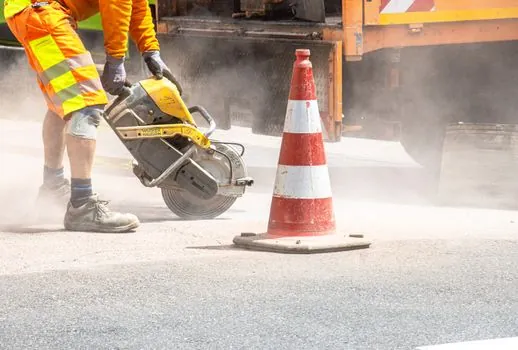
Seven fields stop the requote loop on a concrete groove cutter line. (1) Blade diameter in mm, with the corresponding cutting depth. (2) Kerf width in mm, with a tolerance. (3) Power source: gasoline/diesel/electric, plus voltage and phase for electric. (4) Engine or motor horsepower. (5) Wet-cut water tank volume in litres, with "yes/no" on dust suppression required. (6) Frame weight in kg, with site-access notes (pickup, forklift, crane). (7) Application tag, with the controlling spec if any (Iowa DOT, airport authority, factory safety) [S1][S2][S3].
Buyers who skip field 5 typically get a dry-cut quote that is 15-25% cheaper on paper but unusable on a silica-regulated site, so the "savings" become a re-spec event [S1]. The casting mold RFQ walkthrough covers the same discipline for metal-treatment builds, and the sand reclamation unit RFQ guide applies the same line-by-line logic to a different process tool.
Comparison Snapshot: 3 model families on 4 RFQ criteria
Side-by-side on four decision criteria: the Xingchen HQS series (gasoline, 300-450mm blade, 90-180mm cut, 78-135kg), the QSM/GCM (7.5 hp 3-phase, 3-4mm kerf, 6 inch cut, 150kg, 40-45L tank), and the Gujarat 5 hp diesel (100mm cut, 110kg, manual push) [S3][S5][S9].
On cutting depth, the HQS450 wins at 180mm; on portability, the HQS300 wins at 78kg; on indoor 3-phase compatibility, only the QSM/GCM qualifies; on lowest capex for shallow utility cuts, the Gujarat unit is the shortest spec. Use this four-criteria frame on the RFQ shortlist, then add blade cost and water tank size as tiebreakers because they recur on every job [S1][S3][S5][S9].
Where the Quote Quietly Inflates: consumables, OEM branding, and certifications
Three hidden cost lines will inflate the quote if they are not pinned on the RFQ. Diamond blade replacement cost recurs on every job, and QSM/GCM calls out diamond-tipped blades for hardened concrete as a separate line [S5]. OEM branding (Chinese, Honda, or Robin engine on the HQS series) shifts the engine cost by 20-40% on the same chassis [S3]. ISO 9001 and CE certifications are listed for the HQS line, so any RFQ going to a European structural fab site should request those cert numbers on the quote, not after [S3].
For structural fabrication work that involves adjacent cutting tooling, the concrete groove cutter product reference sits next to the rebar cutter and marble cutter entries in the same tool family, which helps when the same supplier is asked to quote a matched set.
Trackable signals for the next buying cycle: confirm whether the supplier is quoting diamond-tipped or abrasive blades (changes the consumable line), whether the 3-phase variant is in stock versus 4-6 week lead time, and whether the OEM will provide an ISO 9001 certificate PDF before the PO is released [S3][S5].