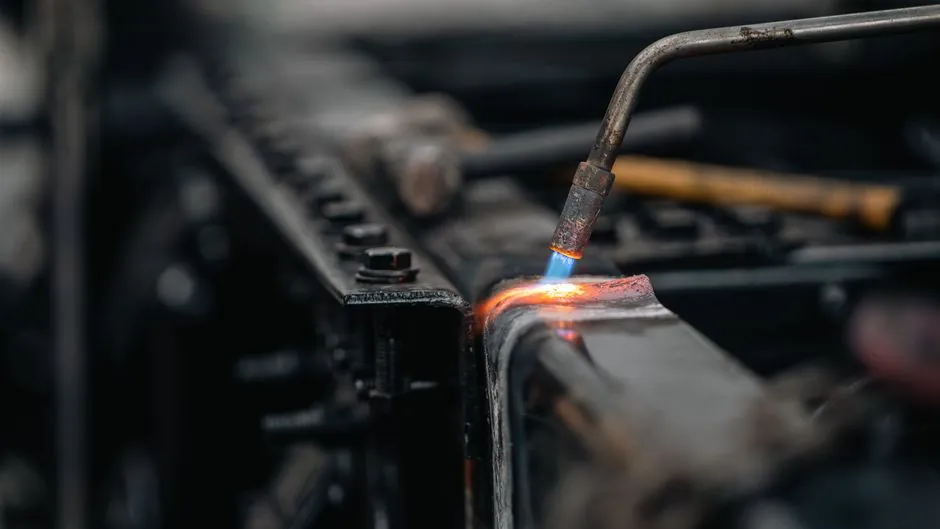
A casting-mold RFQ is not a price request, it is a process specification: the foundry reads it to choose the molding route, the pattern, the alloy, and the inspection regime, so every blank line on the form is a decision the supplier will make on the buyer's behalf.
For metal treatment area equipment (furnace frames, heat-treatment baskets, molten-metal ladles, pump housings, valve bodies) the casting typically carries both the structural load and the thermal-cycling fatigue, so the RFQ has to be exact on alloy, section thickness, and post-casting heat treatment, not just on the drawing [S6].
RFQ Header: Part Identity, Process Route, and Drawing Revision
The first three lines of the form fix the scope: part name, part number, drawing revision, and the casting process the buyer has already selected (or asks the foundry to recommend) [S1]. The header should list the 3D model in STEP or IGES, the 2D drawing with GD&T, the datum scheme, and a clear release status, because suppliers will not hold a quote against an unreleased revision [S3]. For metal treatment area parts the header should also name the standard that governs dimensional tolerance, typically ISO 8062 for castings, plus any internal drawing standard. The buyer should also flag any restricted surfaces (no parting line, no ejector pin mark) on the 2D drawing, since a die-cast pump cover for a quench tank cannot have a witness mark on a sealing face [S3]. A weak header is the single most common reason a foundry returns a quote that is off by a factor of two or more [S1].
Alloy Designation and Material Standard
Stating "aluminum" or "cast iron" is not enough: the RFQ must name the alloy designation, the material standard, the required mechanical properties, and any chemical-composition limits, including RoHS, REACH, or recycled-content restrictions [S3]. For metal treatment area service the alloy choice is usually driven by temperature and corrosion, so buyers should specify the operating envelope (peak temperature, cyclic range, atmosphere) and let the foundry select the grade, or pre-select from common heat-resistant families: ductile iron to ASTM A536 Grade 60-40-18 for furnace doors, austenitic ductile iron or high-nickel austenitic grades for molten-metal handling, and heat-resistant stainless cast equivalents to ASTM A297 (HK, HP) for carburizing fixtures and radiant tubes. For non-ferrous service, aluminum alloy A356 or A319 with T6 temper is common for large heat-treatment fixtures [S5]. The line should also state the material certificate format required, typically EN 10204 3.1 for pressure-related castings and 2.2 for non-safety parts [S3].
Quantity Profile and Program Life
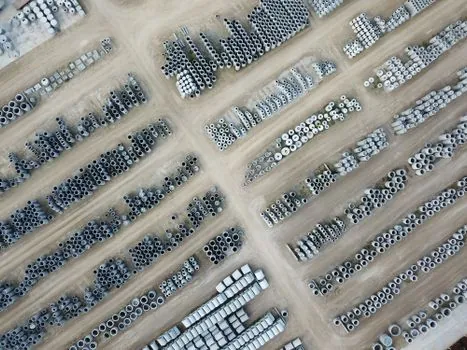
Foundry pricing is volume-driven: cavity count, die steel grade, automation level, and trimming method all change with annual quantity [S3]. The RFQ must therefore break volume into prototype or validation quantity, first production order, annual volume, peak monthly demand, expected program life in years, and total lifetime quantity. A heat-treatment line that needs 200 furnace rollers per year for ten years is a different program from a one-time batch of 40, and the cavity count, die material, and unit price will reflect that. The buyer should also declare whether the order is firm, forecasted, or blanket-release, since blanket releases let the foundry amortize tooling across the program and typically reduce per-part cost by 10 to 25 percent on the second and third years [S3].
Weight, Section Thickness, and Castability Limits
Weight drives melting capacity, pouring time, and yield, so it belongs on the RFQ as both theoretical weight from the model and acceptable weight range after casting [S7]. Section thickness is the next critical line: a sand cast ferrous part under 6 mm (0.25 in) becomes marginal, and a thin distant section may not fill at all; investment casting can go down to roughly 0.76 mm (0.030 in) wall, but with cost and yield penalties [S5]. The buyer should mark the minimum section on the drawing, indicate any isolated thick sections that need risering, and call out any geometry that needs cores. For metal treatment area parts, thermal mass and section transitions are fatigue drivers, so the RFQ should also state whether section changes must be filleted to a specific radius, typically 1.5 to 3 times the nominal wall, to limit stress concentration under cyclic heating.
Dimensional Tolerances and GD&T
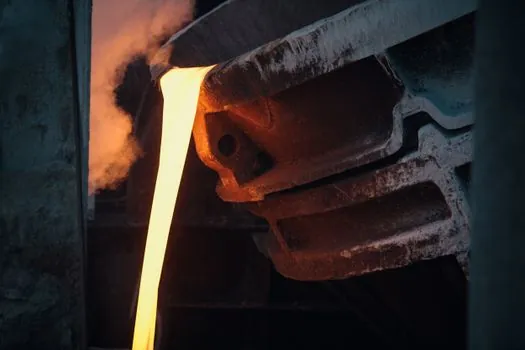
The fastest way to inflate a casting quote is to apply machining-grade tolerances to every as-cast dimension. The RFQ should identify which dimensions are critical (fit, sealing, alignment, dynamic balance) and which are non-critical, and should state per dimension whether the tolerance is required as-cast, achieved by secondary machining, or measured after finishing [S3]. Reference ISO 8062 casting tolerance grades (typically CT 8 to CT 10 for sand, CT 5 to CT 7 for investment, CT 4 to CT 6 for die casting), and note any datum or geometric tolerance that the supplier must hold, including position, runout, and parallelism for mounting faces on furnace carriages or ladle turrets. For die-cast parts the buyer should also declare draft, ejector-pin restrictions, and parting-line orientation, since the same geometry with the wrong parting line can cost 30 to 50 percent more in slide action [S3].
Surface Finish, Cosmetic Limits, and Leak / Pressure Requirements
The surface-finish block must state which faces are customer-visible and which are functional, and the buyer should give a roughness range (for example, Ra 3.2 to 6.3 micrometers as-cast, Ra 0.8 to 1.6 after machining) rather than a single number [S3]. For metal treatment area service the cosmetic limits also include visible defects: flow marks, cold shuts, ejector marks, flash and trim witness, and porosity visible after machining, with acceptance typically per MSS-SP-55 or a comparable visual standard. Where the casting is part of a fluid circuit (quench tank piping, hydraulic manifolds, pump housings) the RFQ must declare leak test or pressure test requirements, with the test medium, pressure, and hold time, since pressure-containing castings drive both process selection and inspection cost [S3].
Mold Type, Pattern, and Tooling
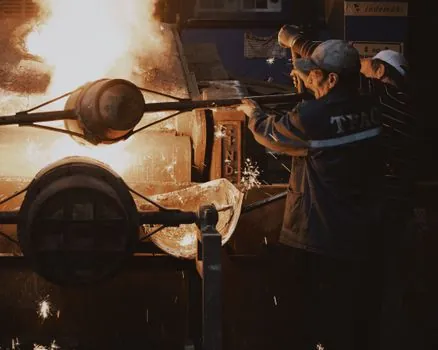
The mold type is the foundry's decision, but the RFQ should still request the foundry to declare it, because the same drawing can be produced by casting mold routes with very different cost and lead-time profiles. For metal treatment area ferrous parts, sand casting mold routes (green sand, resin-bonded sand, no-bake) are typical for prototype and low-volume work, with pattern material (wood, aluminum, steel, resin) quoted separately. For repeat production of small aluminum or zinc brackets, dies are quoted as a separate line with cavity count, die steel grade, expected die life in shots, and whether the die is buyer-owned or amortized into piece price [S3]. The RFQ should also state whether sample parts are first-article inspection only, PPAP-style, or include a pilot run before serial production, since this changes the inspection cost line.
Post-Casting Operations: Heat Treatment, Machining, and Surface Finish
Almost every metal treatment area casting needs post-casting work, and the cost of that work is what often separates the low quote from the realistic one. The RFQ should declare whether heat treatment furnace cycles are in-scope (stress relief, normalize, quench and temper, solution treat and age), with the standard referenced (for ferrous, ASTM A830; for aluminum, AMS 2770 or equivalent) and any required hardness range. Machining scope should list datums, fixtures, critical tolerances, thread specs, and any press-fit or assembly interfaces. Surface finishing should name the process (paint, powder coat, plating, anodize, ceramic coat) and any prep work (shot blast, pickling, passivation) [S8]. The line should also call out metal material traceability for any part that will be re-melted in the buyer's own melt shop, since contamination control starts at the casting supplier.
Inspection, Testing, and Documentation
The inspection block is where many RFQs collapse. The buyer must state dimensional inspection scope (CMM, hand gage, 3D scan), the standard for visual acceptance (MSS-SP-55 or equivalent), and any non-destructive testing: magnetic particle, dye penetrant, radiographic (ASTM E446 or E186 reference radiographs for castings), ultrasonic, or pressure test. Mechanical testing scope (tensile, hardness, impact) should be per-heat or per-lot, and the certificate format per EN 10204 3.1 or 3.2 should be specified [S3]. For metal treatment area parts with cyclic thermal loading, the buyer should also request a microstructural or grain-size check on first article, and any special certification (CE, ATEX for explosive atmosphere furnaces, PED for pressure-bearing castings) must appear on the RFQ so the foundry can plan the audit trail.
Logistics, Packaging, and Acceptance Schedule
The closing block fixes delivery, packaging, and the order of operations: tooling lead time, sample part lead time, serial production lead time, and the commercial terms (Incoterms 2020 EXW, FOB, DDP). The buyer should declare whether castings ship in raw, machined, or finished state, and the packaging needed to protect machined faces and threads (VCI film, foam, custom crating for furnace shells). For metal treatment area work the buyer should also request a documented requote trigger list, so that any drawing revision after the first article triggers a price-and-lead-time review rather than a unilateral cost increase [S3]. A clear acceptance schedule (first article, pilot lot, serial release) tied to PPAP or first-article inspection per AS9102 is the cleanest way to close the loop.
For a related spec-first walk-through of explosion-protected equipment that often sits next to casting-mold supply on a metal treatment line, see the Explosion-Proof Electrical Selection guide. Where the casting carries a quench tank or pump housing, the same buyer-side discipline of declaring each parameter in turn is mirrored in the Explosion-Proof vs Anti-Static selection map. Track, on the next RFQ revision, whether the foundry's tooling amortization lines up with program life, and whether first-article inspection cost was quoted separately or buried in piece price, since those two items are where requote cycles usually start.