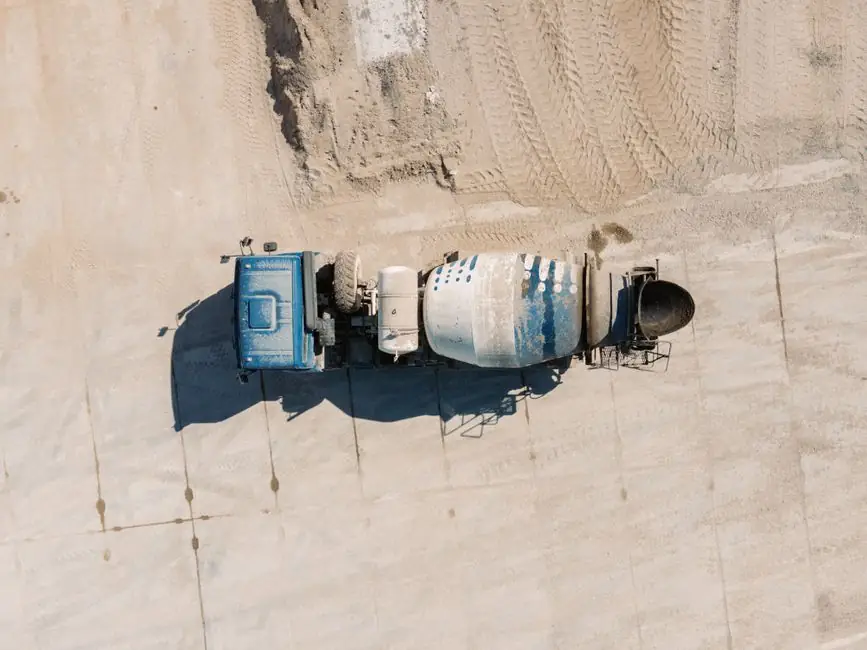
Ready-mix concrete (RMC) in direct food-contact service fails on three independent axes: high-pH alkaline attack (pH 12+ in wet state, per [S7]), aggregate-paste interfacial fatigue under thermal and wash-down cycling ([S5]), and trace-metal migration from fly ash and aggregate inclusions ([S3]). These failure modes are not theoretical; standard RMC MSDSs explicitly classify the wet product as a Category 1A carcinogen with Category 1 eye-damage and STOT-repeated-exposure hazard ([S3]).
For process engineers specifying floors, troughs, sumps, or equipment pads in food and beverage plants, the engineering question is not whether RMC fails, but where the failure boundary sits and what liner system isolates the substrate from the product. The answer hinges on the calcium-silicate-hydrate (C-S-H) paste, which remains reactive until full carbonation takes months to years, and on residual alkalis (Na2O, K2O) that keep pore-water pH well above 11 even after surface curing ([S4]).
Alkaline Burn and pH-Driven Failure: The Wet-State Hazard
Wet ready-mix concrete carries a pH of 12 or higher because of portlandite (Ca(OH)2) and alkali-hydroxide saturation in the pore solution ([S7]). Prolonged skin contact causes chemical burns, sometimes without immediate pain, because the alkaline solution saponifies skin lipids; documented exposures have produced third-degree burns requiring medical attention ([S4]). This same chemistry attacks food-contact surfaces: protein deposits, dairy fats, and acidic food products (pH 3.5–4.5 fruit preparations) accelerate dissolution of the cement paste, releasing calcium hydroxide into the product stream.
Manufacturer MSDSs confirm the magnitude. Cooper Concrete's SDS lists the product as Category 1 Eye Damage, Category 1 STOT-repeated exposure, and Category 2 Skin Irritant under GHS classification, with signal word DANGER ([S3]). Hope Concrete's SDS specifies the same wet-state hazard and adds the engineering caveat: wet-stage RMC poses immediate tissue hazard, but the dry cured product shifts the risk profile to respirable crystalline silica during any subsequent drilling, cutting, or grinding ([S4]). For food-plant use, this dual hazard window is the controlling design constraint.
Aggregate-Paste Debonding and Crack Formation Under Service Load
Fatigue-driven failure of RMC in food-plant service originates at the aggregate-paste interface. Continuous deterioration of the bond between aggregate and cementitious paste under cyclic loading initiates microcracking, which then propagates under thermal, hygral, and mechanical stress ([S5]). In a food facility, the cycling is not optional: steam-clean wash cycles (typical 80–95 °C), refrigeration room swing (-25 °C to +5 °C), and CIP chemical exposure (1–4% NaOH, 1–2% HNO3) impose simultaneous thermal and chemical gradients on the floor or wall substrate.
Kashwani's 2019 review identifies four mechanical and environmental drivers of crack formation: static and cyclic loading, settlement and shrinkage, thermal contraction plus freeze-thaw cycling, and corrosion/alkali/sulphate attack ([S5]). Settlement cracking dominates in newly placed RMC pads and is driven by water-cement ratio and aggregate gradation, both of which are quality-control variables in the ready-mix supplier's mix design ([S2]). For food-plant construction, the practical specification is a maximum w/c ratio of 0.45 with a minimum 28-day compressive strength of 30 MPa (C30/37 per EN 206), combined with a minimum curing period of 7 days wet before any food-contact liner is applied.
Trace-Element Migration: Fly Ash, Crystalline Silica, and Heavy Metals
RMC composition is not a single chemistry; it is a variable system. Cooper Concrete's typical mix is 47% limestone aggregate, 35% sand, 8% portland cement, 2.4% fly ash, and less than 1% silicon dioxide, but the SDS explicitly warns that fly ash "may contain trace amounts of heavy metals" and that SiO2 may be up to 100% crystalline silica depending on natural source variation ([S3]). Hope Concrete's SDS widens the silica window: cements, sand, and gravel may contain 0.1% to 60% crystalline silica (CAS 14808-60-7) by mass, with respirable exposure limits set at 0.05 mg/m3 under ACGIH TLV ([S4]).
The Smith Ready Mix SDS adds a third concern: "trace amounts of naturally occurring, potentially harmful constituents may be detected" because feedstocks are drawn from natural earth materials ([S6]). In a food-contact context, these trace constituents, including arsenic, lead, chromium, and naturally occurring radionuclides, sit in the aggregate matrix and can leach under acidic product exposure. NSF/ANSI 61 certification of concrete for potable water requires controlled extractables testing; standard RMC carries no equivalent food-grade certification, which is why direct food contact is contraindicated in supplier documentation ([S8]).
Material Comparison: RMC vs Food-Grade Surfacing Options
For food-contact service, engineers typically evaluate four substrate or liner options against the RMC failure modes identified above. The comparison is best framed by four criteria: wet-state pH (food safety), thermal-cycle tolerance, extractable metal control, and installed cost per square meter at 50 mm thickness. [S5]
RMC alone scores worst on every criterion except installed cost: pH 12+ wet, thermal cracking risk above 80 °C cycling, uncontrolled trace-metal extractables, and the lowest material cost at roughly $110–140/m3 ([S2]). Food-grade epoxy mortar (typical 6 mm trowel-applied, 100% solids, novolac or bisphenol-A epoxy) raises pH stability to chemically inert, tolerates 95 °C CIP cycling, and is NSF/ANSI 61 certifiable, but costs $45–75/m2 installed. Urethane cement screed (3–9 mm, cement-filled polyurethane) is the workhorse for wet-process areas: pH-stable, 95 °C tolerant, and slip-rated, at $35–60/m2. 304 stainless steel liner (2 mm welded sheet over RMC substrate) is the premium option for high-purity dairy and pharmaceutical lines, costing $180–260/m2 but eliminating substrate-contact migration entirely. For direct food-contact components, the engineering standard is to keep RMC as structural substrate only and bond a certified liner to isolate it.
Selection Criteria: When RMC is Acceptable, and When It is Not
RMC is acceptable as a structural substrate in food-plant construction provided it is isolated from direct food contact by a certified liner. Typical acceptable uses include equipment pads under packaged-goods conveyors, structural slabs beneath urethane-cement or epoxy toppings, and exterior loading-dock aprons. RMC is not acceptable as a direct food-contact surface, as a topping in open-process wet areas, or as a repair material in hygienic-zone floors, because the wet-state alkalinity and post-cure trace-metal extractables exceed NSF/ANSI 51 and 61 thresholds for direct and indirect food contact ([S8]).
For procurement, the specification should require the ready-mix supplier to provide a batch-specific SDS (GHS-compliant, 16-section) and a mix-design sheet stating w/c ratio, SCM content, aggregate source, and 28-day compressive strength. Suppliers operating under ACGIH TLV-compliant dust controls, as documented in industry MSDSs, are baseline acceptable; suppliers that cannot furnish lot-level traceability should be de-selected for any food-facility scope ([S3], [S4]). Material traceability is especially important because supplementary cementitious materials (fly ash, slag) introduce variable heavy-metal content that lot testing alone can catch ([S6]).
Standards, Sourcing, and Field Failure Indicators
Three industry standards govern the safety envelope. GHS hazard classification under OSHA HCS (29 CFR 1910.1200) drives the SDS format and Category 1A/1/2 hazard codes that every supplier must publish ([S3]). ACGIH TLV-TWA sets the respirable crystalline silica exposure limit at 0.05 mg/m3, total dust at 10 mg/m3, and respirable dust at 5 mg/m3 for cement and aggregate handling ([S4]). NSF/ANSI 51 (food equipment materials) and NSF/ANSI 61 (drinking water system components) are the food-contact certification references the liner system, not the RMC, must meet ([S8]).
Field failure indicators in an existing RMC substrate are diagnostic: white efflorescence on the surface signals ongoing Ca(OH)2 migration and active alkali-silica reaction; map-pattern cracking with rust staining indicates corroding rebar and expansive oxide jacking; and dusting under foot traffic points to a laitance layer that was never properly sealed, the result of over-watered mix or insufficient curing ([S5]). The presence of any of these signs in a food-zone area mandates substrate remediation, mechanical removal of the compromised layer, and re-lining with a certified food-grade system before the area returns to service. The 2016 PMC review of RMC occupational safety also documented cleaning of truck mixers and pumps as the highest-frequency injury task, a reminder that wet-stage exposure to workers is the same chemistry that drives food-product contamination ([S1]).
Trackable signals for engineers monitoring this space: revisions to NSF/ANSI 51 extractables testing protocols for cementitious substrates, and the readiness of major ready-mix suppliers to publish mix-design-specific heavy-metal leach data under NSF/ANSI 61 testing rather than generic SDS language. Also, a useful cross-read is the failure-mode analysis methodology in crucible furnace maintenance, which applies the same substrate-versus-liner separation logic to high-temperature service. The RMC-in-food-service question is fundamentally a question of where the chemical boundary sits, and the engineering answer is consistent: keep RMC structural, keep the certified liner on the process side, and document the interface.
Component reference pages worth checking: ready mix concrete, angular contact bearing, and control panel component.