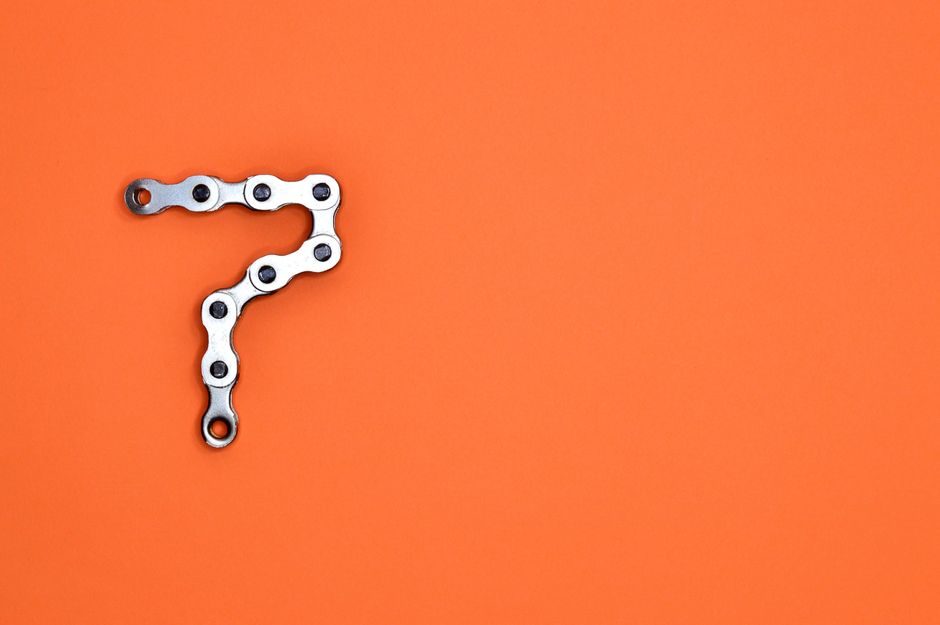
Specifying a roller chain in 2026 starts with three measurable parameters — pitch, strand count, and ISO 606 series — and a target rating life of 15,000 hours under the BS ISO 10823:1996 selection guidance [S3].
Roller chains remain the dominant positive-engagement power-transmission element for shaft-to-shaft drives because they hold a constant speed ratio with no slip, run at roughly 98% mechanical efficiency, and tolerate larger centre distances than gear or timing-belt drives [S3]. The same construction also feeds conveyor chain builds for materials-handling lines, so the selection logic below applies across both markets.
Pitch, Series and Strand Count — How to Read an ISO 606 Chain Code
An ISO 606 short-pitch transmission chain is identified by three numbers: pitch in 1/16-inch units, the letter B for European series, and a strand suffix (1 simplex, 2 duplex, 3 triplex) [S3]. A 06B-3 designation therefore means 6/16 in (3/8 in / 9.525 mm) pitch, European series, triplex strand.
Pitch sizes span 4 mm (0.158 in) up to 114.3 mm (4.500 in) under ISO, while European-series chains carry larger pin diameters than US-series equivalents at the same pitch, giving a larger bearing area and longer wear life on heavy drives [S3]. Buyers will see this reflected in the heavy-duty C2062H ISO designation used for industrial machinery, typically offered in carbon, alloy and stainless steel variants with stainless commanding the highest unit price [S6].
Load, Speed and Service Factor — The Selection Calculation
The design flow on a chain drive begins with transmitted torque, then chain velocity, then required chain tension, followed by bearing stress on the pin and finally a design power check against the chain's power rating [S3]. Service factors on both drive and driven wheels are applied to that rating to compensate for shock load, dust, moisture and multi-shift operation.
For most general industrial drives a simplex single-strand chain is the cost-efficient default; duplex and triplex chains are specified when the power rating of the simplex chain is exhausted or when the designer needs to halve the chain pull by adding a second strand [S3]. Extended-pitch, heavy, cottered, and metric variants exist for the same reason — each trades a different combination of cost, fatigue life, and ease of field assembly [S2]. Engineers cross-checking their roller chain number against a real catalog should verify strand count, attachment type, and whether the part is Japanese premium, corrosion-resistant, or commodity import before locking the BOM.
Lubrication Windows: Matching Grease to Temperature and Load
Chain lubricant selection is governed by continuous operating temperature, base-oil chemistry, and additive package, with the working envelope defined in the lubricant datasheet rather than guessed on the floor [S1]. For sub-zero to ambient service, PAO (polyalphaolefin) greases with aluminum-complex thickener and PTFE/white-solid additives cover -40°C to 150°C, while food-machinery PAO greases with the same thickener span -40°C to 149°C [S1].
Mid-range mineral-oil greases thickened with aluminum complex and loaded with MoS2/graphite hold 0°C to 160°C, and a heavier MoS2-graphite dispersion reaches 0°C to 160°C for chain, gear, and slide service [S1]. For high-temperature chains, the operating window widens to 20–450°C with a MoS2-graphite anti-friction coating, and for anti-seize on threaded fasteners and high-temperature slides the copper-graphite paste with white solids extends -30°C to 650°C [S1]. The takeaway for a buying decision: pick a lubricant whose published temperature window brackets the chain's pin-bushing operating range, not the ambient room temperature.
Premium, Corrosion-Resistant and Engineered Variants
Premium chains from Japanese manufacturers (OCM, D.I.D. Daido) and seal-guard constructions (MAXCO Inspire, MAXCO Seal Guard) sit above commodity ISO 606 chains on catalog pages and target applications where lube intervals or contamination are the bottleneck [S2]. Corrosion-resistant chains — both import and Japanese origin — are the standard pick for washdown, food, marine, and outdoor service, and are typically ordered with matching corrosion-resistant connecting and offset links [S2].
Engineered chains (leaf, mill, pintle, sharp-top) and engineered sprockets at 2.25 in and 2.609 in pitch are separate from transmission chain and are driven by lifting, attachment, or hooking duty rather than shaft-to-shaft power [S2]. For buyers stepping from a power-transmission chain into a materials-handling line, the relevant encyclopedia entry is chain conveyor and the relevant cross-reference is the engineering duty of the chain, not its pitch number.
Sprocket Pairing, Idlers and Mounting Decisions
A roller chain drive is only as good as its sprocket set: A-plate, B-hub, weld, QD, split-taper, and taper-lock sprockets are matched to the shaft-mounting method, while idler sprockets control wrap angle on the slack side of long-centre drives [S2]. For metric pitch chains, metric sprockets must be specified separately to keep the tooth profile correct; mixing ISO 06B chain with a US 35-style sprocket is a common field failure [S2].
Where a single linear guide is too rigid for a contaminated environment, a chain-on-rail arrangement with an idler can substitute as a lower-cost linear axis, and the same principle explains why chain drives often appear inside crossed roller guide assemblies where a positive-engagement track is required.
Pricing, MOQ and Sourcing Channels in 2026
Industrial buyers in 2026 are looking at three channels: domestic distributors with free shipping and no minimum order (US-based), Asian factory-direct with tiered FOB pricing, and online industrial marketplaces listing single-piece SKUs [S1][S2][S6]. Tiered factory pricing on a heavy-duty ISO C2062H transmission chain shows the curve clearly: 500–999 m at US$0.15/m, 1,000–1,499 m at US$0.12/m, 1,500–1,999 m at US$0.10/m, and 2,000 m+ dropping to US$0.09/m [S6].
Online retail of small-quantity chain components (for example, a 06B 14-tooth sprocket, 3/8 in pitch, 14 mm bore, A3 steel) has closed the prototype gap and lets maintenance teams order single pieces rather than full cases [S5]. For larger OEM runs the price-per-meter curve on factory-direct channels is the lever that matters most, and MOQ-driven negotiation typically yields the steepest discount at the 2,000 m threshold [S6].
Standards, Verification and a Cross-Reference Check

Two documents anchor a defensible roller chain specification: BS ISO 10823:1996 for selection guidance and BS 228:1994 / ISO 606:1994 for short-pitch transmission precision roller chains and chain wheels [S3]. Any chain ordered against these standards should be supplied with a published power-rating curve at 15,000 hours life, a stated pitch, an inner-plate width, and a roller outside diameter — the three measurements that fully identify a chain number [S3].
For comparison-style specification work, the most practical cross-reference table is: ISO 606 chain vs shaft speed vs power rating vs required lubrication type, with premium sealed chains and corrosion-resistant chains as the two upward variants. Buyers drilling deeper into selection logic should consult Roller Chain Selection: Pitch, Series, Load and Speed Gates for a more granular walk-through of the calculation flow.
Trackable next signals for the rest of 2026: any revision activity against ISO 606 or BS 228, and any update to the BS ISO 10823 selection guidance — both would shift the rating-life assumption and the service-factor table that every other clause on this page leans on.