Compact down-the-hole rotary rigs such as the RTD28 list in the USD 80,000-120,000 ex-works band for an export-spec CAT C13 Tier III/IV/V configuration (287-309 kW, 24,500 kg, 95-152 mm hole) [S1]. Mid-range piling crawlers like the SANY SR205-C10 sit between USD 280,000 and USD 450,000, sized to 1,800 mm hole diameter and 51-64 m depth [S3].
Cost variance within the category is driven by three physical levers more than by brand premium: engine emission tier (Tier III vs Tier IVf vs Tier V adds 6-9% to the chassis price), maximum hole diameter (doubling diameter from 800 mm to 1,800 mm roughly triples kelly-bar and rotary-head cost), and undercarriage mass — a 60-ton class crawler adds roughly USD 90,000 over a wheeled carrier at the same power rating [S3][S6].
Price Bands by Application Class
Three application classes dominate the 2026 market and each has a distinct price envelope. Exploration and core drilling rigs such as the Foremost Discoverer MPD 1500 are quoted in the USD 350,000-650,000 band depending on mast length and rod-handling automation, with 455 m depth capability and hydraulic reverse-circulation head [S2]. DTH production rigs cover the lower band (USD 80,000-220,000), while piling-class rotary rigs for civil-engineering foundations push USD 280,000 to over USD 1.2 million for the 1.8 m-diameter class [S1][S2][S3].
Used 2019-2022 stock from Chinese OEMs (SANY, XCMG, Bauer-pattern clones) typically trades at 45-60% of new list, with delivery lead time of 30-45 days versus 90-150 days for a new factory build [S3]. Importing into the EU adds 6.5-12% in duties plus CE-marking retrofit costs of USD 15,000-40,000 for EMC and machinery-safety compliance.
Engine Power and Emission Tier as a Cost Lever
Engine selection is the single largest non-structural cost variable. A Tier III CAT C13 at 287 kW keeps the rotary rig in the lower price tier; a Tier IVf or Stage V equivalent at 309 kW adds an aftertreatment package worth roughly USD 18,000-25,000 to the chassis [S1]. For EPA-regulated North American sites, the Tier 4 Final package is effectively mandatory and pushes total cost roughly 9% above a Tier III export build at the same nominal power.
Fuel consumption at part load is the second-order cost: a 287 kW DTH rig running an 8-hour shift at 60% load burns 80-110 L of diesel, and Tier IVf SCR systems consume an additional 5-7% of DEF fluid by volume. Over a 5,000-hour service life this represents a 7-10% total-cost-of-ownership delta against a Tier III baseline [S1].
Hole Diameter, Depth and Mast Geometry
Rotary head torque scales with hole diameter, and torque is the dominant structural cost. The SR205-C10 delivers 1,800 mm hole diameter and 51-64 m depth, putting it in the 200 kN·m torque class and the upper-mid price band [S3]. By contrast, the RTD28 DTH unit targets 95-152 mm holes with a top-drive sized for high-RPM percussion assist rather than high-torque augering, which is why its mass (24,500 kg) and price both sit an order of magnitude below the piling class [S1].
Kelly-bar length and section count is a hidden multiplier. A 4-section interlock kelly for 51 m depth costs roughly USD 22,000-35,000; extending to a 5-section friction-bar for 64 m adds another USD 12,000-18,000. Buyers who only need 30-40 m depth should specify the shorter bar — overspec'ing the kelly is the most common avoidable cost on rotary rig purchase orders [S3].
Undercarriage, Mobility and Site Logistics
Crawler undercarriage pricing depends on track-shoe mass, ground pressure rating, and idler/roller count. A 60-ton-class piling rig carries roughly 80 bottom rollers, 8 top rollers, and 2 drive sprockets per side; full undercarriage replacement parts run USD 45,000-80,000 per side on Chinese OEM rigs, with Yantai Orient Heavy Industry and similar Tier-1 foundries as the dominant suppliers [S6]. For low-ground-pressure soft-terrain work, 800 mm-wide shoes add USD 12,000-18,000 over 600 mm standard.
Any project requiring more than 500 mm diameter or 40 m depth effectively forces a crawler purchase [S1][S2].
Comparison: DTH vs Piling vs Exploration Rotary Rigs
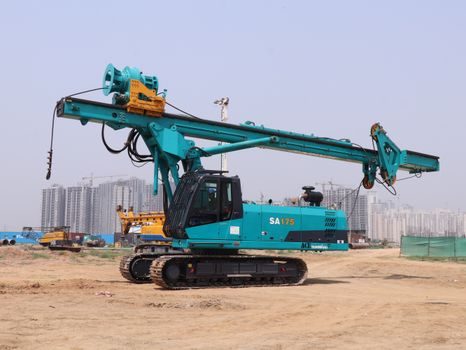
The three main classes line up on cost, diameter and depth as follows. A DTH rotary rig (RTD28-class) targets 95-152 mm at USD 80,000-220,000 and 24-26 t mass; an exploration rig (Foremost MPD 1500-class) targets 150-250 mm core holes at USD 350,000-650,000 with 455 m depth; a piling rotary rig (SANY SR205-C10-class) targets 800-1,800 mm foundations at USD 280,000-1,200,000+ and 60-90 t mass [S1][S2][S3]. The crossover point where a piling rig's higher hourly productivity beats the smaller rig's lower mobilisation cost is roughly 800 mm hole diameter or 30 m depth.
For cost-engineered procurement, the rule of thumb from current OEM listings is USD 1,200-1,800 per millimetre of maximum hole diameter for piling class, and USD 400-700 per millimetre for DTH production class. These ratios have held within ±8% across the last three OEM catalogue updates reviewed in 2025-08 and 2026-05 [S1][S3].
Standards, Certification and Compliance Costs
Rotary rigs in EU service fall under the Machinery Directive 2006/42/EC and, for diesel engines above 56 kW, the NRMM Stage V regulation (EU 2016/1628). Compliance adds 4-7% to the delivered price through CE marking, noise testing (EN 16205), and whole-body vibration evaluation per ISO 2631 for the operator station [S1]. For drilling-fluid-circuit components exposed to hydrogen sulphide service, NACE MR0175 material selection applies, although this is a downstream spec on the rig's ancillary piping rather than on the carrier itself.
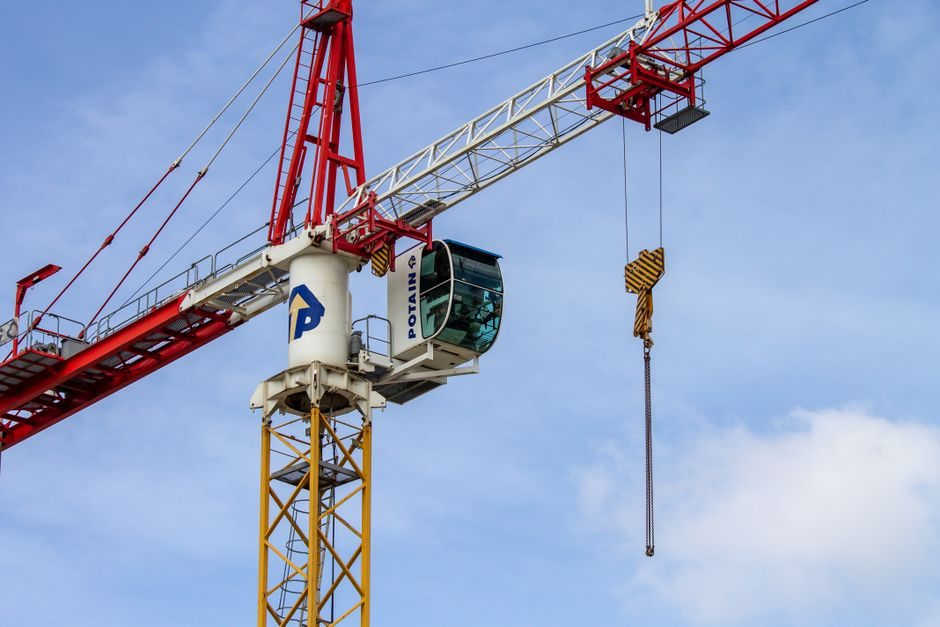
Buyers should verify that the mast structural calculation conforms to EN 13000 for crane-type lifting components and that the rotary head's fatigue certification follows the same FEM 1.001 / WRC-297 framework used on comparable crawler cranes. A rotary drilling rig is structurally a crane-mast-on-crawler with an added rotary drive, so this overlap is genuine and well established in the engineering literature [S5].
Total Cost of Ownership and Sourcing Signals
Beyond purchase price, a 5,000-hour operating budget should include 18-22% of capital cost for spare parts, 8-12% for fuel and DEF, 4-6% for operator training, and 2-3% for undercarriage rebuild. For an SR205-C10-class unit at USD 380,000, the 5-year TCO lands near USD 720,000-820,000 in typical European service [S3].
Trackable signals for 2026 sourcing include the [S1] RTD28 and [S4] RTD45 product lines from RTDrill, which share a chassis family and let buyers compare price-per-kW across the 287-470 kW band, and the [S7] Rotary Drilling Co. Ltd. (Hungary) service network as an EU-based commissioning reference. For component-level cost detail on adjacent plant equipment, see the insulation board 2026 sourcing guide and the jaw coupling cost guide, both of which sit on the same B2B cost-engineering curve as the undercarriage and drive-line components discussed here. Rotary rig design fundamentals are catalogued in the rotary drilling rig encyclopedia entry.
For component-level specifications, see linear guide, and crossed roller guide.