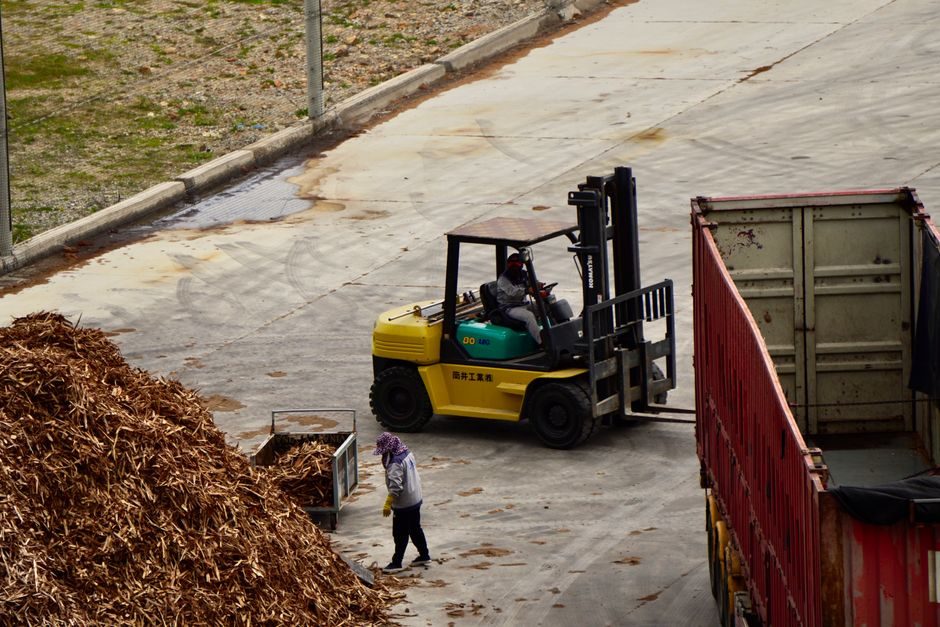
Rough terrain forklifts are most commonly specified in the 3,000-10,000 kg (3-10 t) load window with four-wheel drive, 4-6 m two-stage or 7-12 m triplex masts, and agricultural or industrial lug tyres; a unit picked outside that envelope is almost always a mis-spec for the site conditions buyers actually run [S3].
The category overlaps — but is not interchangeable with — standard forklift warehouse trucks and with telehandlers, and buyers who skip the envelope check usually pay for it in frame cracks, mast deflection, or under-utilised hydrostatic drive. Selection is best done gate-by-gate: load class, drivetrain, mast, ground clearance, and finally OEM/service.
Gate 1 — Rated Load and Load Centre
Rated capacity on a rough terrain unit is published at a stated load centre — typically 500 mm or 610 mm from the fork face — and the published figure collapses quickly as the centre moves out. Most OEM line-ups in this class cover 3,000 kg, 3,500 kg, 5,000 kg, and 10,000 kg at the standard 500 mm LC, with Pioneer-35B (3.5 t) and Land Tiger-50RC (5 t) showing as common mid-range references and Land Tiger-26R (2.6 t) sitting at the compact end [S3].
If the application is pipe, bagged fertiliser, or a non-palletised concrete product, the practical rule is to derate the published figure by 15-25 % before comparing machines. The same calculation also decides between 2WD and 4WD: a 2WD / rear-steer rough terrain unit is acceptable on graded gravel yards to about 3,500 kg, beyond which 4WD is the safer spec because the front axle has to take the rimpull under load [S3].
Gate 2 — Drivetrain, Tyres and Ground Clearance
Two engineering choices dominate drivetrain selection: mechanical 4WD with torque converter (typical of JCB, Sellick, and most Chinese OEM ranges) and full-time hydrostatic 4WD (typical of compact units such as the Hummerbee line) [S1][S2][S5]. Hydrostatic drives win on inching control around rebar stacks and nursery bins, but lose on long uphill grades because they shed braking torque to heat; converter-mechanical wins on raw gradability.
On tyres, the working split is between R4 industrial lug, R3 turf, and L2 traction. R4 is the default for mixed yard and construction; R3 is wrong on crushed rock because the lug height bottoms out; L2 is right for soft-soil forestry yards. Ground clearance numbers in this class run 250-450 mm at the frame, and unloaded approach angles of 25-35° are typical. Buyers who under-spec ground clearance on a limestone yard end up high-centred within a season, regardless of how much torque the drivetrain makes.
Gate 3 — Mast, Lift Height and Reach Envelope
Two-stage masts cover the 3-5 m working range; triplex masts take the unit to 7-12 m and are mandatory where the load must clear a truck sidewall or stacked container tier. Sellick's published range and JCB's rough-terrain programme both centre on this two-stage/triplex split, with optional sideshift common across the segment [S1][S5].
For very tall work — loading 40 ft containers in a one-sided yard, for example — buyers should be looking at a telehandler, not a rough terrain forklift, because at 8+ m the mast-and-carriage geometry of an RT forklift loses stability margin faster than a boom-and-outrigger telehandler does. Where the work is mixed (yard-to-truck plus yard-to-rack), the triplex RT with sideshift and a load backrest extension is the more flexible envelope.
Gate 4 — Power Source: Diesel, LPG or Electric
Diesel remains the default in this class because torque density, refuel time, and ambient-temperature tolerance all matter on outdoor yards. The newer alternative is the compact electric rough terrain unit — EIRMON's 2026 line-up, founded 2017, is built around small and medium electric wheel loaders, electric forklifts, and a growing RT-forklift programme, with export focus on the same duty cycles [S4].
Electric RTs make sense where the work is indoors with short charge windows — cold stores, warehouses, or covered timber yards with floor ratings that exclude diesel fumes. They are the wrong pick for a 12-hour open-yard shift, because the battery pack needed to match a 3 t diesel shift-cycle is still roughly 1.5-2× the cost of the diesel powertrain alone. Buyers comparing OEM ranges should also check IP rating for the electrical box and motor: the published IP65 motor enclosures on the latest compact electric RT programmes are the threshold to write into a tender spec [S4].
Gate 5 — Service Network, Spare Parts and Resale
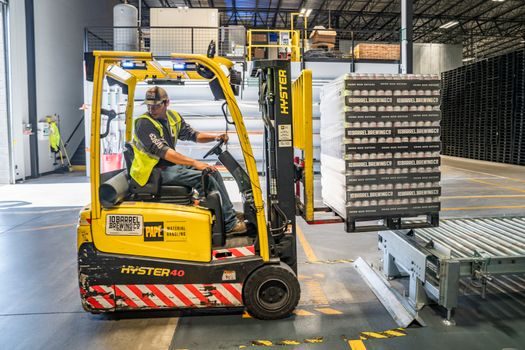
RT forklifts spend their lives on rough ground, so the binding constraint after year three is parts lead-time, not the spec sheet. The brands that hold resale best in the secondary market are the ones with a dealer service footprint — JCB, Manitou, Sellick, Terex — and Terex, with its patented SQUARE SHOOT level-rough-terrain mast system, is a useful reference point in this segment [S5].
Chinese OEM ranges (Pioneer, Land Tiger) are typically 20-35 % below the Western OEM list on a like-for-like tonnage, but parts logistics out of China can extend downtime when a gearbox or controller fails. A pragmatic procurement rule is to score each bid on: (a) local dealer distance and parts-on-shelf depth, (b) warranty exclusion list (tyre, seat, glass), (c) service interval in hours, and (d) hydraulic-oil and filter cross-reference availability. The lowest first-cost bid usually loses on the four-year total-cost-of-ownership line by 10-18 %.
Selection Matrix: 2WD vs 4WD vs Hydrostatic vs Electric RT
The four practical configurations line up against the decision variables as follows. Mechanical 4WD with torque converter: best gradability, highest parts availability, default pick for outdoor construction and lumber yards. Hydrostatic 4WD: best inching and operator control, ideal for nursery, rental fleet, and rebar yards. 2WD: cheapest, acceptable only below 3.5 t on graded gravel. Electric RT: lowest operating cost, quiet, correct for indoor or cold-store duty, wrong for 12-hour open-yard shifts. [S1]
A worked check: a 5,000 kg diesel 4WD with triplex 7 m mast, R4 tyres, 350 mm ground clearance, and 45 % gradability matches the typical Sellick / JCB / Pioneer-35B profile and is the most common shortlist in 2026 [S1][S3][S5]. For lighter duty under 3 t, a hydrostatic compact unit — Hummerbee-style — gives the same mast envelope with tighter turning radius and lower noise, at the cost of higher initial list price [S2].
Common Selection Mistakes and Sourcing Signals
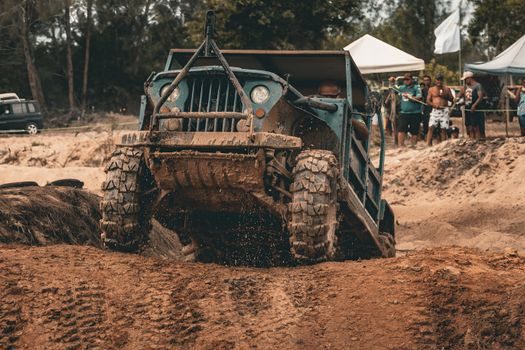
Three errors repeat across tenders. First, copying a warehouse forklift spec to an RT application: warehouse trucks have smaller tyres, lower ground clearance, and a single-pedal inching brake that is unsafe on a 30 % slope. Second, ignoring mast deflection at full lift height with load: triplex masts at 8+ m can show 50-100 mm of deflection at rated load, which is fine for bulk bags but disqualifies the unit for palletised stacked loads. Third, omitting the sideshift and load backrest extension, both of which are usually optional and routinely left off the spec to win a bid, then added back as extras after delivery. [S2]
For 2026 sourcing, the trackable signals are: emissions-tier transition for diesel RTs (Stage V / EPA Tier 4f replacement cycles), battery-supply lead-times for the new electric compact programmes, and dealer-fleet expansion in second-tier cities. Buyers who anchor on those three signals and apply the five gates above will land on a spec that survives three years of site duty, not just the delivery inspection. Operators moving into rough-terrain trucks from standard warehouse fleets will find the mining dump truck selection criteria article useful for the parallel frame, tyre, and drivetrain logic, while three-phase power decisions on electric RT yards mirror the 2026 asynchronous motor spec gates.
For component-level specifications, see pressure transmitter.