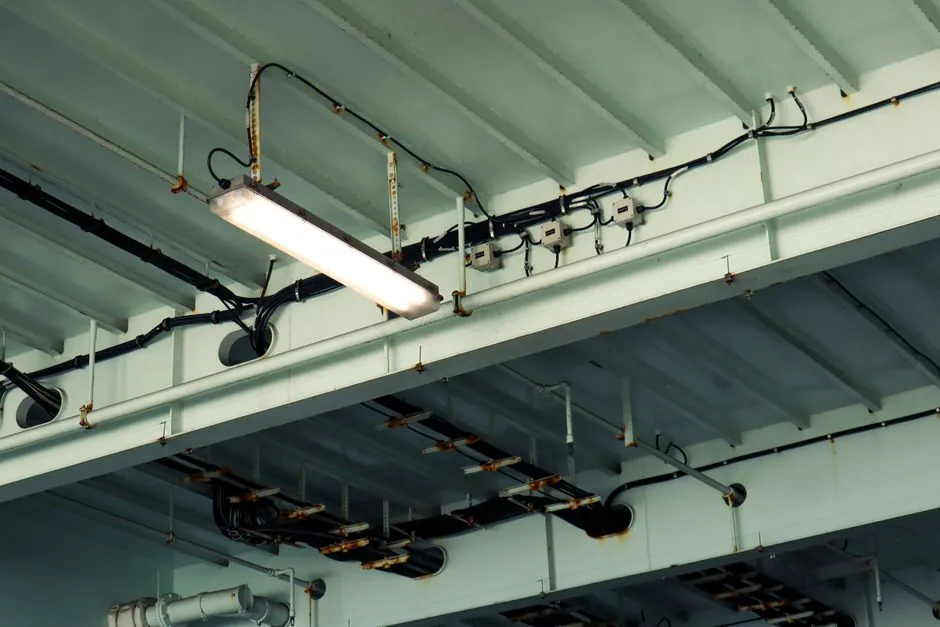
A compliant electrical-room safety fence checklist binds three evidence chains at once: a 36-inch working clearance verified under OSHA 1910.303(g), an NFPA 70E arc-flash label matched to PPE stocked at the gate, and an earthing record dated within 12 months per IS 3043 [S4][S5].
Specifiers should treat the fence as the audit boundary, not as a barrier accessory: it is the first physical control an EHS officer checks when entering a switchboard room, and the most common place where certifications silently expire [S2][S4].
Define the Scope: Indoor LV/MCC Room vs Outdoor MV Switchyard
For indoor rooms at 600 V or below, OSHA 1910.303(g) sets the baseline: 36 inches (3 ft) of depth in front of the panel, 30 inches of width minimum, and 6.5 ft of headroom, with no storage in the working space [S5].
For rooms above 600 V and outdoor MV switchyards, the same OSHA clause plus NFPA 70E drive a wider envelope, and the fence must be a lockable, authorised-personnel-only perimeter with arc-flash labelling at every gated access [S3][S4]. A typical indoor MCC fence gate of 1.0-1.2 m height with a self-closing, key-latched door satisfies the access-control check; MV switchyards commonly step up to 2.4 m welded-mesh fencing with a 3 m clear zone inside the fence line, and specifiers should size from the calculated arc-flash boundary rather than a generic height [S3][S4].
Pre-Audit Evidence: Certificates That Must Be on File
OSHA 1910.303(e) requires voltage, current and wattage markings on the equipment, and 1910.303(f) requires every disconnecting means to be legibly marked to indicate its purpose before the fence is treated as compliant [S5].
The practical evidence stack an auditor expects at the fence gate: a single-line diagram dated within the last revision cycle, an arc-flash study with incident-energy values at each bus, an NFPA 70E task table, an up-to-date panel directory, and an earthing-resistance test record under 1 ohm for most industrial applications per IS 3043 [S4][S5]. For rubber insulating matting in front of panels, the BIS licence number should be verifiable on the BIS portal rather than on a manufacturer self-certificate, and ERDA or equivalent third-party type test reports are expected for any mat in a zone above 11 kV [S4].
Working Clearance, Access, and the Fence Gate

OSHA 1910.303(g) explicitly requires sufficient access and working space around all electric equipment to permit ready and safe operation and maintenance, and 1910.305(d) requires a dead front on panelboards with no live parts exposed on the operating side [S5].
For panels rated 1200 A or above and wider than 6 ft, the code requires an entrance at each end of the working space, and the fence layout must respect this dual-access rule rather than the common single-gate shortcut [S5]. The gate itself should swing outward at 90 degrees minimum, carry an "Authorised Personnel Only" sign, and integrate with a self-closing, self-latching mechanism so the room cannot be left open during energised work, mirroring the safety fence selection criteria typically applied to machine guarding [S2][S4].
PPE and Arc-Flash Matching at the Fence
Insulating gloves in the room must carry the correct voltage class, a current annual retest date, no punctures or chemical contamination, and storage away from sharp tools and solvents, while arc-rated clothing and face shields must be physically present where panels carry arc-flash labels [S4].
If the label on the panel states PPE Category 2 or higher, the PPE category on the panel label must match what is available inside the room, and a missing label or missing kit is a stop-work finding, not a paperwork finding [S4]. Many teams lock the PPE cabinet on the inside of the fence so the act of opening the gate forces a PPE check, which dovetails with broader LV electrical room discipline and reduces the chance of a category mismatch going unnoticed across shifts [S3][S4].
Earthing, Bonding, and the Hidden Failure Mode
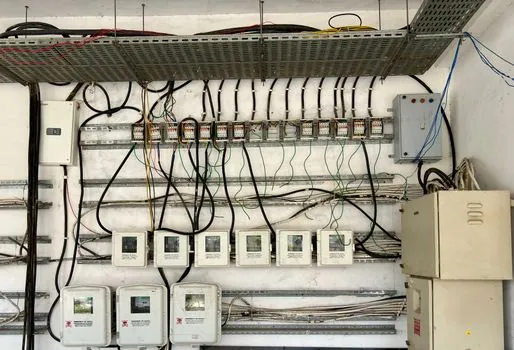
Earthing failure shows up in almost every Indian industrial electrical safety audit, and the fence is not exempt: panel enclosures, switchboard frames and cable-tray structures must be bonded to the earthing system, with conductors intact and free of corrosion along the entire run [S4].
Continuity must be tested at the panel level rather than relying on a visual sweep, and IS 3043 specifies 1 ohm or less for most industrial applications, so any test record older than 12 months is not a valid current status [S4]. For sites tying the fence itself to the equipotential bonding network, the same 1 ohm target and 12-month re-test cadence should be written into the inspection sheet, because a corroded fence-to-rod joint looks intact from 2 m and only fails when a ground fault energises the mesh [S4].
Comparison: Indoor MCC Room vs MV Switchyard Fence
Three decision criteria separate the two scopes: voltage class, access control, and arc-flash boundary. Indoor MCC rooms at 600 V or below typically need a 1.0-1.2 m lockable gate, NFPA 70E Category 1-2 PPE, and 36 inches of working clearance per OSHA 1910.303(g) [S5].
MV switchyards at 11 kV and above move to 2.4 m welded-mesh fencing with a 3 m clear zone, Class B or Class C insulating mats (up to 11 kV or 33 kV respectively per IS 15652), Category 3-4 PPE matched to the calculated incident energy, and an ERDA-validated type test on the dielectric matting rather than a self-certificate [S4]. Across both scopes, the fence must enforce a single authorised-access path, but the indoor case leans on signage and self-closing doors while the outdoor case leans on height, anti-climb mesh, and a documented equipotential bond to the earth grid [S3][S4][S5].
Common Failure Points That Invalidate the Certificate
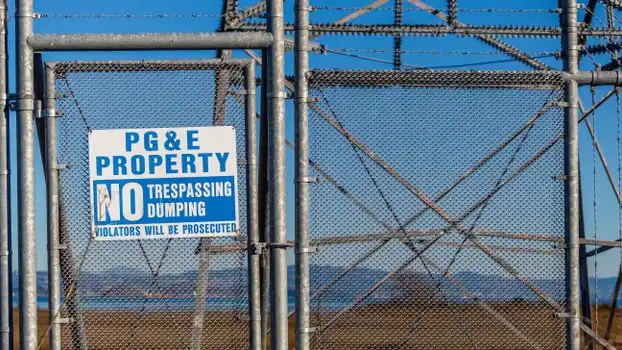
The most frequent audit failures in switchboard rooms are not on the fence but in the supporting evidence: an expired annual glove retest, a missing or illegible circuit directory in violation of 1910.303(f), an unlabelled disconnecting means, an earthing test older than 12 months, and a mat without a verifiable BIS licence number on the BIS portal [S4][S5].
For the fence itself, the recurring defects are a gate that does not self-latch, a missing "No Smoking" or "Authorised Personnel Only" sign, rubber mat coverage that does not span the full working width, and water leaks or HVAC failure inside the room that violate the electrical safety baseline [S2][S3]. Lockout/tagout procedures and emergency-procedure familiarity checks are the final two items a competent electrical safety check expects, and they are the easiest to pass on paper and the easiest to fail in practice [S1][S3].
Who This Checklist Is For, and Who It Is Not
This walkthrough is written for EHS officers, plant electrical engineers, and procurement teams issuing or auditing a safety-fence certificate for an indoor LV/MCC room or an MV switchyard in a cement, chemical, or discrete-manufacturing plant, and it assumes the fence is a regulated access control rather than a visual barrier [S2][S3][S4].
It is not a drop-in template for residential switchboards, data-centre white-space cages without energised panels behind them, or for temporary construction-site distribution boards where the controlling reference is the site-specific electrical safety plan rather than NFPA 70E and OSHA Subpart S [S1][S5]. Users needing fire-system-specific PPE validation should pair this checklist with our insulated tools certification walkthrough for fire protection service, and those planning detection around the same room will find the NFPA 72 heat detector checklist for electrical rooms the natural follow-up.
Verification Steps Before Sign-Off
Before signing a fence certificate, run a fixed sequence: confirm 36 in working clearance and dead-front integrity under OSHA 1910.303(g) and 1910.305(d), confirm arc-flash labels match stocked PPE per NFPA 70E, confirm earthing resistance under 1 ohm with a test date inside 12 months per IS 3043, and confirm BIS licence numbers for insulating mats on the BIS portal rather than on the supplier's own certificate [S4][S5].
For procurement teams sizing the fence itself rather than auditing an existing room, our safety fence buying guide for 2026 lays out the steel grade, mesh opening, and coating levers that should appear on the same RFQ, and it pairs cleanly with this checklist because the buying guide governs the hardware while this checklist governs the evidence stack. Trackable next signals to watch: a 2026 revision cycle of NFPA 70E arc-flash table values, and any BIS portal update that changes how Class C mat licences are surfaced for 33 kV procurement, both of which would force a re-issue of the fence certificate rather than a simple re-test [S4][S5].