
Selection starts with a documented hazard inventory, not with a brand. ANSI Z87.1-2020 (and the CSA Z94.3 equivalent used in Canadian upstream operations) is the floor, defining impact-rated spectacles, side-shielded goggles, and faceshields as three distinct device classes, each with its own marking code [S1].
Upstream and midstream sites layer three independent eye hazards on a single worker: impact from hand tools and dropped fittings at 45-120 m/s, chemical splash from hydrocarbons, acids, and caustics, and optical radiation during hot work, an envelope that no single lens can fully cover.
Hazard Envelope for Upstream and Midstream Sites
On a drilling rig, an open hole, and a gas plant, eye hazards split into four families. Mechanical impact from swinging tongs, dropped drill collars, and pressure-test fragments is the dominant cause of recordable injury; ANSI Z87.1+ (or "Z87+") markings denote devices tested with a 0.25 in (6.35 mm) steel ball at 150 ft/s, well above OSHA 29 CFR 1910.133 general industry requirements [S1][S2].
Chemical splash hazards sit in the splash band: hydrocarbons, H2S condensate, and caustics used in desalter service reach the eye in droplet form rather than vapor form, so a sealed indirect-vent goggle (vented to keep liquids out, vented indirectly to prevent fogging) is the right class, not a vented spectacle. For vapour or fine-mist exposure, a full-face respirator with an indirect-vent polycarbonate visor carries the load, and safety glasses on their own are not enough.
Dust and particulate from abrasive blasting of vessels, sandblasted piping, and milling of scale on turbine rotors is the third family. Here an indirect-vent goggle with a foam liner and ANSI Z87.1+ impact rating, or a sealed faceshield worn over Z87+ spectacles, is the typical specification. Optical radiation during welding, burning, and electrical switching (gas-metal arc welding on pipe racks, arc-flash events up to 40 cal/cm²) is the fourth family and requires a separate auto-darkening filter (ADF) shade 9-13 plate for arc work, plus a faceshield for hot work, layered on top of the Z87+ base [S1].
ANSI Z87.1 Marking Codes, Decoded
Every compliant product carries permanent markings, and reading the code is faster than reading the brochure. The Z87+ stamp means high-impact, the Z87 stamp means basic impact, and suffixes after the plus sign encode optional performance: "D3" for droplet and splash, "D4" for dust, "D5" for fine dust, "W" for welding, and "H" for headform (larger-head) coverage [S1].
Spectacles with side shields covering the temporal field are required by 29 CFR 1910.133 whenever flying-object risk exists; clip-on or integral side shields must be at least 1.5 mm thick polycarbonate. Lens base curve and temple geometry determine the coverage gap; a typical 9-base curve spectacle leaves a 14-18 mm temporal gap on broad faces, which a wrap or a goggle closes. Kite-marked Z87+ products from a recognised test lab (e.g. UL, Intertek) also carry a third-party trace code that procurement can audit back to the certificate.
Selection Criteria Across the Four Hazard Bands
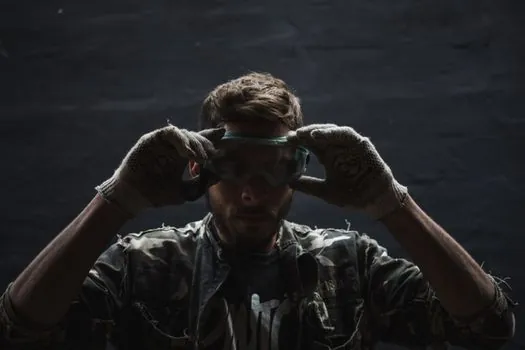
The four hazard bands above map onto four device classes, and procurement can run them as a simple matrix instead of guessing per worker. Impact-only tasks (rig floor, machine shop) take Z87+ spectacles with side shields, indirect-vent goggles are reserved for splash and dust, and welding and arc-flash work add a shade-rated filter or faceshield on top of the Z87+ base layer. [S1]
On the chemical-splash band, compare options on three criteria: droplet sealing (passes D3 in the marking), indirect-vent path (blocks liquid ingress but admits airflow, reducing fog-up at 25-35 °C ambient on a Texas Gulf platform), and chemical compatibility of the frame (nylon resists hydrocarbons better than PVC at 60 °C service). On the impact band, compare on Z87+ versus Z87+ with the headform "H" suffix (broader coverage for workers wearing hard hats with face-mounted arc shields), lens thickness (2.0 mm vs 2.4 mm polycarbonate), and anti-fog coating durability (EN 168 "N" marking, where the coating survives 30 s of steam exposure without fogging).
On the radiation band, compare on auto-darkening shade range (9-13 covers stick, MIG, and TIG; below 9 misses TIG low-amp), switching time (1/25,000 s for premium plates, 1/10,000 s for entry-level), and optical class (1/1/1/1 or 1/1/1/2, lower is sharper). On the comfort band, which drives compliance, compare on weight (22-35 g for spectacles, 90-120 g for goggles), field of view (a wrap 9-base gives ~120° horizontal, a flat 6-base gives ~95°), and the headband tension of indirect-vent goggles (0.4-0.6 N over-wear force is the typical ergonomic window).
Common Failure Modes in the Field
The failure modes are consistent across facilities, and most are procurement decisions, not worker decisions.
Lens pitting from hot particle impingement (grinding, chipping) degrades optical clarity well before impact resistance is lost, which is why 2.4 mm polycarbonate is the practical minimum on grinding tasks. Frame failure at the temple hinge is the second-largest cause of replacement; a metal-core hinge with a 1.5 mm pin is more durable than an all-polycarbonate temple. Compatibility between Z87+ spectacles and a half-mask respirator is a third failure mode, common on H2S sites: the respirator's nose cup pushes the spectacle bridge down and breaks the splash seal, and the fix is a spectacle with a recessed bridge and shorter temple or a goggle worn over the half mask.
Procurement Spec Language and Standard References
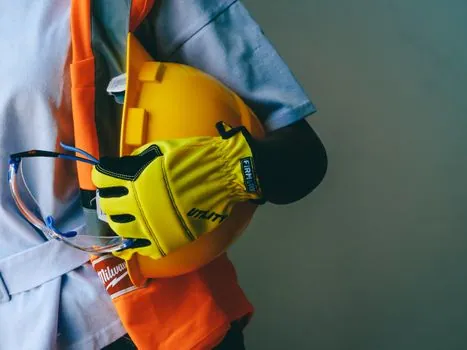
A clean procurement spec for an upstream or midstream site reads: "Z87+ high-impact spectacles with side shields, polycarbonate lens 2.0 mm minimum, anti-fog coated to EN 168 'N', indirect-vent for chemical splash, third-party certificate traceable to the lot." Add: "compatible with half-mask respirator per NIOSH 42 CFR Part 84," and "tested per ANSI Z87.1-2020 section 6.1" for impact and section 6.2 for droplet, where the requirements are explicit. [S2]
For gas/arc work, the spec extends: "Z87+ W (welding) or Z87+ H + faceshield, ADF shade 9-13, switching time ≤ 1/10,000 s, optical class ≤ 1/1/1/2, dielectric faceshield rated to NFPA 70E hazard category 2 (8-25 cal/cm²) for arc-flash work." This anchors each clause to a standard reference a procurement auditor can verify. Specifiers can cross-reference the broader fire safety frame, since arc-flash PPE selection sits inside a wider electrical-safety envelope, and lighting equipment and electric lamps governs the area-illumination class on which the eye-protection spec is layered.
Program-Level Signals Worth Tracking
Track three signals in the second half of 2026. First, the publication of the next ANSI Z87.1 maintenance revision, which historically has tightened anti-fog and lens pitting language; vendors that have already published EN 168 "N"-rated premium SKUs are positioned for the change. [S1]
For adjacent equipment, see the steel section selection map when eye-protection PPE is bundled into site-wide procurement, and the shaft coupling selection map for the rotating-equipment envelope that often co-occurs with grinding eye hazards. The next decision node is a written hazard inventory per task, signed by the area lead, and used as the input to a Z87+ device matrix per PPE category.