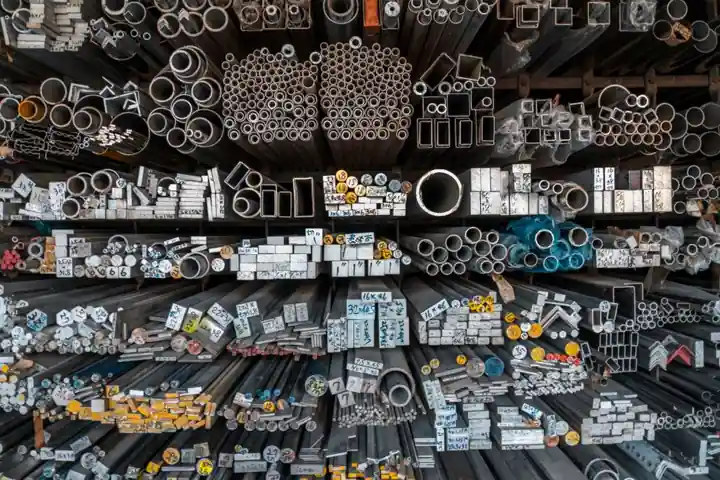
Warehouse column-and-rafter framing is dominated by hot-rolled I-sections (IPE, HEA, HEB) for primary members and cold-formed Z or C purlins for roof and wall cladding, with the section grade chosen to match corrosion exposure rather than load alone.
Standard EN 10025 S275JR and S355JR carbon-manganese grades cover most dry, painted warehouse envelopes; galvanized coating (EN ISO 1461) is the typical upgrade where humidity, salt, or chemical fume exposure is expected, and unpainted weathering grades such as EN 10025-5 S355J0W are reserved for open-sided or well-ventilated sheds where cyclic wet-dry exposure is acceptable.
Section Family vs. Member Role
IPE 200 to IPE 500 profiles are the most common warehouse rafter and column sections, with HEA 200 to HEA 400 used where lateral stiffness in two axes is required, especially in portal frames wider than 25 m. Cold-formed Z 150 to Z 300 purlins, typically 1.5–3.0 mm thick galvanized steel, span 5–8 m between rafters at 1.5–2.0 m centres, and standard steel section catalogues tabulate mass per metre (kg/m) and section modulus (cm³) for direct member sizing. [S1]
For mezzanine floors inside warehouses, UB 203×203×46 to UB 305×305×198 universal columns are routinely specified, with composite slab decks spanning 2.5–3.5 m between secondary beams. The same carbon steel base grade S275/S355 is used throughout; the section choice is structural, not metallurgical.
Corrosion Environment Drives the Grade Decision
Atmospheric corrosion category C2 (dry interior) needs no special coating beyond standard primer; C3 (urban/mild industrial interior, or cold-climate exterior) typically justifies hot-dip galvanizing to EN ISO 1461 with a coating mass of 70–85 µm; C4 and above (coastal, chemical, wash-bay interior) often push specifiers toward stainless fasteners and clip hardware rather than changing the primary section grade [S1].
Stainless garage-door hardware suppliers serving car-wash, wastewater, and DOT salt-storage buildings report that painted and galvanized components in those micro-environments can pit or fail within 12 months of exposure, while matched stainless (typically 304 or 316 austenitic) packages run 5–10× longer before first service call, which is directly relevant to warehouse wash bays, loading-dock brine zones, and any interior wall liner adjacent to a chemical store [S1].
Hot-Rolled vs Cold-Formed: Decision Rule
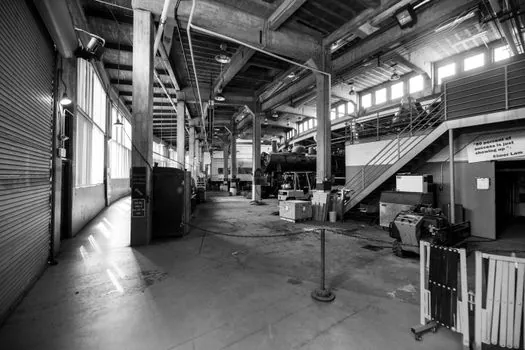
Use hot-rolled I/H sections (IPE, HEA, HEB) for primary rafters, columns, and portal frames where member depths exceed 200 mm and design relies on standard mill tolerances plus third-party CE/EN 10025 certification. Switch to cold-formed Z/C for purlins, girts, and cladding rails where member depth is 100–300 mm and the efficiency gain from cold-forming (higher yield-to-mass ratio in the thin-walled geometry) outweighs the lower mill tolerance on thickness and straightness.
Do not substitute cold-formed sections for primary portal-frame members under cyclic crane loading or heavy snow drift: the limiting slenderness ratios and connection detailing (end-plate, fin-plate) are validated for hot-rolled I/H profiles in the Eurocode 3 / EN 1993 envelope, not for cold-formed hollow sections of equivalent mass.
Connection Hardware and Clip Selection
Bolt grade 8.8 or 10.9 (EN 14399 high-strength structural bolting) is standard for end-plate moment connections in S355 frames, with preloaded assemblies (HR or HV category) required where slip is unacceptable under service load. Web-cleat and fin-plate shear connections typically use 4.6-grade bolts in 18–24 mm clearance holes, with bearing-type or pretensioned categories selected to match the design assumption in EN 1993-1-8. [S1]
For purlin-to-rafter connections, the move over the last decade has been from through-bolted cleats to self-drilling screw and boltless clip systems, which depend on the screw shear and pull-out capacity rather than bearing. In corrosive interiors (car wash, fertilizer store, salt dome) the clip and screw material must be upgraded independently of the rafter: standard zinc-plated clips fail in months under the same chemistry that destroys galvanized purlin coatings [S1].
When to Step Off Carbon Steel Entirely
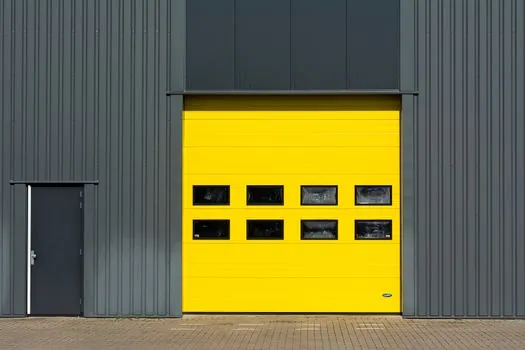
Warehouses that store chlorides, fertilizers, de-icing salts, or that house vehicle-wash operations should specify stainless steel clip hardware (typically 1.4401 / 316 grade) on otherwise standard S275JR/S355JR primary framing. The primary section stays carbon because the tonnage and section depth are set by structural load, not corrosion; only the exposed fasteners, sliding-door tracks, and door hardware carry the premium material. [S1]
For roof sheeting in coastal or aggressive chemical sites, coated coil to EN 10169 (e.g. PVDF or plastisol 200 µm) over a galvanized substrate out-performs bare galvanizing on a 15–25-year life-cycle basis, with stainless only used at cut edges, fasteners, and penetrations where the coating breaches. Avoid mixing galvanically dissimilar metals at any single connection: stainless-to-galvanized contact is acceptable when the stainless area is small relative to the galvanized area, but a stainless bolt through a galvanized clip in a wet chloride environment will still pit the clip at the contact zone over years of exposure.
Fire and Compliance Constraints
Unprotected S275JR and S355JR sections lose load-bearing capacity as steel temperature rises, with the EN 1993-1-2 fire-design curve tabulating retention factors (e.g. ~1.0 at 20°C, ~0.78 at 400°C, ~0.47 at 600°C for hot-rolled profiles). For warehouses storing Class 1–2 commodities with sprinkler protection, a 0 mm fire-protection intumescent coating is often acceptable; for higher commodity classes, board or spray systems sized to R30, R60, or R90 are normal. [S1]
No single international code fixes all warehouse fire cases: NFPA 13 commodity classification, FM Global DS 1-12 storage schedules, and EN 12845 sprinkler design all interact with the chosen section size. Specifiers should size the section for ambient-temperature design first, then check the fire curve and add intumescent only where the section modulus at elevated temperature drops below the required moment.
Limitations and Common Mis-specifications
Two failure modes repeat across warehouse stock: undersized purlins that deflect visibly under snow drift or solar gain, and column bases set on inadequate pad foundations where the base-plate grout cracks within the first year. Both are section-or-detail errors, not material errors; the right alloy steel grade would not fix them. [S1]
Conversely, a common over-specification is using weathering steel S355J0W in a closed, unventilated warehouse where the steel stays damp: weathering grades need wet-dry cycling to form their protective patina, and a constantly humid interior will leave them rusting like ordinary carbon steel with a higher upfront cost. For a related electrical-steel spec case where cyclic vs steady-state exposure also drives grade choice, see Silicon steel selection for rail traction motors.
Track the next decision points: confirm section depth against the rafter span-to-depth rule of thumb (span/20 to span/25 for portal rafters) and verify the corrosion category with the building's intended use, not just the regional atmospheric class. For a comparison-grade spec where the environment and the member role are reversed, see silicon steel selection for general fabrication.