
Safety eyewear is selected by hazard, not by frame style, and the three families that cover roughly 90% of industrial specification are safety spectacles, sealed/ventilated goggles, and face shields, with welding and laser variants layered on top of the same base [S5][S8].
All three are required to carry ANSI Z87.1 or Z87+ markings stamped on the lens or frame, and Princeton EHS treats that mark as the floor for any eye protection issued on campus [S7]. Readers can cross-reference the broader PPE and eye protection framework alongside the general machine and fire safety baseline when writing a job hazard analysis.
Spectacles: Z87 versus Z87+, side shields, and prescription
Spectacles look like normal glasses but must use impact-resistant lenses and metal or plastic safety frames, with side protection mandatory under Z87.1 [S7]. The Z87+ mark indicates the high-impact test, a 0.25 in steel ball dropped from 50 in, which is the spec to call out for grinding, chipping, and pneumatic-tool work [S4][S6].
Over-the-glass (OTG) models and Z87+ prescription carriers are the practical answer when a worker cannot wear contacts, and 3M frames the choice around temple flex, nose-bridge padding, and lens-coating options rather than around brand [S2]. A common spec-writing failure is ordering "safety glasses" without specifying Z87+ versus Z87, the D-rating for droplets or dust, or whether side shields are integral or removable [S4].
Goggles: direct, indirect, and non-ventilated seal classes
CCOHS splits goggles into three seal classes that map directly to hazard: direct-vented for impact-only dust, indirect-vented for liquid splash, and non-vented for vapors and fine particulates [S8]. Houweling adds a "Cyclops" single-lens variant that fully encloses the orbital area, used where side shields on spectacles cannot stop a lateral particle [S5].
Z87 droplet and dust markings (D3 droplets, D4 splashes and dust, D5 fine dust) are the shorthand specifiers, and an Rx-Safety comparison places D2 through D5 as the ratings that matter for any process generating airborne particulate [S6]. For chemical handling, indirect-vented goggles with an ANSI D3 or D4 marking are the minimum; non-vented goggles are required whenever organic vapors are present.
Welding shades: shade numbers, IR, and lens materials
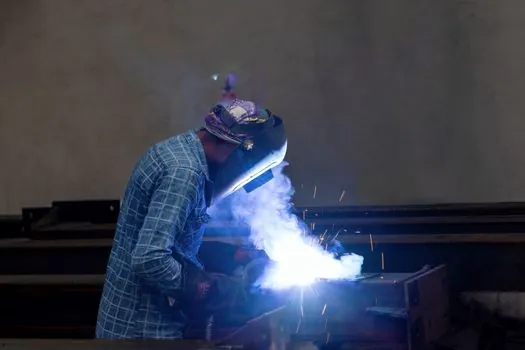
Welding lenses are graded by shade number (typically shade 3 for torch brazing up to shade 13 or 14 for arc welding) and by infrared protection, with the "R" marking added when the lens filters IR [S4]. Phillips-Safety catalogs separate families: athermal glass for hot-work visibility, cobalt blue for gas welding, gold and super-magenta for specific spectral lines, and polycarbonate or glass for the lens substrate [S3].
Auto-darkening filters (ADF) sit in the same spec line but switch shade electronically in 1/10,000 s; the spec-relevant point is the cover-plate size, the grind-mode shade (usually shade 3 or 4), and the UV/IR blocking at the clear state. For incidental spark and slag work, a shade 5 polycarbonate spectacle with Z87+ marking is commonly paired with a flip-up IR filter rather than a full welding helmet.
Laser and radiation eyewear: optical density and wavelength
Laser glasses are selected by wavelength (nm) and required optical density (OD) at that wavelength, with substrate choices including polycarbonate, glass, and thin-film-coated glass for high-power pulsed lasers [S3]. Phillips-Safety's catalog splits the field into polycarbonate, glass, laminated glass, and IPL variants, plus combined laser/radiation glasses for medical and dental suites [S3].
The common spec error is ordering "laser glasses" without locking the OD at each wavelength band; a pair rated OD 6 at 1064 nm is not necessarily OD 5 at 532 nm. For Nd:YAG and fiber lasers, the eyewear must cover both the 1064 nm fundamental and the 532 nm second harmonic if frequency-doubled light is accessible.
Lens tints, coatings, and indoor/outdoor selection
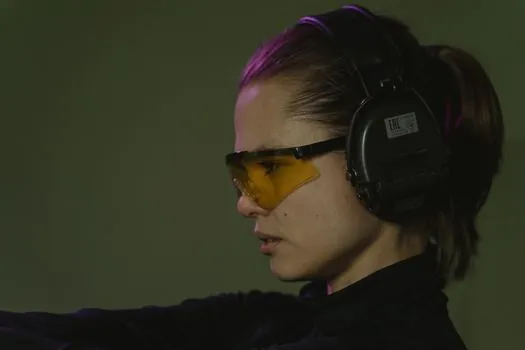
3M organizes lens options by visual task: clear for highest acuity and color recognition, gray for outdoor sun, plus photochromic and polarized variants for variable light [S2]. Anti-fog and anti-scratch coatings (for example, 3M Scotchgard) are spec-line items that change the price tier by roughly 20 to 40% but are non-negotiable in humid process areas.
For indoor electrical and mechanical rooms, clear Z87+ lenses with anti-fog coating are the default; amber or indoor/outdoor lenses are used in low-light inspection tasks where blue-light hazard is a concern. Outdoor construction and transportation work moves to gray or mirror-coated lenses, with side-shield integrity still governed by the same Z87.1 mark [S7].
Selection criteria and comparison
Use the matrix below to lock the spec before issuing a PO, since the most common spec failures are ordering by frame style instead of by hazard class. [S1]
Safety spectacles: Z87 base impact, optional Z87+ high-impact, D3/D4 marking for droplets or dust, side shields mandatory, lowest cost and best wearer compliance for general fabrication [S4][S6][S7]. Goggles: Z87+ impact, D4 splash or D5 fine-dust marking, indirect or non-vented seal, required for chemical handling and dust-heavy processes, lower compliance due to fogging [S5][S8]. Face shields: worn over Z87 spectacles or goggles, not a standalone protector, used for grinding sparks and chemical pour operations [S8]. Welding shades: Z87+ plus shade number 3 to 14 plus R for IR, lens material selected by process (athermal, cobalt, gold), paired with a hard hat and respirator for hot work [S3][S4].
Limits, failure modes, and what the standard does not cover

ANSI Z87.1 addresses impact, droplet, dust, and optical-radiation hazards but does not certify chemical permeation of the frame or lens coating, which is why chemical handling defaults to indirect-vented goggles plus a face shield [S8]. Z87+ only validates the high-impact drop test; it does not validate the lens against continuous abrasive exposure, and scratched lenses lose their impact rating in practice even when the mark is still legible [S6].
Welding and laser eyewear fail most often when the OD or shade number is right for one wavelength or process but wrong for the next; a maintenance shop running both TIG and CO2 laser, for example, needs two pairs or a dual-rated pair, not a single shade-5 lens. Face shields alone are never acceptable per OSHA and CCOHS guidance because they leave the temples and forehead exposed to lateral impact [S8].
Standards and sourcing
ANSI/ISEA Z87.1-2020 is the governing US standard for occupational eye and face protection, with the Z87+ mark indicating the high-impact test and D2 through D5 covering droplet and dust hazards [S4][S6][S7]. CCOHS mirrors the same hierarchy and explicitly classifies goggles by ventilation style, which is the practical analog to the D-codes [S8]. European and global sites often cross to EN 166 mechanical robustness codes, but the ANSI mark remains the procurement shorthand in most US distributor catalogs.
For procurement teams building a hazard-based spec, the decision tree is straightforward: identify the dominant hazard (impact, splash, dust, IR, UV, laser), pick the device class (spectacle, goggle, shield), then lock the markings (Z87 or Z87+, D3/D4/D5, shade number, OD at wavelength). The two trackable signals to watch through the rest of 2026 are any CCOHS or OSHA enforcement letters citing non-vented goggles in vapor service, and distributor stocking shifts toward Z87+ anti-fog SKUs as humidity-controlled process areas expand.
For adjacent PPE and worker-safety specification work, see the eye wash station availability rules and the safety relay cost map for the broader plant-safety procurement picture.
For component-level specifications, see construction machinery and equipment.