A single-function E-stop safety relay lists at roughly $80 to $400 USD per unit, while a multi-function or light-curtain safety relay commonly lands between $200 and $700 USD, and a safety PLC system starts around $1,500 to $6,000 USD once you move beyond discrete relay logic [S1].
Total cost of ownership, not catalog sticker, is what hits the budget: the cheapest quote on a 500-unit lot at $2.80 per relay added $180 in expedited freight, $160 in incoming-inspection labor, and a multi-thousand-dollar line stoppage when failure rates spiked [S6]. For buyers building a safety relay spec map in 2026, the right comparison axis is cost per safety function over a 10-year service window, not unit price alone.
What Actually Drives the Safety Relay Price Tag
Four cost drivers move the number more than anything else: safety integrity level (SIL/PL), number of safe outputs and channels, communication protocol on board, and certifications beyond the baseline IEC 61508 / ISO 13849-1 pair [S4]. A SIL 3 / PLe dual-channel E-stop with a 24 VDC coil and two normally-open + one normally-closed output sits at the bottom of the curve; adding a release-delay timer, OSSD-input support for a light curtain, or speed/frequency monitoring pushes the catalog number up several tiers.
Configuration depth matters because multi-function modules are essentially three or four single-function relays in one housing. AutomationDirect's catalog separates the categories cleanly: 1-channel E-stop and safety-gate units are entry-level, 2-channel redundant units add diagnostics, time-delay and two-hand-control variants command a premium, and OSSD/light-curtain, safety-mat, speed-monitoring, and frequency-monitoring variants each carry feature-specific pricing [S2]. A time-delay E-stop / safety-gate module lists starting at $274.00 in this catalog (UG6961-02PS100-300), which is roughly the midpoint of the multi-function range [S2].
New vs Refurbished vs Repair: the 20-30% Spread
New safety relays are the only choice when the panel is brand-new or when the bill of materials must trace to a single lot date code, but for MRO spares the refurbishment and repair channels cut cost meaningfully. GES's safety-relay replacement-parts page lists new/surplus units at $254, refurbished at $178, and a $329 repair option with a $182 flat-rate repair tier alongside, putting refurb-and-repair roughly 20 to 30% below new [S5]. Lead time is the hidden trade: refurb stock ships in days, repair returns in one to three weeks, and new OEM stock depends on the supply chain.
ABB's Sentry SSR10 is a representative mid-range safety relay in the Jokab line, sold through the gray-market and integrator channels rather than direct e-commerce, so its street price varies with integrator markup [S3]. A buyer who chases the lowest unit quote without checking the channel's warranty, traceability, and date code will pay for it later: the cheapest lot in the field-cost case study cost $2.80 per unit yet generated $4,200 in incident cost once failure rates, inspection hours, and line stoppage were totalled [S6].
Safety Relay vs Safety PLC: the Real Crossover Point
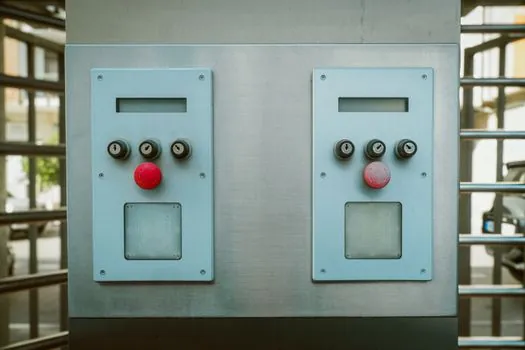
The cost crossover between a discrete safety relay and a safety PLC lands somewhere between $1,400 and $6,000 USD in capital terms, well before the I/O count reaches 32 or 64 points [S1]. A safety relay's per-function cost drops fast because one dual-channel relay replaces what would otherwise be three or four standard relays plus a contactor, but it does not scale linearly: each new safety function (E-stop, gate, light curtain, mat, two-hand) needs its own module or a more expensive multi-function device. A safety PLC charges more upfront but spreads that cost across many safety functions, distributed I/O, and non-safety standard I/O on the same backplane.
Decision matrix for buyers at the 2026 price points: if the machine has one to three safety functions and a 7–10 year service life, a discrete safety relay or two is the lower TCO option. At four to eight safety functions, multi-function safety relays and a small safety controller split the difference. Above eight functions, or where the standard control and safety logic must share data, a safety PLC becomes the cheaper path per safety function even at $1,500 to $6,000 USD for the CPU alone [S1]. For a different cost-driver example in the piping world, see the pipe fitting TCO 2026 trade map, which uses the same per-function and lifecycle framing on a different product family.
Cost vs Application: Matching Spend to Risk Class
Application class is the strongest single predictor of whether a $100 relay or a $600 relay is the right call. A single E-stop on a packaging conveyor at PL c / SIL 1 is the textbook $80 to $400 USD case [S1]. A dual-channel E-stop plus a safety gate with cross-fault detection on a press or robot cell at PL e / SIL 3 typically needs a $250 to $500 USD multi-function module plus the input device, with the relay as roughly 30 to 40% of the function's total installed cost.
Light-curtain and safety-mat applications add an OSSD-input safety relay on top of the sensor cost, and the relay is again a minority of the system price: the safety relay for a type-4 light curtain typically runs $200 to $450 USD. Two-hand-control, speed-monitoring, and frequency-monitoring relays sit in the $350 to $700 USD range because the relay carries more of the safety logic [S2]. Buyer note: pick the category before the brand, since the catalog spread within a category is wider than the spread between comparable units from Pilz, Sick, ABB Jokab, Schmersal, Banner, IDEC, Eaton, and AutomationDirect.
Hidden Costs and Failure-Mode Traps

Three costs don't show on the catalog page. First, the engineering time to wire, configure, and validate each safety function, often 4 to 16 hours per function on a non-trivial machine; the field-cost case put 4 hours of inspection labor at $160 for a 500-unit lot, a $0.32 per-unit overhead that doubled when failures appeared [S6]. Second, the documentation burden: a SIL/PL calculation, a validation report, and a bill of materials traceable to the safety function are non-negotiable for the warranty to hold.
Third, channel count creep: a 1-channel E-stop relay bought for $80 is the wrong module the moment a second safety device lands on the same panel, forcing a redesign to a 2-channel unit at $200+ USD. The risk class also constrains what you can buy: SIL 3 / PLe applications often require a certified device with a TÜV or equivalent mark, and the certified variants sit at the top of each category's price band regardless of brand. For buyers cross-shopping with adjacent electrical gear, the warning tape spec map for electrical work covers another low-line-item, high-failure-cost product where field installation cost dwarfs unit cost.
Standards, Sourcing Signals, and Trackable Inputs
Baseline safety-relay design is governed by IEC 61508 (functional safety of E/E/PE systems) and ISO 13849-1 (safety-related parts of control systems), with EN 60204-1 covering electrical equipment of machines and EN ISO 13850 on E-stop devices; the SIL/PL rating on the device data sheet is what ties the catalog price to the risk class for a given machine [S4]. Multi-function and OSSD-input relays add IEC 61496-1/-2 (light curtains) and IEC 61511 (process industry) into the mix, and the spec sheet should show conformity rather than a generic 'compliant' claim.
Two trackable signals for the next buying window: (1) the spread between new OEM and authorized-distributor stock, which widens when legacy part numbers (Allen-Bradley 440R, Pilz PNOZ, Sick FX3, Omron G9SA) hit allocation; (2) the refurb/repair lead-time differential at GES and similar shops, which compressed during 2024-2025 allocation and is the leading indicator of new-unit price pressure [S5]. For a different angle on industrial sourcing under allocation pressure, the industry digest for 2026-09-13 compiles parallel volume and pricing signals across multiple product families.
Spec-level background on the components involved: linear guide.