
OSHA classifies a face shield as secondary impact protection, not primary eye protection, so Z87+ rated safety glasses or goggles must be worn underneath it on virtually every industrial task [S3][S5].
The face shield's wraparound coverage of crown, chin and ears blocks splashes, sparks and large debris, but the open bottom and side gaps routinely let deflected particles travel up under the visor, which is why primary eye protection is non-negotiable under the shield [S2][S3].
Why a Face Shield Alone Fails ANSI Z87+ Impact
A face shield's lens and headgear are tested as a secondary protector, meaning the assembly assumes a compliant spectacle or goggle is already sealing the eyes [S3]. ANSI Z87+ testing requires the lens to resist a 0.25 in steel ball at 150 fps for high-impact rating, and that performance is not certified when the shield is worn without primary eyewear because the open geometry of the headgear lets projectiles enter from below [S3][S5].
Wesley's guidance, mirrored by WSU's EHS factsheet, treats the shield as a wraparound splash and spark barrier only, and explicitly warns that manufacturers do not design face shields to replace protective eyewear [S3][S5]. In grinding, deburring, furnace work, torch cutting and chemical handling, the entry path for deflected chips and aerosols is the bottom and temple gaps, which is exactly what sealed spectacles or goggles are rated to block [S3].
Safety Glasses, Goggles, or Both Under the Shield
For dust, flying chips and impact work, Z87+ spectacles with side shields or a wraparound lens are the minimum primary protection and are the typical pairing for a face shield on grinding, drilling and chipping stations [S5]. For chemical splash, biological splash or fine mist, indirectly-vented or non-vented goggles that form a liquid-proof seal around the eyes are required, and these can legally substitute for the shield in some OSHA-recognised splash tasks, but never for impact work [S3][S2].
The CDC/NIOSH infection-control guidance published 2025-04-23 ranks well-fitted, indirectly-vented goggles with anti-fog coating as the best choice for splash protection, while face shields are listed as an alternative that also covers the rest of the face, with both typically worn together for full coverage [S2]. MSA's updated guidance, cited in UL's 2026-09-21 release, continues to recommend Z87+ impact eye protection always be worn under face shields, reinforcing the dual-layer standard [S1].
OSHA Standards and the Primary vs Secondary Rule

OSHA 1910.133 for general industry, 1926.102 for construction, and 1915.153 for shipyard employment are the three PPE standards that govern eye and face protection selection in the US, and all three treat the face shield as secondary impact protection [S3]. UL Solutions' 2026-09-21 update on OSHA eye and face protection rule changes confirms that the regulator's hierarchy of protection has not shifted, and MSA's recommendation to keep Z87+ eyewear under every face shield is unchanged [S1].
Wesley's article notes that OSHA does allow indirect-vent goggles alone for chemical splash hazards without a face shield, which is the one documented exception to the stacking rule, but impact work has no such waiver and always requires spectacles or goggles beneath the shield [S3]. For welding, the face shield is replaced by a filtered-lens helmet (typically shade 9-13 for arc welding) and that helmet again counts as secondary, so Z87+ safety glasses are still worn underneath to handle the grind-chip risk during slag chipping [S5].
Comparison of Primary Protectors Worn Under a Face Shield
Spectacles (Z87+), indirect-vent goggles, and direct-vent goggles behave very differently when stacked under a shield, and the right pick depends on the dominant hazard. Impact-only tasks favour spectacles for low weight and anti-fog clarity, while chemical, biological and dust tasks favour indirect-vent goggles for the perimeter seal, even though they trap more heat and fog faster under a shield [S2][S5].
Anti-fog coated spectacles are widely recommended as the baseline pairing because they fit inside most crown-and-chin shields without bridging the seal against the brow, whereas goggles can interfere with the shield's foam headband and create a pressure point during long shifts [S2][S5]. Ergodyne's 2026-09-07 product guidance explicitly markets its Skullerz face shield as designed to pair with Skullerz safety glasses, confirming that the manufacturer's intended stacking is a Z87+ spectacle under a Z87+ shield [S4].
Selection Criteria and Real Use Cases
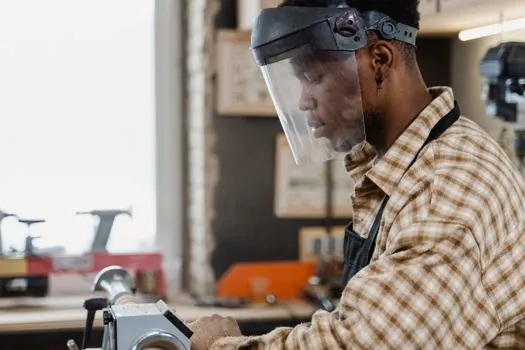
For grinding, abrasive-wheel work, power-tool fastening and machining, the right stack is wraparound Z87+ spectacles with side coverage under a polycarbonate face shield, because the dominant failure mode is a deflected chip entering from the temple or chin gap [S3][S5]. For chemical drum transfer, sodium-hydroxide dispensing and laboratory pour stations, the right stack is indirect-vent chemical goggles under a chin-length face shield, because the seal around the eyes is the only barrier that holds against a splash travelling upward under the visor [S3][S2].
For healthcare and infection control, NIOSH and CDC recommend either indirectly-vented goggles or a face shield that wraps to the ears, with both often worn together where prolonged splash exposure is expected, and with face shields explicitly noted not to seal as tightly around the eyes as goggles [S2]. For welding, the stack changes to a filtered auto-darkening helmet at the correct shade number, with Z87+ safety glasses still required underneath for chipping and grinding, since the helmet flips up and exposes the eyes during slag removal [S5].
Limitations, Fogging, and Common Failure Modes
Fogging is the most common failure mode for stacked eye and face protection, and it is the main reason ANSI Z87+ spectacles with anti-fog lens treatment are the default pairing rather than goggles, which trap exhaled air and humidify the space between the goggle and shield [S2][S5]. An eyewear retainer strap is the standard fix to stop spectacles from sliding down the nose under the weight of a chin-length shield, because a shifted primary lens is as much of a failure as no lens at all [S5].
Scratched, pitted or ill-fitting primary eyewear must be replaced with identical OEM parts, because a Z87+ stamp is only valid when the frame, lens and side shields are the as-tested assembly, not a field-mixed combination [S5]. The cost of getting this wrong is steep: WSU's factsheet cites over $300 million per year in lost production time, medical expenses, and worker compensation from preventable work-related eye injuries, a figure that has been the baseline reference for US PPE programmes for years [S5].
Track two signals through the rest of 2026: any update to the Z87.1-2020 revision cycle that changes the primary/secondary stacking language, and any UL or NIOSH guidance following UL's 2026-09-21 OSHA-rule update that re-ranks indirect-vent goggles versus face shields for chemical splash [S1].
The underlying component specifications are covered under shield machine.
Background reading: Anchor Rod Projection Above Concrete for Leveling Nuts and Grout.