
A safety helmet is head-impact-and-penetration protection governed by EN 397, EN 14052 (high-performance industrial), or ANSI/ISEA Z89.1-2014 in the US, with electrical insulation classes 0 (440 V) through E (20 kV) and optional LD/MM/-30 °C/-40 °C marking for lateral deformation, molten-metal splash, low-temperature performance [S1]. A respirator is inhalation protection governed by EN 149:2001 + A1 (FFP1/FFP2/FFP3 filtering facepiece) or NIOSH-42 CFR Part 84 (N95/N99/N100, R/P-series), with elastomeric half-mask / full-face versions added under EN 136 (full face) [S1].
They protect different body systems against different hazards. A helmet without chinstrap and a particulate filtering facepiece coexist in many light-industrial tasks; in contrast, abrasive blasting, painting, or welding fume work usually calls for either a tight-fitting full-face respirator plus a separate helmet, or a combined helmet-respirator assembly such as the EKASTU 6500/Basic platform [S1]. Chinese suppliers such as ZK-BEST list dedicated safety-mask respirator, respirator-filter, and safety-helmet product lines as separate catalogs rather than a single SKU family [S2].
What each PPE class actually does
A safety helmet absorbs and redistributes the kinetic energy of a falling or swinging object across the shell and harness, and resists penetration by a pointed striker; the EN 397 spec calls out a 5 kg striker dropped from 1 m onto the shell, plus a 3 kg pointed striker at 250 mm drop for penetration, while the US Z89.1-2014 adds Class C (conductive, no electrical rating), Class G (2200 V), and Class E (20,000 V) electrical insulation tiers (2025-08). Helmet shells are typically HDPE, ABS, or PC, and harness webbing is polyester or nylon; side impact and chinstrap retention are separate add-on criteria under EN 14052 and EN 12492, not EN 397. Helmets do not filter air. [S1]
A respirator filters particulates, gases, vapors, or a combination from inhaled air, classified by the hazard and the APF (assigned protection factor) assigned by OSHA 29 CFR 1910.134. Tight-fitting APFs run from 5 (half-mask, negative-pressure) to 1000 (full-face, positive-pressure) when fit-tested; supplied-air SAR/SCBA and PAPR units sit above that ceiling. The filter itself carries the standard marking: FFP2 (EN 149:2001 + A1) targets ≥94 % of a NaCl + paraffin oil aerosol, FFP3 ≥99 %, N95 ≥95 %, N100 ≥99.97 % at 85 L/min [S1].
Selection criteria: hazard first, comfort second
Specifying PPE starts from the hazard inventory, not the brand catalog. Falling-object risk, fixed-object impact, electrical exposure, and molten-metal splash are helmet criteria; dust, mist, fume, gas, vapor, and oxygen deficiency are respirator criteria. Welding, for example, can demand both: Z89.1-class impact, an auto-darkening filter (EN 379), and an FFP2/FFP3 or supplied-air respirator for fume [S3]. The right rule is: a helmet never replaces a respirator, and a respirator never replaces a helmet, regardless of how complete each feels in isolation.
Fit and seal drive respirator effectiveness more than filter grade. A passing quantitative fit test (QNFT, OSHA-accepted methods including generated aerosol, ambient aerosol, or controlled negative pressure) is mandatory for tight-fitting facepieces; facial hair in the seal zone breaks the seal and is not permissible for tight-fitting negative-pressure respirators under 29 CFR 1910.134(g)(1). Helmet fit is independent — a chinstrap or wheel ratchet on a 52–62 cm headband is what holds the shell in place when the wearer looks up or slips. Comfort pads, vented shells, and accessory slots (30 mm or dual slots for ear muffs / visors) are helmet-side decisions.
Combined helmet-with-respirator assemblies

Combined assemblies integrate a head-impact shell with a face seal, visor, and either a cartridge-pair respirator or a supplied-air hose. The EKASTU 6500/Basic is offered as a helmet with respirator configuration in this combined class [S1]. On the supply side, ZK-BEST lists safety helmet, safety mask respirator, and respirator filter as three distinct product lines rather than a single integrated SKU [S2]. Welding helmet respirator SKUs on industrial marketplaces such as Alibaba cluster around an auto-darkening ADF filter combined with a replaceable particulate cartridge, sold as one face shield rather than two stacked facepieces [S3].
The engineering trade-off is straightforward: integrated assemblies lock fit and hose routing to the helmet, which removes fit-test variables, but they are heavier on the head (commonly 1.0–1.6 kg for a basic hard hat with cartridge pair and visor, vs ≈350 g for a hard hat alone) and harder to decontaminate. Separate helmet + respirator, on the other hand, allows independent replacement, individual fit-test records, and the use of a supplied-air hood when the contaminant requires a higher APF than tight-fitting facepieces can deliver.
Comparison: separate vs combined
Specifiers weighing separate helmet and respirator against a combined assembly line up against four decision criteria. (1) Hazard coverage: combined units cover impact + particulates in one seal zone; supplied-air hoods needed for IDLH or carcinogen vapor work usually require a separate helmet anyway. (2) Fit-test load: combined units reduce the number of fit-test interfaces (often one), while two separate tight-fitting facepieces must each pass a QNFT. (3) Maintenance: separate components can be decontaminated and replaced independently; combined assemblies are commonly wipe-down only, with filter life tied to the head harness. (4) Weight and fatigue: combined units add 600–1200 g of cartridge, hose, and visor mass to the head and neck — a real variable on a 10-hour shift, and a factor that tends to push users toward loose-fitting PAPR hoods when the hazard allows it. [S2]
Who the combined unit is for — and who it is not for
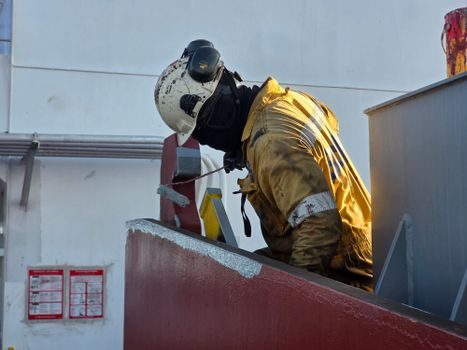
Combined helmet-respirator assemblies fit abrasive blasting, grinding with heavy dust load, paint spraying, and some welding tasks where a tight-fitting face seal is acceptable and the operator is clean-shaven in the seal zone. They are not appropriate for IDLH atmospheres (oxygen below 19.5 % or unknown contaminant concentration), where NIOSH requires a pressure-demand or continuous-flow respirator with a minimum APF of 1000, usually a SAR or SCBA; they are also not appropriate for any task where the wearer has facial hair in the seal zone, since the respirator half of the unit fails fit-test the same as a standalone tight facepiece. A separate helmet plus a safety barrier approach — full supplied-air hood plus a stand-alone hard hat — is the common pattern for IDLH or unknown atmospheres. [S3]
Cost frame for 2026 sourcing: half-mask elastomeric respirators with P100 or P3 cartridges are typically under USD 60 for the facepiece, with cartridge pairs USD 8–18; a basic EN 397 hard hat runs USD 6–25; an EN 14052 high-performance industrial helmet runs USD 40–110; combined helmet-respirator assemblies are commonly USD 150–500 depending on visor, ADF, and supplied-air versus cartridge [S2]. The cheapest spec that still passes the hazard inventory is the right answer — not the most expensive unit that fits the line item.
Standards and certification pointers
Helmet-side standards to anchor a spec: EN 397 (industrial safety helmets, baseline), EN 14052 (high-performance industrial, 4 kJ lateral), EN 12492 (mountaineering, includes chinstrap retention ≥50 kg), ANSI/ISEA Z89.1-2014 (US), and CSA Z94.1 (Canada). Respirator-side standards: EN 149:2001 + A1 (FFP1/2/3), EN 143 (P-series particle filters), EN 136 (full face), EN 137 (SCBA), NIOSH-42 CFR Part 84 (US N/R/P series), and the OSHA fit-test and medical-evaluation rules under 29 CFR 1910.134. Eye/face and hearing PPE that often pair with either unit sit under EN 166 (eye/face), ANSI Z87.1, and EN 352 / ANSI S3.19 for hearing, and can be browsed via the safety glasses and safety gloves reference pages when the full PPE kit is being assembled. [S1]
Two trackable signals for the next procurement cycle: the EU PPE Regulation (EU) 2016/425 has been in full effect across the member states since 21 April 2018, with UKCA routes post-Brexit, so any helmet or respirator sold into the EU/UK has to clear those certification tracks before it reaches the warehouse. On the supply side, Chinese export SKUs from ZK-BEST and similar platforms continue to bundle the safety helmet, safety mask respirator, and respirator filter into three separate product lines rather than a single combined SKU family [S2], and combined helmet-respirator listings on global marketplaces continue to be framed around welding-class visors with replaceable particulate cartridges rather than full supplied-air systems [S3].
For related coverage, see Arc Welder vs TIG Welder: 2026 Spec Cut for Fabricators and Buyers.