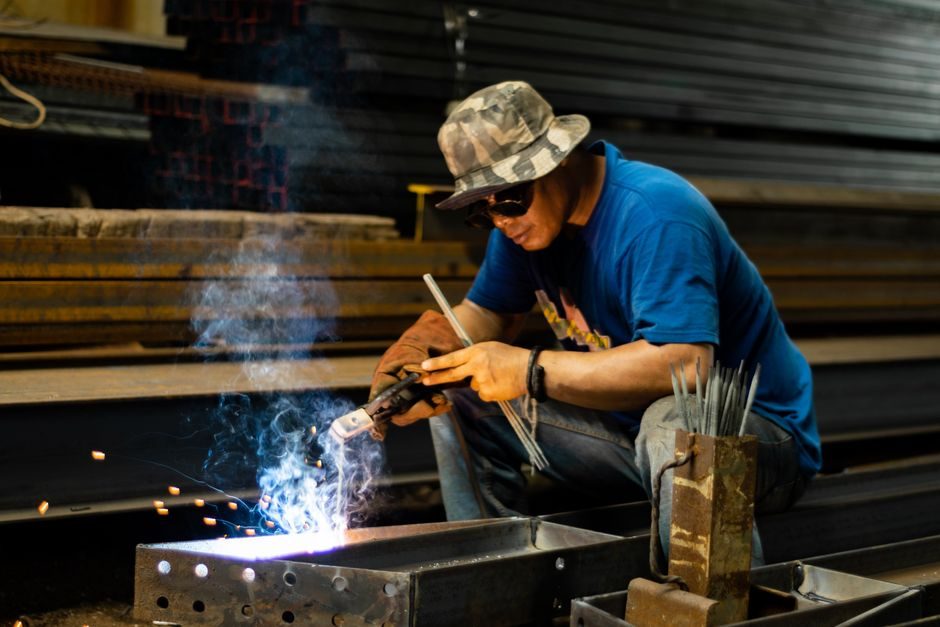
Arc (stick/MMA) welders and TIG welders are both constant-current arc power sources, yet they target very different jobs: MMA burns a flux-coated consumable stick in open air, while TIG feeds a separate filler rod under inert argon shielding with a non-consumable tungsten electrode.
On a 2026 procurement desk the practical gap shows up in four numbers: weld thickness range, current range, weight, and unit price. A typical MMA inverter in the 200 A class is listed at roughly US$98 per piece with 1.6–3.2 mm rod capacity, 9.5 kg class chassis, and 110/220 V dual-voltage input. A comparable dual-process TIG/MMA inverter such as the TIG-200S ships at 10–200 A current range, 1.6–3.2 mm rod diameter, 9.5 kg weight, and 371×153×300 mm footprint [S6].
Process Definition and Where Each One Belongs
Arc welding in the narrow procurement sense refers to shielded metal arc welding (SMAW, "stick" or MMA): a flux-coated electrode is the consumable, the flux decomposes to shield the weld pool, and no external gas cylinder is needed. The arc welding machine category in Chinese OEM catalogues is dominated by inverter-type MMA units, including compact single-phase 110/220 V IGBT models in the 200 A class and heavy-duty stud-welding CNC benches [S1][S4].
Modern TIG welder units are typically inverter-based and dual-process — TIG plus MMA — so one power source covers both clean-shop and field-repair duty [S6].
Spec Comparison: Arc vs TIG on the Same Shop Floor
Side by side, the two processes diverge on shielding, current waveform control, and achievable bead cosmetics. TIG holds the cleaner-puddle crown because the argon envelope excludes oxygen and nitrogen; MMA tolerates dirt, rust, and outdoor wind that would wreck a TIG bead. The 200 A-class IGBT MMA inverter in [S7] advertises 1.6–3.2 mm rod capacity, while the TIG-200S dual-process unit [S6] overlaps that rod range but adds a 10–200 A TIG range with foot-pedal or torch-slide current control, which is the lever that makes TIG usable on 0.5–3 mm stainless and aluminium sheet.
A useful comparison table for specifiers (data drawn from [S6]):
Criterion 1 — Shielding gas: MMA = none (flux-generated); TIG = argon (99.99%) external. Criterion 2 — Current range at 200 A class: MMA rod 1.6–3.2 mm; TIG 10–200 A with HF/Lift-arc start. Criterion 3 — Weight and footprint: MMA inverter ≈ 9.5 kg, compact; TIG/MMA inverter ≈ 9.5 kg at 371×153×300 mm, similar envelope. Criterion 4 — Typical FOB Shenzhen price: MMA Arc200 ≈ US$98/pc MOQ 1; TIG-200S negotiated MOQ 10 pcs, capacity 200 pcs/day from a Guangdong maker [S6].
For a buyer comparing arc welder line items, the cheapest 200 A IGBT MMA inverter on Made-in-China sits under US$100 per piece, whereas a dual-process TIG/MMA inverter of the same current class ships at higher per-unit cost with a 10-piece MOQ [S6].
Use Cases: Field Repair vs Clean-Shop Precision
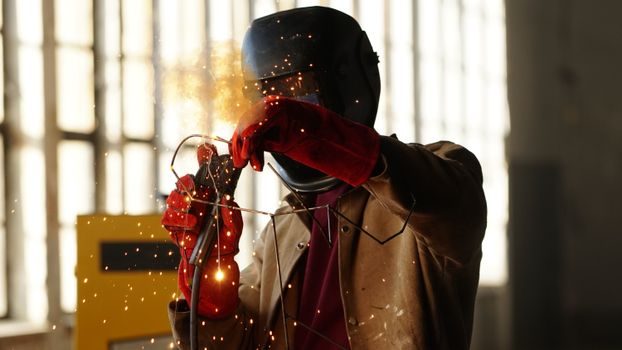
MMA remains the default for site erection, pipeline tie-ins, ship repair, and agricultural-steel fabrication because the flux coat tolerates mill scale, paint residue, and light rust, and the equipment is gas-cylinder free. The CNC stud-welding bench from [S1] shows the MMA-derived family extending into automated fastener welding at 3–8 mm thickness on 500×300 mm work envelopes, with 50 Hz output and pneumatic clamping.
TIG is the chosen process for stainless-steel food-grade piping, aluminium bicycle and automotive frames, aerospace thin-wall tubing, and any joint where post-weld grinding has to be minimised. Megmeet's process overview states that gas-shielded arc processes (TIG/MIG/MAG) "stand out as the most versatile and widely used techniques across industries — from aerospace and automotive to DIY home repairs". For a 2026 fabricator, that translates to: specify MMA for steel structural work, TIG for stainless, aluminium, and cosmetic-critical joints.
Limitations and Failure Modes
MMA produces slag inclusions if the rod is not deslagged between passes, and spatter is high compared with TIG; the resulting bead typically needs grinding or pickling before painting or food-grade service. The arc welding industry is also being pushed toward high-efficiency, energy-saving inverter designs precisely because conventional MMA transformer sets are heavy and lossy [S3].
TIG is unforgiving of contamination: a fingertip touch on the tungsten or filler rod, a draft from an open door, or an argon flow below roughly 8–10 L/min will turn the bead grey and porous. Operator skill is the binding constraint — TIG travel speed, torch angle, and filler dab rhythm are not parameters an inverter can fix for you. For buyers evaluating CNC and downstream machine-tool integration, the broader 2026 capital-equipment backdrop is mapped in CNC and machine tool market 2026: size, forecast and spec levers for buyers, where inverter-based welding cells sit alongside machining centres on the same plant capex line.
Standards, Sourcing, and 2026 Supply-Side Signals
Chinese OEM capacity in both categories is large and consolidated in the Guangdong and Jiangsu clusters. Captain Weld Technology in Guangdong lists MMA inverter welders, arc welding machines, TIG welders, and plasma cutting machines as its main products, with 50,000 pieces/month supply ability and 500-piece MOQ on MMA inverter lines [S4]. Wuxi-based makers maintain dense B2B listings on Made-in-China for arc welding machines, with 151+ active suppliers as of June 2026 [S5]. Multi-process IGBT inverter platforms bundling MIG/TIG/arc/plasma in one cabinet are also rising from the same supplier base, listed at roughly US$113/piece at 10-piece MOQ.
For a 2026 buyer, the spec levers that actually move the price/performance needle are: (1) inverter topology (IGBT vs legacy transformer — the 200 A IGBT Arc200 weighs in the 9.5 kg class versus 60+ kg for a transformer stick welder); (2) dual-voltage 110/220 V input for jobsite flexibility; (3) TIG option with HF or Lift-arc start, since scratch-start tungsten contamination is a common field failure [S6]; (4) duty cycle at rated current, which separates a real 200 A industrial unit from a 200 A peak-rated hobby box.
For component-level specifications, see coding machine.