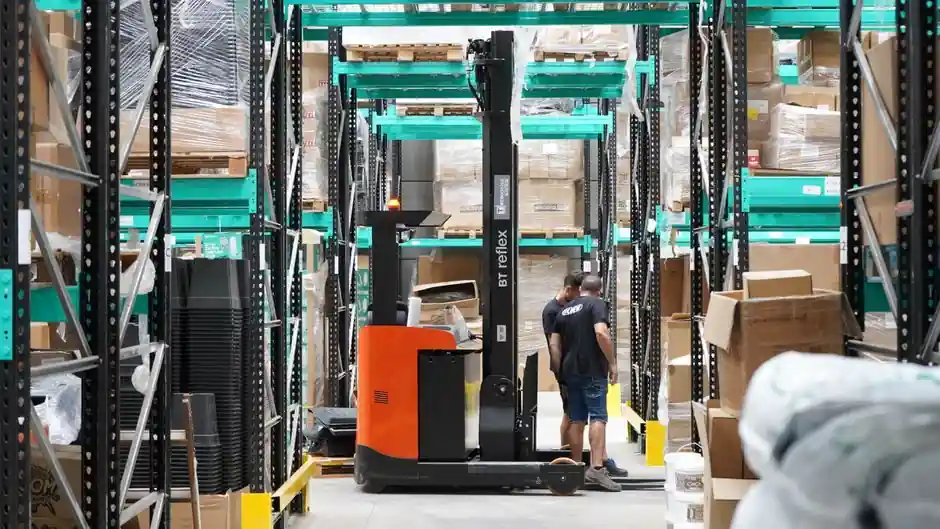
Full-body harnesses certified to EN 361 with dorsal and sternal attachment points are the baseline spec for warehouse fall-arrest work above 2 m, while EN 358 work-positioning models are added when operators need hands-free lateral restraint on racks or mezzanines [S1][S2].
The current DirectIndustry catalogue lists 115 fall-arrest harness products across 40 manufacturers, of which 65 carry EN 361, 39 carry EN 358, and 52 are tagged class 3 full-body, giving warehouse buyers a dense, comparable spec set [S5].
Standards and Attachment-Point Geometry
EN 361 governs full-body fall-arrest harnesses and requires a minimum of one dorsal and one sternal attachment point capable of arresting a free fall and distributing load across the body [S2][S3]. EN 358 governs work-positioning belts and lanyards used to hold the worker in place at height without arresting a free fall, and is commonly combined with EN 361 on dual-certified warehouse harnesses [S1][S4]. A warehouse buyer should require both markings when the same harness is used for order-picker platforms, mezzanine access, and rack-climbing inspections.
Attachment-point layout directly affects the rescue plan. Edelweiss HERCULES EVO-2 ships as a 7-buckle full-body harness with sternal and dorsal EN 361 D-rings in high-tensile steel, plus two revolving lateral EN 358 light-alloy D-rings for double-mode positioning lanyards [S2]. The sit-harness variant (HERCULES EVO-2, EN 358 only) omits the dorsal and sternal fall-arrest rings entirely, which is the wrong spec for any warehouse task where an uncontrolled fall is possible [S1].
Webbing, Buckles, and Salt-Spray Rating
Webbing width and stitching are the second decision line. CATU's MO-70/MO-71 entry-level harnesses use 45 mm wide polyester straps with two attachment points (dorsal and sternal) and universal buckle adjusters, sufficient for light electrical or maintenance work but not for repeated warehouse loading-dock use [S3]. Heavy-duty warehouse harnesses should specify webbing at 44-45 mm, alloy or zinc-plated steel buckles, and a salt-spray rating above the EN 362 / EN 365 baseline of 72 hours.
IRUDEK EXPERT 2 publishes 120-hour zinc-plated steel buckle salt-spray survival against the 72-hour standard baseline, paired with aluminium positioning rings and 3D EXO RIPSTOP padding on the positioning belt [S4]. That 120-hour figure is a real differentiator for warehouses near loading bays, cold stores, or coastal ports where salt aerosol and condensation corrode buckles within a single season. DirectIndustry's 65 EN 361 and 39 EN 358 product counts confirm that dual-rated full-body designs dominate the current industrial supply, not single-standard belts [S5].
Comfort and Throughput: Why It Matters in a Warehouse
A warehouse operator wearing a harness for an 8-hour shift will not tighten the buckles properly if the shoulder and leg padding is thin; the harness then rides low and the dorsal D-ring sits below the shoulder blades, which is exactly the geometry that fails the EN 361 dynamic load test in field misuse. IRUDEK's EXPERT 2 uses padded 3D EXO floating positioning belt with RIPSTOP fabric on back and shoulders, an ANTISLIP SYSTEM belt take-up, and adjustable height and leg straps to keep the dorsal ring at the correct scapular height over a full shift [S4].
Edelweiss HERCULES EVO-2 takes a different route: a polyethylene-insert-reinforced padding, an external CSPE (synthetic rubber) coating that resists abrasion and UV, and reflex tape at the waist belt for low-light forklift-aisle visibility [S2]. Both are valid; the difference is environment. UV-exposed outdoor yards and cold-store loading bays chew through uncoated polyester webbing, while indoor ambient-temperature warehouses tolerate standard webbing but punish loose buckles.
Tool-Carrying Load and Lanyard Keepers
Tool load is a hidden failure mode in warehouse harnesses. A 5 kg tool bag hung from a gear loop changes the centre of gravity during a fall, and on a sit-harness variant this can flip the user face-down before the lanyard catches. Edelweiss rates HERCULES EVO-2 gear loops at 10 kg and the auxiliary back loops at 5 kg, with 6 waist-belt slots for small accessories, which gives a documented carrying envelope rather than an unmarked loop [S2].
IRUDEK EXPERT 2 instead routes tools through the positioning belt and supplies four lanyard keepers (including two at the waist) so unused lanyard stows flat against the body and cannot snag on racking [S4]. For warehouse work where barcode scanners, box cutters, and shrink-wrap rolls are worn on the body, an explicit gear-loop rating or lanyard-keeper layout should be a line item on the PO, not a footnote.
Traceability and Inspection Records

EN 365 requires periodic inspection of fall-arrest equipment, and the 2024-2026 trend in warehouse PPE programmes is RFID/NFC-tagged inspection logging instead of paper registers. IRUDEK EXPERT 2 is built around an NFC Ready Chip that stores product traceability, status, and revision data, allowing the safety officer to scan the harness at issue-out and capture inspection history without handwritten tags [S4]. The chip is a soft feature that pays back fastest in warehouses with 50+ harnesses in rotation.
For lower-tier warehouse procurement, a protected textile identification label (as supplied on EXPERT 2) plus a manual inspection log is still acceptable, but only if the inspection interval matches the warehouse risk class: every 6 months for routine order-picker work, every 3 months for cold-store or coastal loading-bay harnesses, after any fall event regardless of date. A fall arrest harness page on the engineering reference side covers the broader PPE taxonomy and links to the related warehouse automation specs.
Comparison: Entry, Mid, Heavy-Duty Warehouse Harnesses
Three spec tiers cover the warehouse envelope. Entry: CATU MO-70 / MO-71, 45 mm polyester webbing, dorsal and sternal EN 361 attachment points, universal buckle, suited to occasional electrical maintenance and light platform work [S3]. Mid: Edelweiss HERCULES EVO-2 full-body variant, EN 361 + EN 358 dual, 7 quick-adjust buckles (no plastic parts), CSPE-coated fabric, gear loops rated 10 kg, sternal/d dorsal high-tensile steel D-rings, recommended for mixed warehouse and light rope-access tasks [S2]. Heavy: IRUDEK EXPERT 2, EN 361 + EN 358, 120-hour salt-spray buckles, aluminium positioning rings, 3D EXO RIPSTOP padding, ANTISLIP belt take-up, NFC chip for inspection traceability, sized for daily warehouse rotation in corrosive or coastal environments [S4].
Cross-tier criteria: (1) standards coverage, EN 361 only vs EN 361 + EN 358 dual; (2) salt-spray survival, 72-hour baseline vs 120-hour on EXPERT 2; (3) tool load, marked 10 kg gear loop vs lanyard keepers only; (4) traceability, paper label vs NFC chip. Buyers should score each candidate against the four criteria before opening price negotiations, because the cheapest harness on the PO is rarely the lowest total cost when an entire warehouse PPE fleet is being specified.
Adjacent Equipment and Sourcing Notes
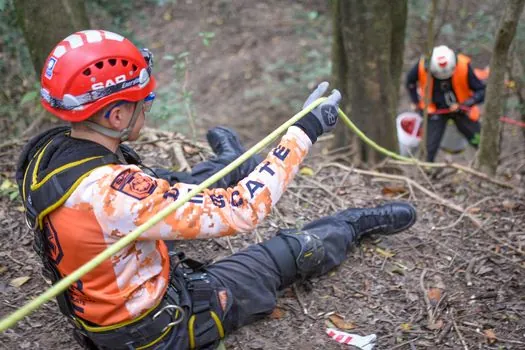
A harness is only one node in the system. Compatible self-retracting lifelines (SRLs) and energy-absorbing lanyards must be matched to the harness attachment point, and the anchor on the warehouse racking or mezzanine column must be rated to EN 795 or equivalent. A pressure transmitter link is not directly applicable, but a warehouse safety officer reviewing the engineering catalogue will see how the same spec-first discipline applies across instrumentation categories. For racking anchor selection and SRL pairing, reference the existing warehouse automation selection guide on the engineering reference site sorting system selection for warehouse automation. [S5]
For electrical substation or live-panel work inside the same warehouse envelope, the harness spec shifts toward arc-rated webbing and dielectric buckles; that profile is covered in the fall arrest harness selection for electrical work reference. For mining and heavy-industry analogues where 120-hour salt-spray and full-body EN 361 + EN 358 are also baseline, the mining fall arrest harness selection page provides a parallel spec map.
Next verification nodes: (1) confirm the warehouse racking anchor carries an EN 795-A or EN 795-B rating with documented 12 kN ultimate load, (2) capture the harness serial and NFC chip UID into the PPE register before issue, (3) set the inspection cadence at 6 months for ambient warehouses and 3 months for cold or coastal sites, and (4) audit a random harness at the 12-month mark to verify the EN 362 / EN 365 inspection pass rate before bulk re-order.
Component reference pages worth checking: flow meter.