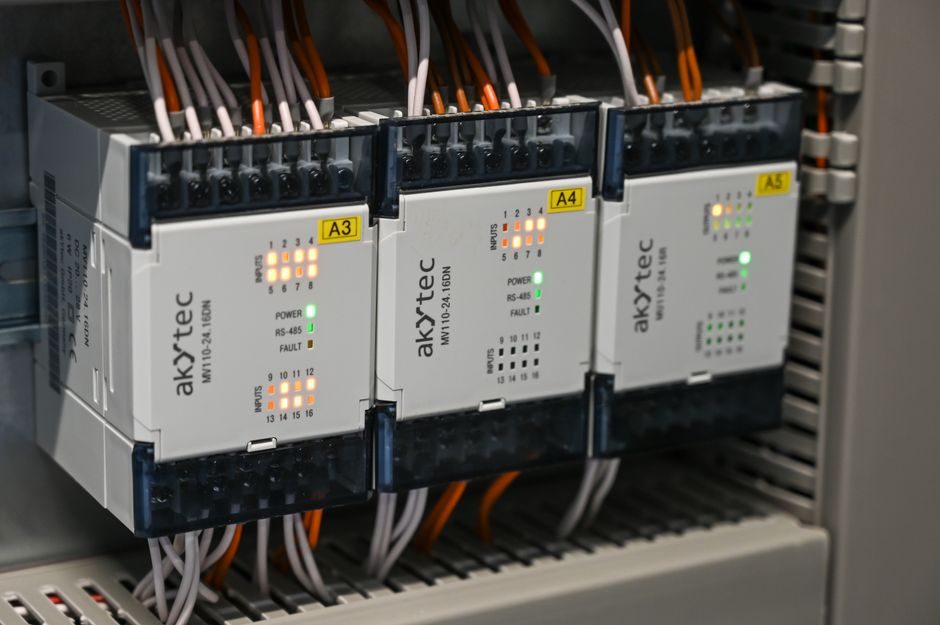
A safety PLC is selected against five engineering gates — Safety Integrity Level target, scan/response time, I/O mix, fieldbus/protocol stack, and certification scope — before brand or price enters the conversation.
This gate list is the same whether the platform is destined for a greenfield European chemical skid, a North American burner-management retro fit, or a robot cell governed by ISO 10218. The fundamentals in encyclopedia/safety-plc.html carry through every project: a safety PLC is a SIL-rated logic device with redundant, diverse architectures and self-diagnostics that shut the system to a safe state on internal fault.
Gate 1 — SIL Target and the Standards Stack That Pins It
The Safety Integrity Level is the design floor, not the ceiling: SIL 1 is the minimum used for non-critical protective functions, SIL 2 covers the majority of process-shutdown and guard-door logic, SIL 3 governs burner management, press safeguarding and high-hazard chemical reactors, and SIL 4 is reserved for nuclear and select large-scale petrochemical applications with PFD budgets below 10⁻⁸ [S1][S2].
Engineers should not treat SIL as a marketing badge. The level chosen drives the architecture (1oo1, 1oo2, 2oo2, 2oo3), the diagnostic coverage requirement (60–99% depending on level and architecture) and the proven-in-use obligations under IEC 61508. A SIL 2 mandate locked at a PFD of 10⁻⁶ to 10⁻⁷ will disqualify a single-channel design on day one of the audit. For a deeper base of terms, safety PLC fundamentals cover the difference between hardware fault tolerance and systematic capability, both of which feed back into the SIL number written on the spec sheet.
Gate 2 — Scan Time, Response Time and the Safe-State Window
Response time for a safety PLC chain runs from sensor event to actuator de-energise, with the controller's scan/cycle time being only one term. A 10 ms sensor-to-shutoff target — common on press-brake and high-speed robot cells — forces a controller cycle under 5 ms and dedicated safety I/O that bypasses the standard I/O backplane [S1].
Engineers routinely confuse scan time with safety reaction time. Scan time is the CPU cycle; safety reaction time adds the worst-case input propagation delay, the application-logic execution time, the output propagation delay, and the diagnostics window. A 20 ms controller in a 50 ms chain is fine; a 20 ms controller in a 10 ms chain is scrap. Select on the worst-case number stamped in the manufacturer's safety manual, not the headline scan time. Practical selection notes such as cycle-time budgeting and I/O propagation penalties are collected in motion-controller buying guides, where the same scan-vs-response logic applies across automation equipment.
Gate 3 — I/O Mix: Safety-Rated Versus Standard I/O
Mixing standard and safety I/O on one chassis looks cheap on paper and burns time on site. The decision tree is short: safety I/O must be used wherever the input drives a safety function, even if the device (light curtain, E-stop, guard interlock) is itself certified. The base PLC platform cannot share its working memory and diagnostics between safety and standard tasks without a formally partitioned runtime; mixing them on the same I/O card usually fails the certification audit. [S1]
Specify the I/O count by physical wiring, not by "spares for future". A 32-point safety digital input card consuming four channels for a single E-stop is wasted capacity. Plan for 15–25% unused safety I/O for commissioning changes; beyond that, specify a second card. Analog safety inputs (4–20 mA with HART, NAMUR, or 0–10 V) carry their own hardware-fault-tolerance rules and typically max out at 8 or 16 channels per card — count them in a separate line item, do not roll them into digital headroom. For comparison against a controller-class alternative, the cut between a safety PLC and an industrial PC-based platform is laid out in motion controller vs industrial PC 2026 spec guides.
Gate 4 — Fieldbus and Protocol Stack Compatibility
PROFIsafe on PROFINET, CIP Safety on EtherNet/IP, and FSoE (Fail Safe over EtherNET) are the three protocols that carry safety data on standard industrial Ethernet in 2026. A safety PLC selected in isolation is half a system — the drives, remote I/O and valves on the other end must speak the same safety protocol with the same revision [S1].
Check three things on the bus before signing off: (1) protocol version and conformance test certificate (a vendor's "supports FSoE" claim without an FSoE conformance test ID is not acceptable for SIL 3); (2) the safety PDU cycle time, which must be inside the response-time budget from Gate 2; (3) the black-channel behaviour — what happens to the safety PDU when standard traffic spikes. A safety PLC that meets SIL 3 on its own and fails the bus gateway at integration is the most common late-stage re-spec seen in cell retro fits. The gateway is a SIL-rated node, not a transparent bridge.
Gate 5 — Certifications: TÜV, ATEX 2014/34/EU, IEC 61511, and the Audit Trail

Certifications are line items, not checkboxes. A safety PLC targeting the EU process industry needs TÜV or equivalent third-party SIL certification, an ATEX 2014/34/EU rating for the hazardous-area zone (Zone 1/2 gas, Zone 21/22 dust), and the manufacturer must publish a functional safety management certificate (FSM) under IEC 61508. Process-industry plant owners additionally reference IEC 61511 for the application layer, with documented Safety Instrumented Systems (SIS) per IEC 61511-1 [S1].
For North American installations, look for UL 508A listing on the panel build and FM or CSA certification on the controller. For machinery, ISO 13849-1 PL e (Category 3 or 4) is the common yardstick, and the safety PLC must show a Pfhd below 10⁻⁷/h to land at PL e. Do not accept vendor marketing collateral in place of a certificate number traceable to the issuing body. Skipping this gate is the most expensive way to fail a PHA or LOPA review in week 24 of a project.
Use Cases and the Limits of a Safety PLC
A safety PLC is the right answer for: emergency stop circuits on assembly lines, guard-door interlock logic with light curtains and proximity switches, burner-management systems, robotic cells under ISO 10218 and ISO/TS 15066 (collaborative robot power-and-force limiting), process-shutdown logic in chemical and oil & gas plants, and any function that must continue to operate correctly under hardware fault. [S2]
A safety PLC is the wrong answer for: SIL 4 nuclear-grade applications (specialty hardware with diversity + segregation), wire-only E-stop loops on small machines (a safety relay or contactor is cheaper), and high-speed press lines where a 1 ms reaction time is mandatory (safety drive with hardwired STO is faster). The cost ranking inside the controller class — what each axis, bus and drive stack costs in 2026 — is broken down in motion-controller price & cost guides and is a useful proxy for budgeting safety-PLC hardware per I/O point. For an adjacent B2B reference with the same gate-discipline approach, filling-machine selection criteria walks through four spec gates for a related capital purchase decision.
Comparison Pass: How the Main Controller Families Stack Up

Standalone modular safety PLCs (Siemens F-CPU, Allen-Bradley GuardLogix, ABB AC500-S) offer the deepest third-party certification libraries and the broadest I/O ecosystem; integrated safety drives and controllers (Bosch IndraDrive Safety, Beckhoff TwinSAFE) win on response time and footprint inside machine retro fits; and SIL-rated compact controllers for smaller skids (Phoenix Contact RFC, Pilz PMC, Wago PFC100/200) cut the panel real estate but cap I/O density at 30–60 safety points per unit [S1][S2].
Three decision criteria separate them in 2026: (a) conformance to PROFsafe / CIP Safety / FSoE and the supported revision, which gates integration cost with the rest of the plant network; (b) the maximum number of safety I/O on one node before the bus must segment, typically 256–512 digital points, and (c) the cost per safety I/O point, which for modular systems runs roughly $90–$180 per point at 32-point density versus $140–$260 for compact systems. None of these numbers is a brand endorsement; they are the band the specs sit in when quoted on a typical skid-build quotation.
Two more engineering rules travel across all three families: first, never accept a single-channel architecture at SIL 2 or above without a written fault-tolerance argument in the safety manual; second, the safety PLC's firmware version must be frozen and documented in the as-built safety case — re-flashing a controller in service without re-running the proof test is a violation under IEC 61511 and the equivalent machinery standards.
For component-level specifications, see safety barrier.