
Safety shoes split into two classification frameworks: the European EN ISO 20345 system uses letter-plus-number codes S1, S1P, S2, S3, S4, and S5 to grade protection, while the North American ASTM F2413 standard rates individual hazards such as impact (I), compression (C), metatarsal (Mt), electrical hazard (EH), static dissipative (SD), and puncture resistance (PR) [S1][S4]. Both frameworks coexist on most global job sites, and a single boot routinely carries both marks.
Across the categories, the dominant variables are toe-cap material, sole construction, water resistance, and electrical behavior. The toe cap alone has three main commercial variants: steel, composite (Kevlar, carbon fiber, plastic), and alloy (aluminum, titanium) [S1][S2]. Each trades weight, conductivity, and cold-soak behavior against the other, and each is paired with a different midsole and outsole to reach the EN class the manufacturer claims.
Toe-cap materials: steel vs composite vs alloy
Steel-toe caps remain the most common impact-protection option and are specified wherever heavy falling-object risk dominates, such as construction sites and manufacturing plants [S1]. The trade-off is mass: a steel cap adds noticeable weight versus composite alternatives, and the cap can feel cold in freezers or hot in foundry work [S1]. When the steel cap is properly insulated from the wearer, the boot will not complete an electrical circuit to ground, so steel-toe footwear is not automatically excluded from electrical hazard zones [S1].
Composite toe caps use non-metal materials such as Kevlar, carbon fiber, and plastic, making them lighter than steel, non-conductive, and thermally neutral in extreme temperatures [S1][S2]. That combination suits electrical work, cold storage, foundry work, and any site with walk-through metal detectors. Alloy toe caps use aluminum or titanium; they are lighter than steel and thinner, which preserves toe-box room in athletic and hiking silhouettes, while still meeting the same ASTM F2413 impact and compression thresholds [S1][S2].
EN ISO 20345 S1 through S5 explained
The European EN ISO 20345 safety-footwear standard uses six practical classes, with the S-prefix denoting a toe cap rated to 200 joules of impact and 15 kN of compression [S4]. S1 adds a closed seat region, antistatic properties, and energy-absorbing heel; S1P layers a penetration-resistant midsole on top of S1; S2 adds water resistance to the S1 baseline; S3 combines water resistance with a cleated outsole and penetration-resistant midsole; S4 and S5 are the rubber or polymer equivalents of S2 and S3, used where leather uppers are not appropriate [S4].
For a plant buyer, the practical reading is simple: S1 covers dry indoor work with light impact risk, S1P and S3 cover most industrial floors with nail or shard risk, S2 covers wet indoor work without puncture risk, and S5 covers wet outdoor sites where both puncture and water immersion are routine [S4]. The EN code is stamped on the boot tongue or inside quarter and should be matched to a written risk assessment, not chosen by habit.
ASTM F2413 hazard ratings: I, C, Mt, EH, SD, PR
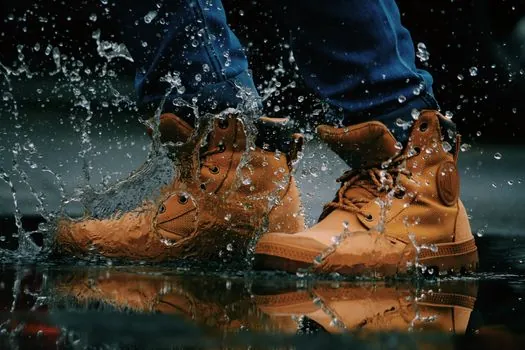
ASTM F2413 is the US reference standard for protective footwear, and it tests each hazard independently so a manufacturer can claim only the ratings the boot actually passed [S1]. The two core ratings are I/75 for impact resistance (50 ft-lbf of impact energy, which equals a 50 lb object dropped from 1 ft) and C/75 for compression (2,500 lb of static load) [S1][S5]. Mt adds metatarsal protection over the top of the foot; EH (Electrical Hazard) rates the secondary protective sole and toe for non-conductive performance; SD (Static Dissipative) controls static buildup; PR (Puncture Resistant) addresses midsole penetration [S1][S5].
Electrical hazard (EH) rated boots are tested to withstand 18,000 V at 60 Hz for one minute with no current flow or leakage above 1 mA, which is the threshold most safety officers in the US use to qualify footwear for work near open circuits [S2]. EH and SD are not the same: EH reduces the chance of a current path through the foot, while SD bleeds off static charge to prevent sparks in flammable atmospheres, which is a different hazard profile entirely.
Specialty constructions: metatarsal, conductive, slip-resistant
Metatarsal guard shoes add a shield over the top of the foot behind the toe cap, and are specified in logging, heavy rigging, and stamping operations where the metatarsal arch is exposed to crushing loads [S1][S3]. Puncture-resistant shoes add a steel or textile midsole, the same physical feature that distinguishes S1P and S3 boots in the EN framework, and are required where nail or sharp scraper risk is high [S1][S4]. Conductive and static-dissipative footwear is the inverse of EH: instead of blocking current, the sole is engineered to pass a small, controlled current to ground, used in electronics assembly, munitions handling, and ATEX-style zoned areas [S3].
Slip-resistant outsoles are the highest-volume specialty construction and use softer rubber compounds, tread geometry, or both to meet common floor-coefficient-of-friction targets [S2][S5]. Waterproof or moisture-resistant uppers pair sealed membranes with water-resistant leather and correspond to the S2 or S3 EN classes [S2][S3]. For a working reference on a closely related PPE category, see the comparison of insulated tool selection criteria for the same kind of voltage-class, standard-anchored decision logic.
Comparison: toe materials and EN classes on the same axes
On a four-axis decision grid, the trade-offs line up as follows. On weight, steel is heaviest, alloy is intermediate, composite is lightest [S1][S2]. On electrical conductivity, steel is conductive unless insulated, composite is non-conductive by construction, alloy is conductive unless paired with an EH-rated assembly [S1][S2]. On thermal comfort in extreme temperatures, composite performs best because the cap does not cold-soak or heat-soak, while steel performs worst in freezers and foundries [S1]. On price and availability, steel is the lowest-cost and most widely stocked option, alloy is mid-range, and composite typically commands a small premium [S2].
On the EN class axis, the same boot profile can be re-engineered across the range: a leather upper, steel toe, and steel midsole is the most common S3 configuration; the same upper without the midsole drops to S1P; without water resistance, S1; with a rubber upper instead of leather and the same features, S5 instead of S3 [S4]. For buyers matching footwear to a wider PPE program, the eye wash station compatibility rules follow a similar risk-class-plus-standard pattern that helps when auditing a site.
Selection workflow and failure modes
A working selection workflow starts with the hazard inventory: falling-object impact, compression, puncture, electrical contact, static discharge, wet conditions, chemicals, and metatarsal exposure [S1][S5]. Each hazard maps to a single ASTM F2413 rating or EN feature, so the boot specification becomes a checklist rather than a brand choice. The most common specification error is specifying steel-toe footwear for an electrical-hazard zone without confirming the EH rating, since the toe cap alone is not the same as an EH-rated assembly [S1][S2]. The second most common error is using S1 dry-class boots in wet areas, where water resistance (S2 or above) is required to keep the foot insulated and to maintain the antistatic heel performance over a shift [S4].
Standards compliance is the non-negotiable layer: OSHA 29 CFR 1910.136 requires protective footwear where foot injury is a hazard, and in the EU the corresponding obligation is met by CE-marked EN ISO 20345 footwear supplied through the employer's PPE risk assessment [S1][S4]. Two trackable signals to watch are updates to ASTM F2413, which the committee revises on a multi-year cycle, and any plant-side move from S1/S1P to S3 or S5 driven by wet-floor incidents, both of which are visible in annual safety-procurement tender language.
Spec-level background on the components involved: safety shoes, construction machinery and equipment, and lamps and light fittings.