Sand blasting machines divide first by propellant method — suction (venturi), pressure-pot, and gravity — and second by containment: open-air room, closed cabinet, and inline pass-through, with abrasive-blast wheel machines occupying a parallel family for steel plate and pipe work [S2][S3].
Current 2026 Chinese OEM catalogues list 8,136+ sand-blasting products across roughly 312 manufacturers on Made-in-China, with a Guangdong-based pass-through steel-pipe unit quoted at US$85,000–95,000 per set and annual capacity of 300 sets [S4][S6]. Hangzhou Norvee's NR-series spans drum, crawler, single-station wheel, and 220 V 50 Hz glass-bead units, all carrying ISO 9001 / CE marks [S3].
Propellant Method: Suction, Pressure-Pot, Wet, and Wheel Blasting
The four propellant families — suction (venturi), pressure (direct-pressurised pot), wet (slurry injection), and wheel (centrifugal) — define the upper-level classification that every downstream spec cascades from [S2].
A pressure-feed system uses a direct-pressurised pot (typically 0.5–1.0 MPa shop-air supply) to push abrasive through a blast hose and nozzle, delivering 3–4× the impact velocity of suction-feed at the same compressor size. Suction-feed (venturi) units pull abrasive into a low-pressure airstream at the nozzle; they are cheaper and simpler but cap productivity on heavy scale. Wet blasting injects abrasive-water slurry to suppress visible dust and is the default for applications where silica-bearing media (sand, garnet) raise respiratory concern, although it leaves a slurry to handle. Wheel blasting throws abrasive by an impeller — wheel diameters of 350–500 mm are common — and is the workhorse for steel plate, structural sections, and pipe, where throughput beats surface precision. The linked sand blasting machine reference covers the propellant-family comparison in full.
Containment Geometry: Cabinet, Room, and Pass-Through
Containment geometry — enclosed cabinet, walk-in room, or inline pass-through — is the second classification axis and is driven by workpiece size, production volume, and dust-collection duty [S1][S6].
A blast cabinet is a sealed glove-box style enclosure, typically 0.6–1.5 m³, suited to small parts, jewellery, and watch cases; SANKEN's SKS series automatic glass-sandblasting line is PLC + touchscreen controlled with both manual and automatic firing modes for flat and curved architectural glass [S1]. Walk-in rooms (10–60 m²) handle truck bodies, large fabrications, and rail components, and require dedicated reverse-pulse cartridge dust collectors to keep visible-dust below the operator exposure thresholds that wet-blast and cabinet designs avoid by enclosure alone. Pass-through designs index long workpieces — steel pipe, I-beams, alloy bar — through opposed blast stations; the Guangdong pipe unit cited above handles continuous in-line blasting at the 300 sets/year OEM capacity [S6]. Wheel-blast rooms and drum-style crawlers handle small ironware in batch, with shot recovered, sieved, and recycled; the Norvee NR-023 drum-type and NR-024 crawler-type are concrete examples of this batch geometry [S3].
Power, Media, and Application Fit

Spec selection maps back to three paired numbers: drive power (kW), abrasive flow rate (kg/min), and the workpiece-media compatibility matrix [S3].
Glass-bead work on quartz crucibles and architectural glass runs on 220 V 50 Hz single-phase mains at low nozzle pressure (0.2–0.4 MPa) because thermal shock and substrate fracture set the upper limit [S3]. Steel-shot peening on small ironware or thin plate typically uses 0.5–0.8 mm S230/S280 steel shot at 0.5–0.6 MPa to reach Almen intensities of 0.3–0.5 mmA for peening, while descaling of hot-rolled plate uses 0.8–1.2 mm cut wire or steel grit at 0.6–0.8 MPa. Ceramic-shot peening — favoured for titanium plate and mould surfaces where ferrous contamination must be avoided — uses zirconia or alumina beads of 0.2–0.4 mm at lower pressures. Quartz-crucible and watch-case applications stay in the wet or cabinet family because the substrate is brittle; structural steel and pipe move to open or pass-through wheel systems where the abrasive is recycled by elevator-and-separator loops. The complete abrasive-and-system pairing is documented on the shot blasting machine encyclopedia page.
Selection Criteria: Productivity, Surface Class, and Containment
Three decision gates — production volume, surface-finish class, and dust/silica control class — collapse the catalogue to one or two viable machine types [S2][S3].
Volume below roughly 5 m²/hr of finished surface suits a cabinet or small wet unit; 5–30 m²/hr is the pressure-feed room range; above 30 m²/hr on plate, bar, or pipe the wheel-blast family wins on energy per kilogram of abrasive and on recyclable-shot economics. Surface-finish class — visual-only, Sa 2½ / Sa 3 to ISO 8501-1, or peened (Almen-controlled) — drives media choice and pressure: garnet and aluminium oxide for cleanliness, steel shot/grit for peening, glass bead for cosmetic matte on stainless and aluminium. Dust and silica control increasingly pushes users away from open sandblasting of silica media toward wet-blast, vacuum-blast cabinets, or non-silica abrasives, with ISO 9001 / CE machines from Chinese OEMs (Norvee NR-022 through NR-028) being the typical documented compliance baseline [S3]. For foundries integrating blasting into a moulding line, the upstream sand mixer and downstream sand casting mold process steps set the cycle-time boundary the blaster must hit.
Safety, Standards, and Failure Modes
Operating pressure, abrasive velocity, and silica-bearing dust are the three failure-mode drivers that standardise around the same engineering controls [S2][S3].
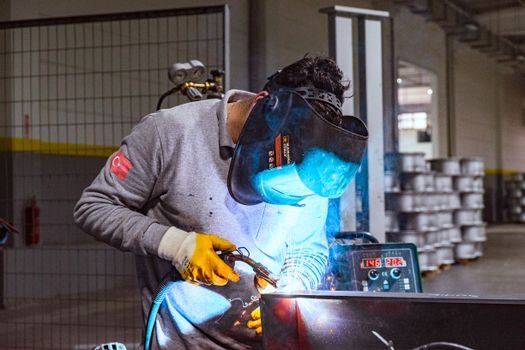
Abrasive particles at high velocity — Atlas Copco describes the process as propelling particles at very high velocity against a chosen surface [S2] — mean that any containment breach or operator error produces eye and skin injury; abrasive-rated helmets, deadman-valve nozzles, and CE-marked interlocked cabinets are baseline. Sand as an abrasive is increasingly restricted in many jurisdictions because crystalline silica dust generated on impact is a recognised respiratory hazard, and wet-blast or non-silica substitutes (garnet, aluminium oxide, glass bead, ceramic shot) are the engineering response. Failure modes cluster around: hose burst at couplings (use whip-check restraints and rated hose), dust-collector filter saturation (ΔP alarm set per OEM), media contamination (ferrous carryover into stainless work, or vice versa), and uneven coverage from clogged nozzles (nozzle pressure check at shift start). Cement-mortar abrasion testers — a related but distinct instrument class — run a 0.4–1.0% revolution-error speed under pre-set digital turns to characterise material wear, which is the upstream test data a blaster's output is often graded against [S8].
2026 Catalogue Snapshot: Pricing, Lead Time, and OEM Patterns
The 2026 export catalogue landscape is dominated by Chinese manufacturers, with Guangdong as the hub for inline pipe units and Zhejiang for general-purpose cabinet and wheel machines [S3][S4][S6].
Made-in-China lists roughly 8,136 sand-blasting products from 312 manufacturers as of the current catalogue state, with product names spanning sandblaster, sand blast room, blast cabinet, and shot-blast variants on the same platform [S4]. Specific 2026 listings worth tracking: SANKEN SKS automatic glass sandblasting line (PLC + touch screen, flat and bent glass) [S1]; Norvee NR-022 industrial sandblaster and NR-024 crawler-type ceramic/steel shot unit from a 2006-established Hangzhou OEM exporting to North America, Western Europe, Eastern Europe, South America, Southeast Asia, and the rest of the listed region set [S3]; and the Guangdong pass-through steel-pipe sandblasting line at US$85,000–95,000 per set, 300 sets/year, with L/C and T/T terms [S6]. Watch listings for the next refresh on Made-in-China SANKEN flat/bent tempering-furnace siblings (lines 1–9 of the SANKEN glass product tree) because the same furnace vendor supplies the upstream glass surface that the SKS blaster finishes [S7].
Two trackable signals from the 2026 OEM catalogue: continued bifurcation between single-station wheel units (small-batch, ≤10 m²/hr) and pass-through pipe-and-plate lines (≥30 m²/hr, US$85k+ per set), and migration of glass and watch-case blasters onto PLC + touchscreen platforms with both manual and automatic firing modes. For procurement, the gate is abrasive-media compatibility, dust-control class, and whether the OEM is on an ISO 9001 / CE audit trail — not the marketing tier.
Related analysis: Lithium Carbonate 2026: Top Suppliers, Specs, and Sourcing Map.