
For aluminum parts in the 1-100 lb range, the decision between sand, permanent mold, and die casting is dominated by three numbers: surface finish in microinches or RMS, tooling cost as a function of annual volume, and the minimum wall thickness the process can fill without porosity [S1][S3].
Sand casting uses a one-time bonded sand mold and is the only one of the three that can pour ferrous alloys economically; permanent mold uses a reusable steel or iron die filled by gravity or low-pressure tilt pour; die casting uses a steel die filled by high-pressure injection at 10,000-15,000 psi [S4][S5]. All three target near-net shape, but the engineering tolerance bands and acceptable annual volumes differ by an order of magnitude across the set.
Mold Material and Reusability
Sand casting molds are made by mixing sand with a binder (green sand, nobake, coldbox, or shell variants) and are broken apart after each pour, so the mold is one-time consumable [S1]. Permanent mold and die casting both use steel dies that survive thousands of cycles; permanent mold dies can last up to roughly 100,000 shots when properly maintained, and die casting dies are similarly long-lived but must be stronger because injection pressure is roughly 100x higher than gravity fill [S2][S4].
Because the die is the capital cost, the break-even volume follows directly: sand casting tooling is the cheapest and is suited to under 500 pieces per year, permanent mold tooling typically costs about half of a die casting tool and suits the few-thousand-per-year band, and die casting tooling is the most expensive but earns back its cost on long runs of small, thin-wall parts [S1][S3][S4]. For a deeper look at how the bonded-sand variants behave on the pattern side, see this note on parting powder on green sand patterns and mold joints.
Surface Finish and Linear Tolerance Comparison
The published as-cast surface finish windows are: sand casting 300-560 RMS for nonferrous, 560-900 RMS for ferrous green sand; permanent mold 200-420 RMS; die casting 20-120 RMS, with the older LeClaire figure citing "better than 125 microinches" for high-pressure die cast aluminum [S1][S2][S3][S4]. On aluminum linear tolerance, permanent mold holds 0.015 in for the first inch plus 0.002 in per additional inch on features on the same side of the die, while sand casting holds 0.030 in for the first inch plus 0.002 in per additional inch under the same condition [S1].
Concentricity for aluminum follows the same hierarchy: permanent mold starts at 0.025 in for diameters up to 5 in (plus 0.003 in per additional inch), while sand casting starts at 0.050 in for diameters up to 5 in (plus 0.005 in per additional inch) [S1]. Die casting tightens further, with aluminum alloys routinely cast to plus or minus 0.004 sq in and walls as thin as 0.04 in, which is why thin-wall consumer and automotive housings default to die casting rather than permanent mold [S4].
Porosity, Mechanical Soundness, and Alloy Choice
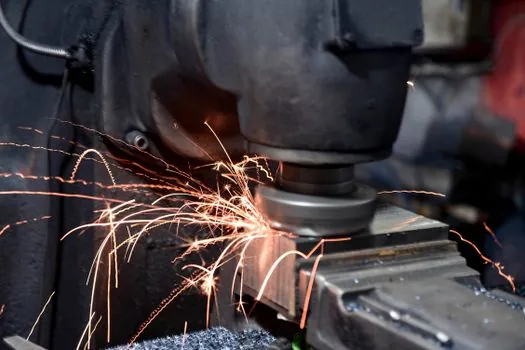
Porosity behavior flips the apparent finish ranking. Die cast parts have the best as-cast surface but higher internal porosity because the high-velocity shot traps air, which is why thick die cast sections can be weaker than thin ones and why vacuum assist, slower shot profiles, or semi-solid casting exist as mitigations [S3][S4]. Permanent mold's tilt-pour, gravity-fed fill introduces less turbulence and less trapped gas, giving lower porosity, higher yields in secondary machining, and parts that can be polished without revealing divots or pinholes [S2][S3]. Sand castings carry the highest risk of gas porosity plus sand inclusions and shrinkage defects, which is why they usually need heat treat, machining, or coating downstream [S1].
Alloy selection narrows quickly: aluminum A380 is the dominant die casting alloy, A356 dominates permanent mold, and zinc ZA5 and ZA12 also run in permanent mold at shops such as Batesville [S3]. Sand casting is the only one of the three that can pour ferrous metals like cast iron and steel economically, because the expendable mold survives the higher melt temperatures that would damage a reusable steel die [S1][S5]. For buyers comparing post-cast heat treatment routes on carbon steel castings, the normalizing vs full annealing process map pairs naturally with this material selection.
Volume, Tooling Cost, and Cycle Time
Volume bands map cleanly onto the three processes. Sand casting makes sense under about 500 pieces per year and for prototyping, because tooling is cheap and the per-piece labor is high [S1]. Permanent mold is the moderate-volume workhorse, typically a couple thousand pieces per year, where the reusable steel die and tilt-pour cycle recover the die cost without the die casting capital burden [S1][S3]. Die casting is the high-volume choice, with cycle times of roughly 30 seconds to 1 minute per shot, highly automated cells, and a per-piece cost that drops fastest at the highest volumes despite the highest upfront die cost [S4][S5].
Die life is roughly 100,000 shots for a well-maintained die casting tool, so the per-piece tooling amortization falls sharply once a program passes that volume threshold [S4]. Permanent mold cycle is slower than die casting, but the dies are less complex and roughly half the price, which is the deciding factor for many moderate-volume programs that also need pressure-tight or weldable parts [S2][S3]. The full casting process taxonomy, including the reusable steel tooling that defines both permanent mold and high-pressure die casting, is covered in the casting mold encyclopedia entry.
Decision Matrix: Which Process Fits Which Job
Specifying a process comes down to four criteria. Surface finish: die casting wins at 20-120 RMS, permanent mold sits at 200-420 RMS, sand casting trails at 300-900 RMS [S1][S3][S4]. Porosity and mechanical soundness: permanent mold is the safest default because lower trapped gas means fewer machining reveals and weldable, heat-treatable parts, while die casting needs vacuum or semi-solid routes to match that [S2][S3][S4]. Volume: under 500/year pick sand, a few thousand per year pick permanent mold, tens of thousands or more pick die casting [S1][S3][S5]. Alloy: ferrous or very large parts force sand casting; aluminum A356 routes to permanent mold; aluminum A380 and other high-pressure die alloys route to die casting [S3][S5].
Use sand casting for prototypes, short runs, very large parts, and any ferrous alloy; the expendable mold absorbs the thermal and economic hit of low volume [S1][S5]. Use permanent mold for pressure-tight vessels, medical and food equipment, utility hardware, and any program in the few-thousand-per-year band where weldability and low porosity matter more than the last 100 microinches of finish [S2][S3]. Use die casting for thin-wall, high-cosmetic, high-volume aluminum or zinc parts where the per-piece cycle time of 30-60 seconds and automation outweigh the die cost [S4][S5]. The die casting and die casting die encyclopedia pages cover the reusable-tool side of the trade in more depth.
Limits, Failure Modes, and Sourcing Constraints
Die casting fails on thick sections (shrink porosity forms inside before the skin freezes), on parts that need deep cored passages (cores must pull straight out of the die), and on any ferrous alloy above aluminum or zinc melt temperatures [S4][S5]. Permanent mold fails on very thin walls below about 0.18 in because the gravity-fed fill cannot feed them reliably, and on extremely large parts where the steel die cost crosses the line into being uneconomic for the volume [S3]. Sand casting fails on tight tolerance and cosmetic requirements, since 300-900 RMS plus 0.030 in first-inch linear tolerance forces secondary machining or coating on most non-prototype parts [S1].
Sourcing risk also differs. Sand casting has the broadest shop base, including jobbing foundries that take one-off work, while permanent mold and die casting shops typically want a committed annual volume to keep the die amortizing. For low-pressure tilt-pour work in the moderate-volume band, expect tooling lead times measured in months rather than weeks, and confirm whether the quoted die cost includes the die casting machine or aluminum die casting machine cell that will run it.
Trackable signals worth watching on sourcing: per-shop minimum wall thickness capability for permanent mold (the 0.18 in figure is a common baseline, not a universal floor), die life achieved on existing tooling in your alloy (the 100,000-shot figure is a planning number, not a guarantee), and whether a candidate die caster offers vacuum-assisted or semi-solid cells if your part is borderline on porosity [S3][S4]. For buyers choosing between a steel die and bonded sand on a one-off, the sand casting mold reference covers the expendable-mold economics in detail.