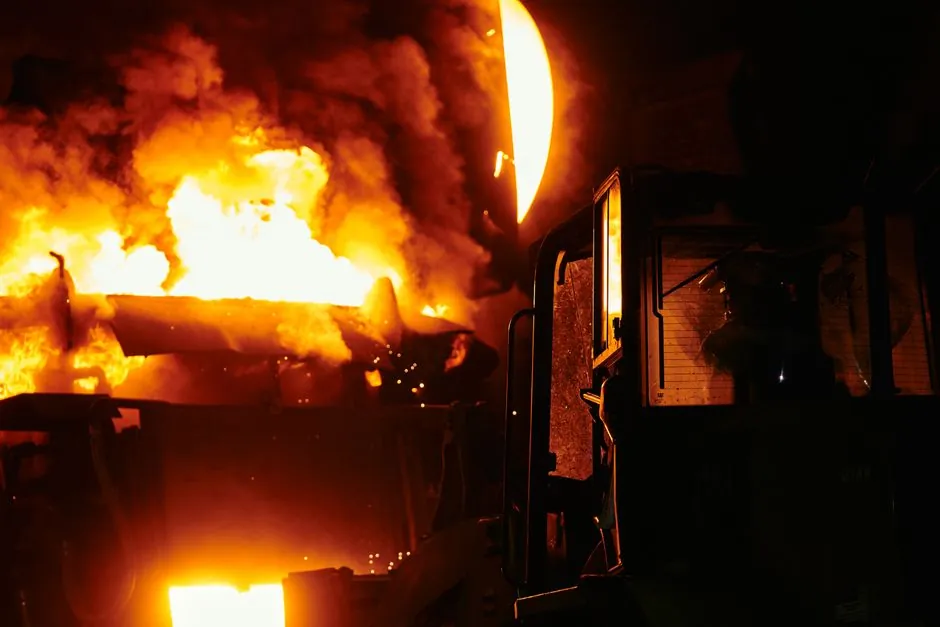
Enriching the tuyeres blast with oxygen is the lowest-capital way to push more iron through a cupola per hour, with Linde reporting up to 15% hourly production gain and Air Liquide stating that pure-oxygen injection lifts flame temperature to roughly 1500°C in the coke bed [S2][S7].
For iron foundry engineers deciding between cold-blast operation, hot-blast recuperation, and oxygen supplementation, the relevant variables are melting rate, spout iron temperature, coke-to-iron ratio, and refractory life, all of which shift together when oxygen is added to the blast [S4][S5].
Why oxygen enrichment moves the cupola energy balance
Coke combustion in the tuyere zone releases -33,260 kJ per kg of carbon, and the subsequent CO2 + C endothermic reduction consumes +14,009 kJ per kg of carbon, which is why nitrogen in ordinary air acts as a thermal ballast that the operator pays to heat through the stack [S4]. Replacing part of that nitrogen with oxygen raises adiabatic flame temperature, accelerates coke consumption, and shifts more of the released heat into the descending metal droplets instead of the off-gas [S1][S6]. EPA-documented foundry experience shows the first adopters of cupola oxygen enrichment pursued melt-rate increase as the primary objective, with tapping temperature and coke consumption as secondary outcomes [S1].
Production-rate and coke savings: documented ranges
Linde's productivity paper reports three concrete results from direct-oxygen injection: hourly production rate up 15%, metal-to-coke ratio improvement above 15%, and specific oxygen consumption reduced up to 10% [S2]. A separate hot-blast cupola control study recorded a coke consumption drop of 22% with no reduction in metal tapping temperature, while melting rate climbed from 26 t/h to 36 t/h, a 38% throughput increase on the same shell [S8]. The Linde Supersonic Direct Injection (SSDI) variant pushes oxygen at Mach II through nozzles into the coke bed, and one customer conversion from subsonic to supersonic injection improved the coke ratio by nearly 10%, translating to roughly $1/ton in melting cost savings [S2].
Spout temperature and the role of flame temperature
Air Liquide states that pure oxygen raises the combustion flame temperature to 1500°C, allowing more energy transfer to the metal charge and enabling higher spout iron temperatures at a given coke rate [S7]. Cold-blast cupolas normally have difficulty reaching high spout iron temperatures unless coke charge and blast volume are pushed up at the expense of melting rate; the giessereilexikon entry attributes this to the high specific coke consumption of cold-blast operation and the fact that a large fraction of combustion energy leaves with the CO-rich stack gas [S4]. Adding oxygen to the blast directly attacks both problems by raising flame temperature and reducing the nitrogen ballast that carries heat out the top, which is why enrichment is often paired with hot-blast recuperation on the 400–600°C preheat range [S4].
Continuous operation: the refractory and cupola-control trap
US Patent 3,295,959 (filed 1964) makes a sharp point that continuous oxygen enrichment had not been widely accepted because two failure modes were associated with it: loss of cupola control when coke percentage was cut to chase savings, and excessive refractory attack on the lining [S3]. The patent's solution is to raise the rate of coke charged in proportion to the oxygen-enriched blast rate, thereby keeping coke bed height near normal so carbon pickup in the iron stays consistent [S3]. Modern Casting's operations guide echoes the same lever, listing blast volume, blast temperature, and oxygen use as the operator-controllable inputs that change the conversion balance, with refractories (acidic vs basic lining) fixed at install time and therefore dictating which slag chemistry is even safe to run [S5]. For cupola designers weighing these trade-offs, the practical rule is that continuous enrichment needs a compensating coke schedule, while intermittent enrichment remains a useful tool for cold-start ramp and temperature correction.
Direct injection vs blast enrichment: a side-by-side comparison
The two delivery modes are not interchangeable. Blast enrichment mixes oxygen into the main tuyere air through spargers in the blast line, which is simple, low-cost, low-maintenance, and well suited to foundries whose priority is thermal uplift across the whole bed [S2]. Direct injection (and the SSDI supersonic variant) puts oxygen through dedicated nozzles into the coke bed at high velocity, pushing the combustion front toward the center of the shaft, cooling the walls, and extracting more of the heat into the metal; this is the path foundries take when they specifically want to raise the metal-to-coke ratio beyond what enrichment alone delivers [S2]. On the criteria a process engineer actually trades off: capital cost is lowest for blast enrichment, throughput gain is highest for SSDI (one Linde site gained 10% on coke ratio on top of an already-enriched baseline), and wall-side refractory load is lower for direct injection because the combustion front is held off the lining [S2]. For cupola operators whose bottleneck is cold start, the Modern Casting operations guide lists oxygen as one of the day-to-day inputs that can be adjusted hourly, but only after the operator has confirmed that the lining type and slag chemistry can tolerate the higher flame temperature without accelerated wear [S5].
Selection rules and decision criteria for a working cupola
Choose blast enrichment when the cupola is melt-rate-limited and the foundry wants a low-capital, low-maintenance intervention; choose direct oxygen injection when the priority is to cut specific coke consumption while keeping spout temperature, and choose SSDI when a lined cupola is showing refractory wear and the goal is to keep the combustion front off the walls [S2]. Hot-blast recuperation with 400–600°C preheated blast is the right pairing for any of the above when cheap steel scrap is a major charge component, because the higher preheat widens the usable scrap fraction and tightens iron composition spread [S4]. Cold-blast operation below 2–10 t/h melting rate is the regime where oxygen enrichment is most economically attractive, because furnace efficiency is around 60% and a large fraction of combustion energy is wasted in the CO-rich exhaust [S4]. Continuous oxygen enrichment above the levels the patent describes is not recommended unless the coke charging schedule is recalculated to hold the bed height steady, otherwise cupola control and refractory life both degrade [S3]. For foundries also selecting process instrumentation, the same principle of measuring what you change applies: the process sensing and analyzer options for stack gas and tuyere oxygen are the feedback path that lets the operator actually close the loop on enrichment level.
Trackable signals: foundry-side reported melt-rate gains of 15–36% and coke savings up to 22% with no loss in tapping temperature, contingent on the coke charge being raised in step with oxygen flow; the upper practical enrichment level remains bounded by refractory attack and iron-chemistry drift, both of which are now routinely mitigated by direct-injection nozzle geometry and bed-height-controlled coke scheduling [S2][S3][S8].
For component-level specifications, see dissolved oxygen meter.