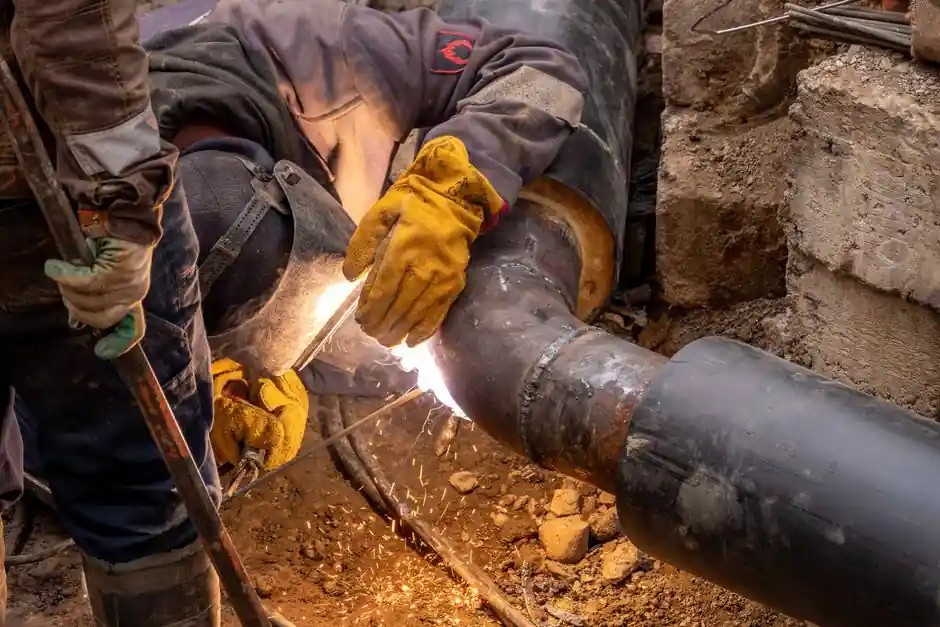
For school buildings, dormitories, and campus utility tunnels, steel-plastic composite pipe (SP-CP) is now the most-specified water and drainage material in Chinese mainland bid documents, with a manufacturer-quoted design life of 50 years [S5].
SP-CP is not a single product, it is a family that includes inner-and-outer plastic-coated steel pipe, steel-belt reinforced SP-CP, steel mesh skeleton SP-CP, perforated steel-strip SP-CP, and seamless steel pipe-reinforced SP-CP, each aimed at a different pressure, temperature, and jointing regime [S5].
What counts as a "steel-plastic composite pipe" in a school spec
In the school-project context SP-CP refers to a steel substrate (welded or seamless) carrying an internal and/or external thermoplastic or thermoset anti-corrosion layer, manufactured by pretreatment, preheating, internal coating, levelling, and post-treatment [S5].
The two structures a campus MEP engineer will see in tender sheets are: (1) inner-and-outer plastic-coated steel pipe, where the anti-corrosion layer is welded or bonded on both faces, used for risers, fire standpipes, and exposed service lines [S5]; and (2) steel-belt reinforced SP-CP and steel mesh skeleton SP-CP, where the steel reinforcement is embedded between two polymer layers for buried water mains where trench width, depth, and bedding material have to be optimised [S1][S5].
Compared with traditional galvanised steel, SP-CP's oxygen-barrier effect allows direct use in drinking-water risers inside dormitories, and both inner and outer plastic layers give the corrosion resistance a humid boiler room or buried clay environment demands [S5].
Selection criteria specific to school water and drainage
For a school bid the four non-negotiable filters are: (1) the pipe must tolerate vibration, water hammer, and thermal expansion in a building that is unoccupied for 10+ hours overnight; (2) the inner wall must meet potable-water hygiene standards for drinking fountains and canteen lines; (3) the material must be recyclable under the school's green-building scoring; (4) the total installed cost, not just the unit metre price, has to fit the budget [S4].
Cold-water buried mains on a campus typically run at 0.6-1.0 MPa working pressure, and the steel-belt reinforced SP-CP variant is built for exactly this pressure class with a smoother inner plastic wall (lower friction loss) than a plain galvanised steel pipe of the same DN [S4][S5]. For hot-water recirculation lines in dormitories, internal plastic-coated steel pipe with a working temperature ceiling around 95°C is the common bid line, while laboratory acid-waste lines need the chemically resistant PE-lined variant.
Trench design is a hidden line item: rigid steel needs wider, deeper trenches with controlled bedding, while steel-reinforced composite pipe is flexible enough to follow building curves, which on a school site full of paved courtyards and tree lines saves both excavation and reinstatement cost [S1].
Comparison: the four SP-CP sub-types against school decision criteria
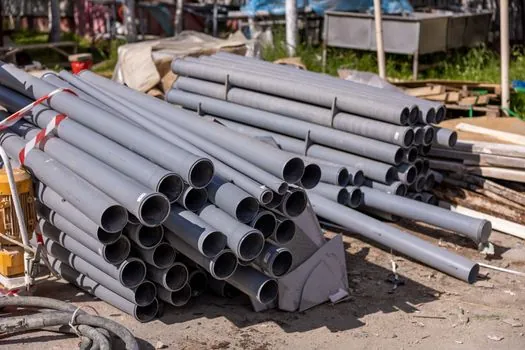
The four sub-types a campus engineer will most often weigh against each other are: inner-and-outer plastic-coated steel pipe, steel-belt reinforced SP-CP, steel mesh skeleton SP-CP, and seamless steel pipe-reinforced SP-CP [S5].
On pressure rating the inner-and-outer coated steel pipe leads (suited to fire standpipes and high-rise risers), steel mesh skeleton SP-CP comes next, then steel-belt reinforced SP-CP for medium-pressure water mains, and seamless-steel-reinforced SP-CP for the most demanding industrial and hot-oil lines a school rarely needs [S5]. On installation cost, steel-belt and steel mesh skeleton variants are the lowest because they accept push-fit or electrofusion jointing with lower labour and lifting equipment demand, compared with the welding or threading typically required by the coated-steel variant [S1][S5]. On corrosion resistance all four rate high because of the polymer skin, but the perforated steel-strip variant is the weakest link in aggressive soil and should be ruled out for direct-bury under playing fields where groundwater is present [S5]. On thermal performance, the seamless-steel-reinforced sub-type handles the widest temperature swing, which matters for boiler-room headers feeding dormitory radiators.
Where SP-CP fits on a school site, and where it should be ruled out
SP-CP is the right call for: dormitory hot and cold risers, canteen and drinking-fountain potable lines, fire hydrant and standpipe networks, buried campus water mains feeding multiple buildings, and rainwater downpipes where the school wants a 50-year design life and is bidding a green-building credit [S5].
SP-CP is the wrong call for: chemical-waste lines from school science labs carrying strong organic solvents (use PP or PVDF-lined pipe instead), and for any run that requires repeated field bending, because coated steel pipe explicitly disallows bending during installation, and cut ends must be repaired with the manufacturer's non-toxic room-temperature-curing glue before further welding or threading [S5]. For more on the broader FRP composite family used in chemical-waste stacks, see the dedicated encyclopedia entry.
Limitations, failure modes, and field quality-control points
The dominant failure mode for SP-CP on a school site is delamination at the steel-polymer interface when installation crews skip the manufacturer's pretreatment and preheating steps; the bond is only as good as the surface prep [S5].
Second on the failure list is mechanical damage to the outer plastic skin during backfill, which then lets groundwater reach the steel substrate; trench design (width, depth, bedding material) directly controls this risk and is the difference between a 50-year and a 15-year service life [S1]. Third, hot-water recirculation lines operating above the polymer's rated ceiling will creep at the joint, so the working-temperature line on the data sheet, not the pressure rating alone, must be checked against the boiler supply temperature. Reinforced composite pipe also has non-standard internal diameters relative to steel nominal sizes, so cleaning pigs and inspection gauges must be re-spec'd rather than reused from the steel era [S6].
Standards, sourcing, and pre-PO checklist
School bids in the China mainland market typically reference the CJ/T 136 family of product standards for SP-CP and the GB/T 17219 hygiene standard for drinking-water liners; campus engineers elsewhere should map these to their local equivalents and request the test report on the actual production batch, not just the catalogue data [S5]. For a primer on the broader category of metal-plastic hybrids used in building services, the steel-plastic composite pipe encyclopedia entry lays out the manufacturing route and welding behaviour a quality engineer will need on the receiving inspection.
Pre-PO checklist for a school campus tender: (1) confirm the sub-type (coated steel vs steel-belt vs steel-mesh) matches the pressure class in the BOQ; (2) confirm the working temperature ceiling covers the boiler supply plus 10°C safety margin; (3) require the manufacturer's written installation procedure including the cut-end repair glue, since bending is not allowed on the coated variant [S5]; (4) require a hydrostatic test certificate for the supplied lot; (5) confirm potable-water hygiene certification for any line feeding drinking fountains or the canteen. For the underlying steel substrate options that the contractor may swap in if SP-CP lead time stretches, the seamless steel pipe reference is worth a cross-read.
Trackable signals over the next procurement cycle: (a) whether the school owner asks for a recycled-content declaration to support a green-building score, which currently drives more SP-CP bids than any strength spec; and (b) whether the campus engineer specifies steel mesh skeleton SP-CP for buried mains in clay soils, where the 50-year design life claim only holds if the bedding material and trench width follow the manufacturer's trench table [S1][S5]. For projects that also touch plastic-only drainage, the plastic pipe reference clarifies where pure-polymer is the cheaper substitute and where it falls short of SP-CP on temperature and pressure.
Related analysis: Digital Twin vs Digital Shadow vs Digital Model: Spec-Level Differences for Industrial.