APP and SBS modified bitumen membranes remain the dominant low-slope waterproofing sheet for school buildings, supplied in 3 mm, 4 mm, and 5 mm thicknesses on 1 m wide rolls of 10 m or 7.5 m length, with GB 18243-2008 as the baseline product certification cited by Chinese exporters [S2].
Two polymer families cover the school-roof use case: atactic polypropylene (APP) for thermoplastic, heat-tolerant caps and styrene-butadiene-styrene (SBS) for elastomeric, cold-flexible base or single-ply assemblies, both built on a polyester (PY) or fiberglass mat with PE film, sand, or mineral granule surfacing [S1][S6].
APP vs SBS: pick the polymer to the exposure profile
APP modified bitumen gains its performance from atactic polypropylene blended into the bitumen, producing a thermoplastic sheet that softens under torch heat, re-hardens into a dense UV-resistant skin, and tolerates service temperatures around 90 °C on exposed roofs, per APP product literature [S1][S5]. The same source notes APP sheets shrug off 60 mm hail when an armored granule cap is specified and remain stable on slopes between 1% and 5% where single-ply seams would risk ponding.
SBS modified bitumen uses styrene-butadiene-styrene thermoplastic elastomer as the modifier and a polyester mat as the reinforcement layer, with PE film, fine sand (S), or mineral granule (M) as upper surfacing [S6]. Self-adhesive SBS grades add SBR plus tackifying resin, reach an initial bond above 5 °C without torch heating, and carry a published working range of -20 °C to 70 °C with elongation at break of 30% or higher [S4]. For deeper context on the cold-storage parallel, see this SBS vs APP spec map for cold storage.
Thickness, reinforcement, and lap geometry for school roofs
Standard school-roof assemblies run 3 mm or 4 mm APP cap sheet over a sand-surfaced SBS base, with 5 mm APP used at high-traffic podium decks where puncture resistance matters; one Chinese product line offers 1.2/1.5/2.0/3.0/4.0 mm self-adhesive SBS in 1 m × 10/15/20 m rolls at 10-20 m² per roll [S4][S7]. Coil width is fixed at 1 m across both APP and SBS product lines, with coil area options of 10 m² (10 m length) or 7.5 m² (7.5 m length) on the typical 3-5 mm APP offering [S2].
Lap width must be 100 mm with the lap sealed separately and the joint filled with a bitumen strip on hot-adhesive construction, per the self-adhesive SBS install sequence [S4]. Upper-surface barriers on Chinese-export APP membrane are selectable as polyethylene film (PE), fine sand (S), or mineral granule (M); the lower face is always PE film for torch-off or peel-and-stick application [S2]. For the broader membrane category, the waterproof membrane encyclopedia entry covers the full sheet family. A general modified bitumen membrane reference consolidates polymer, mat, and surfacing choices.
Where schools differ from warehouses, cleanrooms, and cold stores
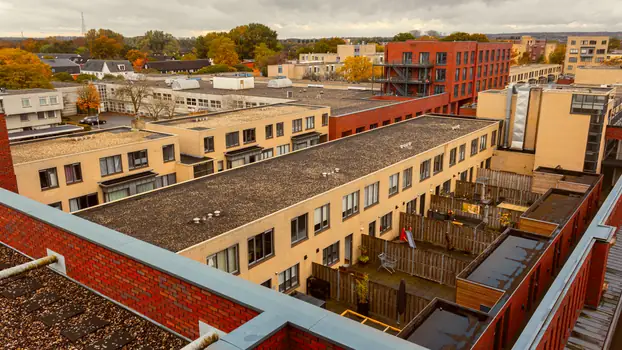
Schools are occupied during construction windows, so cold-process and self-adhered SBS assemblies are preferred over torch-applied APP to keep kettle smoke at zero near classrooms; the same source flags self-adhered and cold-process sheets as the standard pick for offices, schools, and clinics that must stay open [S5]. Cleanroom sub-floors, by contrast, demand tighter vapour and outgassing control, which is why the parallel cleanroom sub-floor selection map leans harder on self-adhered SBS with PY reinforcement and sealed laps.
Unlike cold-storage warehouses, school roofs rarely see sustained sub-zero exposure; the SBS low-temperature flexibility to -20 °C is therefore an over-spec margin for most temperate-school projects, but it remains a useful safety factor in northern climates [S4][S5]. APP's 90 °C heat tolerance is the more relevant discriminator for sun-exposed school roofs in hot regions, where standard asphalt would soften and bleed [S1][S5].
Installation sequence and quality gates
The hot-adhesive construction sequence is fixed: subgrade treatment, additional layer at corners, pipe roots, gutters and expansion joints, large-area laying with non-curing adhesive, air expulsion and compaction, water-tightness test, then protective layer [S4]. The self-adhesive variant replaces the heated bed with a primed deck, peeled release film, and a full-width pressure roller, again followed by water-tightness test and protective layer [S4].
Mod-bit assemblies on low-slope decks average 4.5 kg/m² finished weight, pass FM 1-90 uplift ratings, and can be detailed to keep seams tight at laps heated until asphalt bleed-out is visible, per the Cittrix install playbook [S5]. Routine care is light: drain clearance, pitch-pan reseal, and a top-coat on white cap sheets roughly every ten years to preserve reflectivity [S5]. End-of-life sheets are recyclable into asphalt pavement mix, which keeps demolition waste out of landfill [S5].
Decision rules and what to avoid
Choose APP 4 mm with mineral granule (M) cap for exposed school roofs in hot climates or where hail is a documented risk; choose self-adhered SBS 3 mm with PY reinforcement for occupied teaching blocks, mechanical rooms over classrooms, and any project where torch-applied sheets are restricted [S1][S2][S4][S5]. Specify lap width 100 mm, elongation at break 30% minimum on SBS, and a working temperature window of at least -20 °C to 70 °C for SBS grades [S4].
Avoid bare 3 mm APP without a granule cap on walkable podiums, since UV and foot traffic will age the sheet faster than a mineral-surfaced equivalent, and avoid torch application directly over timber decks in occupied schools; switch to peel-and-stick SBS or cold-process adhesive to control smoke at air intakes [S2][S5]. Confirm GB 18243-2008 or an equivalent ASTM/EN product standard is named on the supplier's data sheet before order release, since the same factory may run both certified and non-certified lines [S2].
Track two signals over the next procurement cycle: published elongation and tensile values on the supplier's per-batch test report, and whether the school district's fire-code section still classifies torch-applied APP as permissible over occupied wood-frame classrooms in your jurisdiction. Both determine whether APP or self-adhered SBS wins the next school-roof tender.
Spec-level background on the components involved: pressure transmitter.