Plastem's CVRAK plastic sealing ring lists internal diameters of 5–6.4 mm (0.20–0.25 in), outside diameters of 12–17 mm (0.472–0.669 in) and thicknesses of 2.7–13.4 mm at a starting price of €0.12 ex-VAT [S1].
DirectIndustry's stainless-steel washer index tracks 89 catalog SKUs from 36 manufacturers, with bore ranges spanning 4–82 mm and thickness envelopes from 1 mm (GN 6343 shim) up to 22 mm (DIN 6319 spherical) [S2].
What a Sealing Washer Actually Does on the Joint
A sealing washer is a flat or shaped ring compressed between a bolt head, nut or port face and the mating flange, where it must (a) close the micro-gap in the thread or face and (b) resist the process fluid on the other side. [S1]
Plastem's CVRAK is illustrative of the simpler duty: a PA (nylon) ring that drops into a CVAKR screw cap to seal a screw head, with a natural colour and millimetre-only dimensional system [S1]. At the other extreme, the HYTORC ZRW reaction washer handles bolt-locking and torque reaction on high-vibration flanges with bores from 15–82 mm and thicknesses up to 10 mm [S2].
Materials and geometry therefore change with duty: plastic and fibre for low-pressure face seals, stainless or elastomer-bonded metal for pressure class up to Class 600, and reaction-washer composites for controlled torque on structural joints. Buying the wrong geometry for the duty — for example, a shim washer in a pressure port — is the most common RFQ error seen in 2026 [S2].
Gate 1 — Fluid, Temperature and Pressure Class
EPDM, FKM (Viton), NBR (Buna-N), PTFE and metal-jacketed graphite each have a defined envelope: NBR suits hydrocarbons to roughly 110 °C, FKM extends to ~205 °C, EPDM handles steam and glycol up to ~150 °C, and PTFE/graphite covers the upper end of the temperature range. [S2]
Pressure class is set by the joint, not the elastomer. A 1/2 in BSPP port with a Buna-bonded sealing washer, as listed on the commodity eBay channel at US $2.96, is rated by the port standard, not by the washer — the washer only needs to survive the system test pressure and medium [S5].
On stainless-steel washers, the DirectIndustry index shows reaction-washer SKUs at 3.1–10 mm thickness, which corresponds to high-vibration flanged joints in oil & gas and structural steel [S2]. Forged and roll-formed load paths are typical for Class 600 and above; thin stamped stainless is not.
Gate 2 — Material Pairing and Galvanic Risk
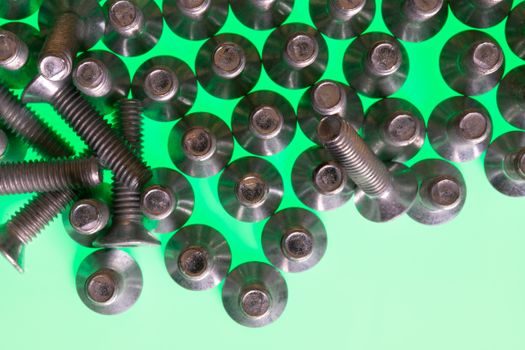
The DirectIndustry editorial guidance is unambiguous: "washers are made from the same material as the screw to avoid any risk of galvanic corrosion" [S2]. On stainless assemblies, AISI 304 (e.g. GN 6343, 1–5 mm thickness range) is the default; AISI 316 is the upgrade when chlorides or marine atmospheres enter the envelope [S2].
Zinc-plated steel gives moderate corrosion resistance at the lowest cost, while zinc-bichromate (yellow) and phosphate coatings shift the surface chemistry and colour for identification. None of these coatings survive in chlorinated or sour service — once chloride concentration or H₂S partial pressure rises, the spec moves to stainless or to a bonded elastomer-on-metal sealing element.
When the fastener is carbon steel and the joint is stainless, the washer must be a non-conductive barrier (EPDM-, PTFE- or PA-bonded), or galvanic pitting will eat the fastener. The PLASTEM CVRAK ring is one example of using PA as both seal and insulation layer [S1].
Gate 3 — Geometry, Standard and Cert Scope
Three standard families dominate the 2026 catalog: DIN 6319 spherical (bore 6.4–56 mm, OD 12–92 mm, thickness 2.3–22 mm) for non-parallel flange faces; GN 6343 shim washers (bore 4–16 mm, OD 8–30 mm, thickness 1–5 mm) for levelling in jigs; and RIPP-LOCK radial-rib lock washers (bore 4.3–31.02 mm, thickness 2–6.3 mm) to replace spring washers in vibration duty [S2].
Sealing-washer standardisation is thinner than for plain washers. BSPP, NPT, SAE J1926 and ISO 6149 each define the O-ring boss and the elastomer hardness, while sanitary and pharma builds need FDA 21 CFR 177.2600, USP Class VI or 3-A Sanitary Standards on the elastomer. Potable water builds in the EU additionally call for WRAS, DVGW W270 or KTW approval on the elastomer.
For sour service (NACE MR0175 / ISO 15156), the constraint is on the metal: 316L with hardness ≤ 22 HRC is the typical boundary; the elastomer is selected separately for H₂S compatibility. Without that metals-side cert, the washer is not fit for sour hydrocarbon service regardless of the elastomer chosen.
Gate 4 — Vendor, Cert Evidence and Lead Time

Stainless-steel washer sourcing on DirectIndustry in mid-2026 shows 36 manufacturers and 89 SKUs aggregated, with reaction-washer specialists (HYTORC), spec-stocked stainless (GANTER / GN 6343, 6344), and lock-washer specialists (RIPP-LOCK) as the three supplier clusters [S2].
Commodity duty, by contrast, is dominated by trade channels: 1/2 in BSPP sealing washers with Buna seals list on eBay at US $2.96 per piece, brand-new in retail packaging, and Geberit/RAK Compact 600 toilet-valve sealing washers at GBP 3.99 — pricing that frames the floor for non-engineered builds [S5][S6].
For engineered builds, request the cert pack (material certificate to EN 10204 3.1, FDA/WRAS/3-A dossier, NACE MR0175 statement, and PPAP or FAI for safety-related joints) before issuing the PO. If a vendor cannot supply EN 10204 3.1, the unit price advantage evaporates under audit.
Plastic vs Metal vs Bonded — Decision Comparison
Three material families cover almost every 2026 sealing-washer RFQ: plastic rings such as PLASTEM PA at €0.12 from, stainless shims/reaction washers from ~1 mm thickness upwards, and elastomer-bonded metal (Buna-, EPDM-, FKM- or PTFE-faced) for threaded port sealing. The PLASTEM CVRAK lists 5–6.4 mm bore at 2.7–13.4 mm thickness for a low-pressure cap seal [S1]; GN 6343 stainless runs 4–16 mm bore at 1–5 mm thickness for jig levelling [S2]; DIN 6319 stainless spherical runs 6.4–56 mm bore at 2.3–22 mm for non-parallel flange clamping [S2].
For low-pressure face caps and screw-head covers, plastic (PA, LDPE) is the lowest-cost, lightest, dielectric choice. For mechanical-engineering shimming and structural joints, stainless (AISI 304 default, 316 for chloride exposure) is the workhorse. For threaded ports under pressure and temperature cycling, elastomer-bonded metal (Buna, EPDM, FKM, PTFE-faced) is the only category that combines a metal load path with a compliant seal — and that combination is exactly what a 1/2 in BSPP Buna-sealed washer delivers at the commodity tier [S5].
Engineers should reject any RFQ response where the vendor cannot identify (1) the elastomer compound and hardness, (2) the metal grade and any surface treatment, and (3) the relevant cert dossier. The absence of any one of those three is the most reliable signal of a non-engineered, non-auditable part.
For buyers building a complete joint cost model, pair this spec map with the Sealing Washer Selection: Four-Gate Spec Map for Buyers reference and cross-check fastener/load-path behaviour against a Bellows Seal vs Gland Packing: Spec-Driven Selection Map when the joint is a valve stem rather than a static flange. For elastomer selection on the polymer side, the Rubber Tubing Price and Cost Guide 2026: Polymer, Spec, Pack and Sourcing reference covers the same compound families in a different geometry. For background on the underlying sealing washer family and its relationship to spring washers versus linear guide rail scrapers, the encyclopedia entries give the wider taxonomy.
Track the next two signals before the next RFQ cycle: (1) any change in the EN 10204 3.1 / NACE MR0175 dossier format from the major stainless-washer OEMs on DirectIndustry, and (2) the PLASTEM CVRAK pricing tier — a move off the €0.12 floor is an early read on PA resin cost.