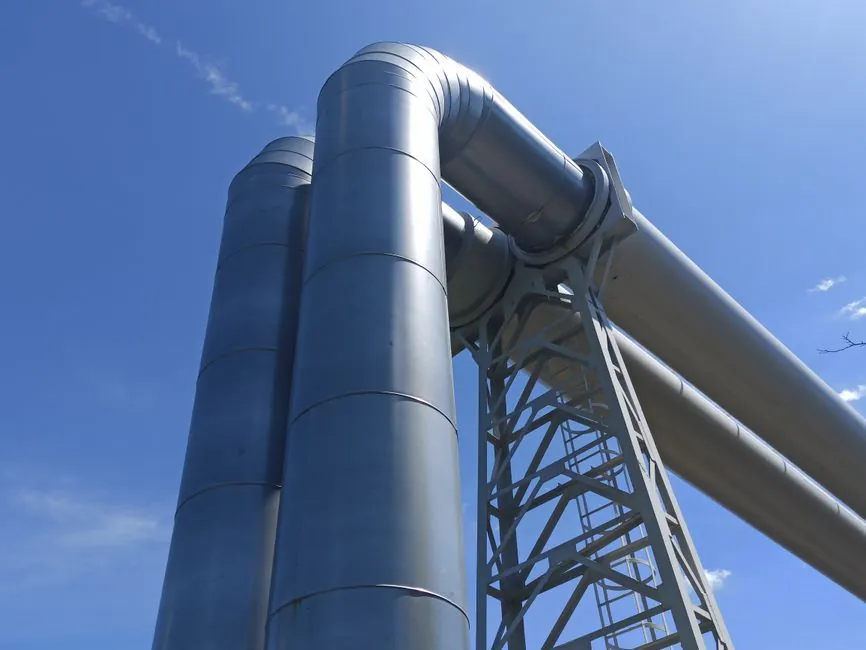
Seamless pipe for boiler tube service is specified to small-diameter (OD typically 1/4 in to 4 in), high-temperature, high-pressure standards (ASTM A192, A210, A213, A335, ASME SA-106, SA-213, SA-335), while line pipe service uses API 5L by nominal diameter and schedule at 30-80% lower cost [S1][S3].
The selection pivot is service class: boiler tubes demand seamless construction because weld seams under cyclic thermal stress are a documented failure-initiation point, whereas line pipe can be welded where the duty allows, governed by API 5L and ASME B31.3/B31.4 [S1][S2][S3]. For a deeper dive on pressure-service selection, see the comparison Seamless vs Welded Steel Pipe for High-Pressure Service: Spec-Driven Selection.
Defining the Two Service Classes
Boiler tubes are defined as hollow open-ended steel products with a large length-to-circumference ratio, transmitting high-temperature, high-pressure media in power, petrochemical, and metallurgical plants, where quality directly governs equipment safety and service life [S4]. In practice, boiler tube duty is split: general boiler pipe operates below 450°C and is produced by hot rolling or cold drawing, while high-pressure boiler pipe must resist oxidation, flue-gas corrosion, and creep at sustained elevated temperature, requiring high durable strength and microstructural stability [S1].
Line pipe, by contrast, is specified by nominal diameter and schedule (for example, 6 in Schedule 40 means 168.3 mm OD with 7.1 mm wall) and conveys fluids or gases in oil and gas transmission, water distribution, and process systems under API, ASME B31, and ISO rules [S3]. The key differentiator is the controlling standard family: ASME/EN/ASTM/GB 5310 for boiler tube, API 5L plus ASME B31.3 or B31.4 for line pipe, with seamless seamless steel pipe being the common construction method for both when pressure and temperature warrant.
Material and Standard Map for Boiler Tubes
Boiler tube material selection runs across three families. Carbon steel is covered by ASTM/ASME A/SA 106, ASTM A179, ASTM A192, ASTM/ASME A/SA 210, and ASTM A333 Grades 1, 6, 7 through 9; alloy steel by ASTM/ASME A/SA 213 T1, T2, T5, T9, T11, T12, T22, T91, T92 and ASTM A335 P1, P2, P5, P9, P11, P12, P22, P91, P92; stainless steel by ASTM A268, ASTM A213 with grades TP304/L, TP316/L, 310S, 309S, 317, 317L, 321, 321H, and duplex grades [S1]. Common dimensional envelope runs OD 6 mm to 1240 mm and wall thickness 1 mm to 50 mm, though in practice the bulk of boiler pipe is small-bore, OD under 1 1/2 in (1/4, 1/2, 3/4, 1, and 1 1/2 in nominal), extending to 2, 2 1/2, 3, and maximum 4 in [S1].
For Chinese-market or Chinese-supplied projects, the equivalent is GB 5310 seamless steel pipe for high-pressure boilers, designed for high-pressure boiler systems using carbon, alloy, and heat-resistant steel [S4][S7]. European equivalents route through EN 10216-2 for seamless and EN 10217-2 for welded pressure purposes, replacing the US/ASME code body for EU-sourced tube [S4]. The P-number and T-number system in ASME Section IX is how alloy grades are grouped for welding procedure qualification, with T91/P91 and T92/P92 being the modern creep-resistant ferritic-martensitic grades replacing older T22/P22 in ultra-supercritical plants.
Material and Standard Map for Line Pipe
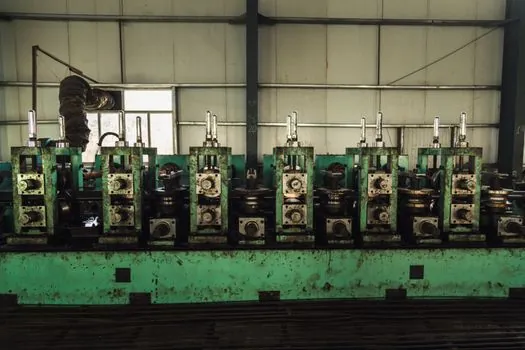
Line pipe is governed by API 5L, which specifies product specification levels PSL 1 and PSL 2 across grades A, B, X42, X46, X52, X56, X60, X65, X70, X80, X90, X100, and X120, with the higher grades requiring tighter chemistry control, lower sulfur, mandatory CEV limits, and Charpy impact testing at PSL 2 [S3]. The pipe-vs-tube distinction is administrative: pipe is dimensioned by nominal diameter and schedule for pressure service (fluid or gas containment), while tube is dimensioned by exact OD and wall for mechanical or structural use, with both using identical seamless or ERW manufacturing equipment [S3].
The relevant piping codes are ASME B31.3 for process piping (refineries, chemical plants, utilities), ASME B31.4 for liquid hydrocarbon pipelines, and ASME B31.8 for gas transmission. For sour service, NACE MR0175/ISO 15156 limits hardness and governs material selection to prevent sulfide stress cracking. Corrosive CO2/H2S service typically pushes selection toward CRA-lined carbon steel, 13Cr, 22Cr, or 25Cr duplex stainless, or solid alloy 825/625 cladded pipe, none of which are first-cost-optimized but all of which are required when partial-pressure H2S exceeds the NACE threshold.
Seamless vs Welded: Cost, Performance, and Limits
Seamless pipe commands a 30-80% price premium over equivalent welded pipe, driven by piercing-rolling equipment cost, billet heating to 1,200-1,250°C, lower throughput of 20-60 t/h versus 100-200+ t/h for welded mills, 85-90% material yield against 95-98% for welded, and a $50-100/t billet-vs-coil feedstock spread [S3]. Welded boiler tubes are typically 20-30% more cost-effective than seamless equivalents, with lower material loss and higher production efficiency, though they pay an inspection tax (X-ray, ultrasonic) to verify seam integrity [S4].
Seamless wins where pressure rating, high temperature, or cyclic thermal fatigue rules out a seam; for boiler tubes this is essentially mandatory per the cited boiler-tube references, which state welded tubes are generally not applicable for critical services because seam integrity limits under cyclic thermal stress [S1][S2][S3]. The size ceiling is roughly 650 mm OD for seamless; above that, welded LSAW or HSAW is the only technically and economically available route, and most seamless stock stops at 24 in [S3][S5]. Manufacturing variables also bite: seamless tube OD and wall can vary more than welded because of piercing dynamics, while welded tube delivers tighter dimensional consistency and surface finish for heat-exchanger bundle fabrication where precise tolerances matter [S4].
Decision Matrix: Pick the Right Spec Path
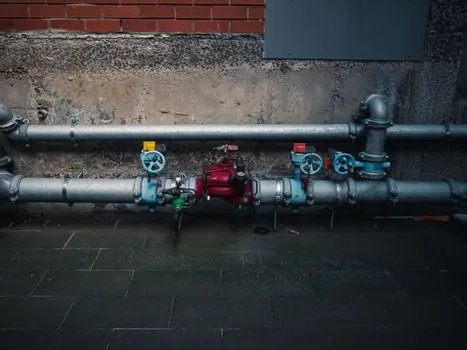
Use the following four-criterion comparison when choosing between the two spec paths. The decision is governed by service duty, not preference. [S3]
Temperature and pressure envelope: boiler tube service (steam, superheat, reheater) generally runs above 450°C and at high internal pressure, mandating seamless per ASTM A192/A210/A213/A335 with T91/P91 or T92/P92 for ultra-supercritical; line pipe service in oil and gas transmission typically runs below 200°C and at lower hoop stress, allowing welded API 5L with seam NDT [S1][S3]. Diameter: small-bore boiler tube falls inside the seamless sweet spot (OD 1/4 to 4 in); line pipe spans everything from 1/2 in gathering lines through 48 in trunk lines, where welded construction becomes mandatory for cost and size reasons [S1][S3][S5]. Inspection regime: seamless gets hydrostatic and uniformity testing without seam NDT, while welded always pays for radiographic or ultrasonic seam inspection per the applicable code [S4][S5]. Cost premium: seamless runs 30-80% over welded for line pipe, and 20-30% over welded for boiler tube, so the premium is harder to justify in line-pipe service unless pressure rating or sour-service NACE compliance forces it [S3][S4][S5].
Use Cases, Failure Modes, and Sourcing Signals
Boiler tube service routes to seamless ASTM A192 (low-carbon steel for low/medium pressure) and ASTM A210 (medium-carbon for higher temperature) for carbon-steel selections, with alloy grades T11/P11, T22/P22, T91/P91, T92/P92 from A213/A335 covering higher-temperature creep duty [S1][S4]. Stainless and duplex boiler tubes (TP304/L, TP316/L, 321, 321H) address corrosion and oxidation, with duplex grades used where chloride stress corrosion cracking is a concern. Line pipe routes to API 5L PSL 2 for transmission duty, with grade selection driven by design factor, operating pressure, and required fracture toughness (Charpy at 0°C or lower); sour-service projects overlay NACE MR0175 with hardness caps and CRA selections [S3].
Common failure modes differ by service: boiler tube failures concentrate at tube-to-tubesheet joints, weld-affected zones in reheat/superheat sections, and from creep cavitation in aged T22 installations; line pipe failures concentrate at seam defects in older ERW, at girth-weld defects, and at third-party damage or corrosion at the bottom of the pipe [S4][S5]. Inspectability matters: welded tube and pipe both require radiographic or ultrasonic seam testing to be specified in critical service, while seamless skips that step but must still pass hydrostatic, dimensional, and NDT per the relevant ASTM or API standard [S4][S5]. A practical sourcing signal is that the bulk of boiler pipe is small-bore, OD under 1 1/2 in, with stock readily available in carbon and common alloy grades, while line pipe in API 5L B through X70 is broadly stocked in welded and available in seamless with longer mill lead times. Trackable next nodes: API 5L PSL 3 specification rollout status and updates to ASME B31.3/B31.4 are the two standards movements that will most directly shift spec choices for line pipe in 2026.
For component-level specifications, see molding line, and automatic molding line.