Seamless steel pipe sizing is governed by four interlocking parameters: outside diameter (OD), wall thickness (schedule), material grade, and the manufacturing/inspection standard stamped on the pipe, with OD ranges from 10 mm up to 1200 mm and grades from carbon (10#, 20#, 45#, ASTM A106 Gr.C) to austenitic stainless (TP304, TP316L) and duplex [S2][S3][S4].
Buyers in oil and gas, power, chemical, and construction treat the seamless variant as the default for high-pressure, high-temperature, and cyclic service because rotary-pierced or cold-drawn production eliminates the weld seam, the recognised initiation point for corrosion and fatigue cracking [S1][S2]. Standards written for these duties (ASTM A106, ASTM A53, API 5L, GB/T 8163, GB 18248) all require mandatory hydrostatic testing, with dimensional and mechanical tolerances that welded pipe in the same nominal size cannot always meet [S3][S4][S8].
OD, Wall, and Schedule: The Three Numbers That Decide Everything
OD spans 10-1200 mm in the current merchant market, while wall thickness is most commonly called out by schedule (SCH 40, SCH 80, SCH 160, XXS) for ANSI/ASME B36.10/B36.19 lines or by direct millimetre callout for GB and DIN lines [S3][S4]. Two pipes with the same 6 in nominal size can differ by more than 2x in wall mass between SCH 40 and SCH 80, so the schedule choice is the single biggest lever on pressure rating, weight, and unit cost [S3].
For process lines, ASME B36.10 covers carbon and alloy, B36.19 covers stainless; both use the same schedule numbering, but the resulting pressure ratings differ because allowable stress is grade-dependent. The steel pipe basics reference page covers how schedule numbers map back to wall in inches and millimetres. Where service includes H2S (sour service), NACE MR0175/ISO 15156 imposes additional hardness, chemistry, and qualification limits that can override the cheapest grade that otherwise meets ASME stress [S8].
Grade and Standard: Match the Line, Not the Catalog
Carbon-steel seamless pipe is dominated by ASTM A106 Gr.B/Gr.C for high-temperature service, ASTM A53 Gr.B for general/process, API 5L Gr.B/X42-X80 for linepipe, and GB/T 8163 20# / GB 3087 20G for boiler and Chinese pressure-piping work [S3][S4]. Stainless grades split cleanly by duty: TP304 and TP316L cover general chemical and sanitary service, TP321, TP347H, and TP310S cover elevated-temperature boilers and superheaters, and duplex/super-duplex is the default for chloride-bearing marine and offshore process [S2].
Gas-cylinder seamless tube is a separate branch under GB 18248 with grades 37Mn, 30CrMo, 34Mn2V, 35CrMo, 34CrMo4, and 30CrMnSiA, each picked for a specific strength/toughness window and not interchangeable with linepipe grades [S8]. The seamless steel pipe reference page lists the full standard/grade matrix. Mechanical and honed tubes for hydraulic cylinders (H8, H9, H10 tolerance, cold-drawn) are a third branch that overlaps with structural seamless but is held to tighter ID roundness and surface finish [S5].
Selection Criteria: A Comparison Across Duty Profiles
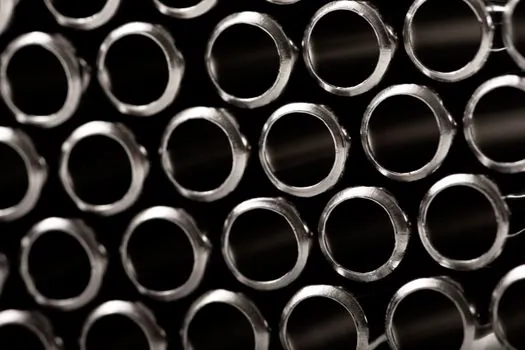
Comparing the four duty profiles buyers actually specify: high-pressure process line (ASTM A106 Gr.C, SCH 80, OD 50-300 mm), high-temperature boiler (GB 3087 20G or TP347H, SCH 40 to SCH 80), sour-service linepipe (API 5L X65 + NACE MR0175, SCH 40 to SCH 80, hardness ≤ 22 HRC), and chemical-corrosion service (TP316L or duplex, SCH 10S to SCH 40S for stainless) [S2][S3][S4][S8]. On three decision criteria, the ranking shifts: for raw cost per metre, ASTM A53 Gr.B leads; for high-temperature strength, TP347H and 20G lead; for chloride pitting resistance, duplex beats 316L by a wide margin at a higher alloy surcharge; for sour-service qualification, only API 5L + NACE MR0175 grades are accepted [S2][S8].
Two specifications, the same nominal 4 in pipe, can therefore span roughly US$499-5,999 per ton on the merchant market depending on grade, schedule, and the order quantity, with MOQs from 1 ton for stocked GB 45# to 25 tons for API-certified SMLS shipments from Tianjin [S4][S6]. FOB Tianjin and Shanghai are the dominant shipment ports for Chinese mill exports, with 25-day typical delivery for stocked API SMLS pipe [S6]. The 316L spec and supplier map walks through how semiconductor-grade orders diverge from standard 316L on testing, traceability, and surface finish.
Manufacturing Routes and Their Sizing Limits
Hot-rolled seamless (piercing + elongation) covers the bulk of OD 60-720 mm and is the cheapest route for thick-wall structural and linepipe material [S3][S5]. Cold-drawn seamless tightens OD/WT tolerance, improves surface finish, and is required for honed hydraulic tube (H8-H10) and for precision applications where hot-rolled scale and ovality are unacceptable [S5]. For OD above ~720 mm, the cost-per-ton rises sharply because most mills top out at 720-820 mm in standard product lines, with the 1200 mm upper bound achieved by a handful of large-piercing mills and not on every grade [S3][S4].
Mill selection therefore constrains sizing: Liaocheng-area mills (Shandong) typically publish OD 10-426 mm carbon and stainless seamless, 316L included, with cold-drawn honed tube as a separate line; Pan-Steel and similar trading houses quote up to 1200 mm on rolled plate-pipe or large-pierce SMLS but with longer lead times [S4][S5][S7]. The steel-plastic composite pipe page is the natural next read for buyers who find seamless steel over-spec for their corrosion duty.
Who Should NOT Pick the Cheapest Carbon Seamless
Three service classes are wrong for the cheapest ASTM A53 Gr.B or 20# offering: (1) any line with sustained metal temperature above ~400 degC, where A53/A106 Gr.B yield drops and creep dominates, requiring 20G, TP321, TP347H, or TP310S instead [S2][S3]; (2) any sour-service line per NACE MR0175, where unlisted carbon grades routinely fail hardness limits even when the strength and chemistry look adequate on paper [S8]; (3) chloride, seawater, or HCl-bearing process service, where 304/316 will pit or SCC long before the wall is mechanically worn out, and only 316L with low carbon, duplex, or higher alloys will hold [S2].
Also worth ruling out: cold-drawn honed tube is overkill for non-hydraulic structural service and adds 30-60% on the ton price versus hot-rolled equivalent [S5]. Specifying SCH 160 or XXS where SCH 40 already covers the design pressure is the most common waste in small-bore process piping, and the flange price map shows how over-spec'd pipe cascades into over-spec'd flange classes on the same line.
Acceptance Testing and What to Demand on the MTC
Every spec'd seamless shipment should arrive with a mill test certificate (MTC) to EN 10204 3.1, listing heat number, chemistry, mechanical properties (yield, tensile, elongation), and hydrostatic test pressure or non-destructive test method [S2][S3]. For sour service, the MTC must additionally confirm hardness (typically ≤ 22 HRC per NACE MR0175), HIC/SSC test results where required, and traceability from billet to pipe [S8]. For stainless sanitary, surface roughness (Ra), pickling/passivation status, and PMI (positive material identification) verification on each end are non-negotiable [S2].
Watch-outs from 2025-2026 sourcing: merchant SMLS at API 5L specs is widely available ex-Tianjin at US$630-725/ton with 25-ton MOQ, but NACE MR0175 + HIC-tested linepipe is a separate quote and longer lead time [S6]. ISO 9001:2008 is the most commonly listed mill certification on Chinese exporter sites, with EN, ASTM/ASME, and JIS production referenced in the same MTC line, so the buyer should not infer dual certification from a single reference [S9].
Shortlist Logic and Trackable Signals
A defensible shortlist: (1) ASTM A106 Gr.B or A53 Gr.B SCH 40 for non-sour utility process below 400 degC; (2) GB 3087 20G or ASTM A106 Gr.C SCH 80 for boiler and high-temperature process; (3) API 5L X65 + NACE MR0175 for sour linepipe, hardness and HIC called out on MTC; (4) TP316L or duplex for chloride or acid service, with PMI on each pipe end [S2][S3][S8]. Track for the next sourcing cycle: 316L semi-conductor grade uplift (tighter Ra, full traceability, longer mill lead times) and Tianjin/Shanghai FOB spread for API SMLS versus GB 8163 carbon lots.