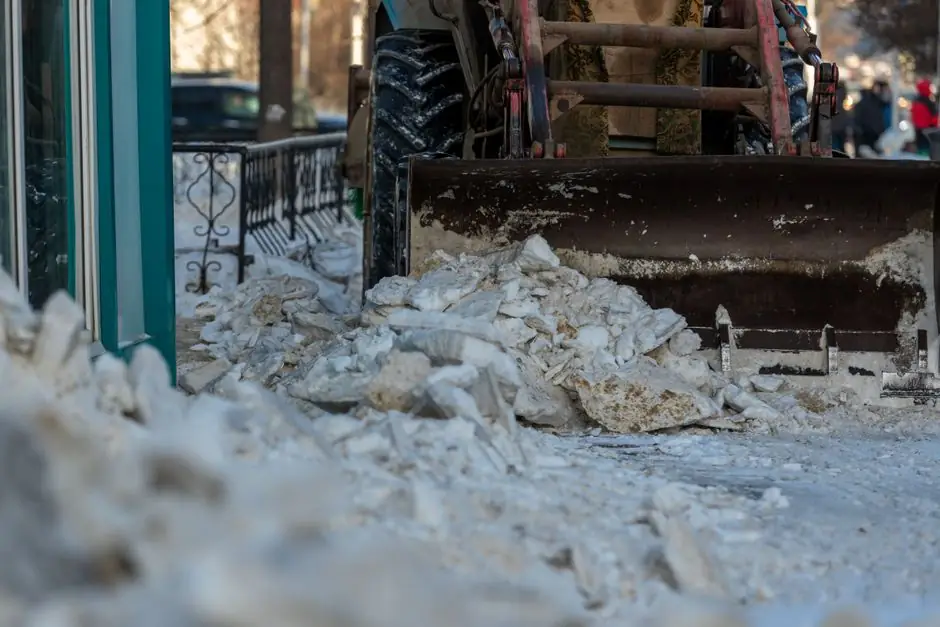
Henderson's reversing and oscillating underbody scrapers feature 1 in-thick moldboards available in 10, 11, and 12 ft lengths [S1].
The equipment serves municipal trucks and industrial snow fleets that need pavement access, turning-radius clearing, and additional plow coverage without replacing the vehicle’s primary body or front-mounted plow [S2][S3].
Underbody scraper geometry and operating scope
An underbody scraper is a hydraulically operated blade mounted beneath a truck, where it attacks residual snow and compacted ice after a front plow has opened the roadway [S3]. The available fixed-angle, reversing, and oscillating architectures determine how directly the operator can steer the blade and whether the attachment can reshape the road surface [S1][S7].
Typical published dimensions make the geometry concrete. Henderson reversing and oscillating models use a 1 in thick moldboard available in 10 ft, 11 ft, and 12 ft lengths [S1].
The scraper complements rather than replaces the dump truck front plow. The Falls Underbody Scraper can be mounted in combination with a Falls Snow Wing [S2].
Fixed angle, reversing, and oscillating mechanisms
Henderson’s fixed-angle design uses single-lever operation and simplified hydraulics, making it the least mechanically complex option in that manufacturer’s range, while its heavy-duty reversing and oscillating versions use two double-acting power-reversing cylinders [S1].
Both Henderson reversible and oscillating scrapers reach plowing angles up to 45° [S1]. The oscillating model adds two oscillating cylinders that tilt the moldboard up to 6° in either direction, allowing the operator to correct surface irregularities, reshape shoulders, and rebuild the road crown [S1].
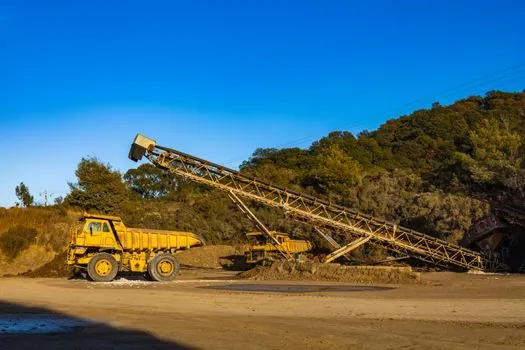
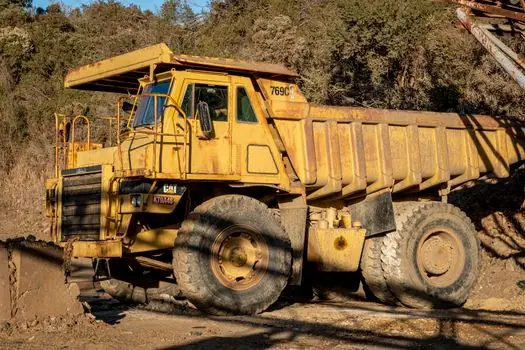
The mining dump truck comparison is therefore not defined by blade width alone, but by the intended correction path, namely a fixed attack angle, power reversal, or trip-edge discharge.
Selection criteria for municipal and industrial fleets
Fleet matching starts with the truck’s permitted underbody envelope, hydraulic capacity, axle and suspension arrangement, and expected snow density. A 10 to 12 ft moldboard is a meaningful width decision, but blade length alone does not establish compatibility; mounting geometry and hydraulic supply still need verification against the truck configuration [S1].
Material thickness provides a second comparison. Published steel thicknesses range from 0.5 in for Everest’s 10 ft and 11 ft full-trip moldboard to 1 in for Falls and Henderson designs [S1][S2][S5]. Henke’s assembly uses a solid 2.5 in hinge shaft, four hinge-anchor points, and hangerboard circle clamps, identifying the mount and hinge system as additional specification checks rather than blade-width-only decisions [S6].
Operators should also compare hydraulic pressure, control count, and intended maneuverability. Falls specifies consistent hydraulic pressure through an accumulator system and includes a 500 PSI reducing valve [S2]. Henderson uses single-lever control on its lightweight fixed-angle model but two double-acting cylinders on the reversing and oscillating models [S1].
Where underbody scrapers create operational value
Underbody scrapers get operators to pavement sooner, support travel over ice, clear the turning radius, and increase the plowing impact of a truck fleet [S3]. These functions matter most after the front plow has displaced the main snow mass, leaving a residual layer that a conventional blade mounted above the chassis may not contact.
The attachment is well suited to municipal trucks, highway departments, site operators, and industrial fleets working routes where compacted residual snow and ice accumulate. Falls explicitly lists municipal trucks as compatible machines and offers the scraper with a snow wing for combined operations [S2]. An Everest customer who is the Ghent, New York, highway superintendent reports using more than 80 pieces of equipment to maintain 142 lane miles of highway [S5].
For a broader equipment context, an aerial work truck is not the direct category for this attachment, because an underbody scraper serves pavement treatment rather than elevated work access. The relevant comparison remains among dump trucks, municipal trucks, and industrial site vehicles with compatible frames, mounts, and hydraulic systems.
Hard ice, road shape, and operating limitations
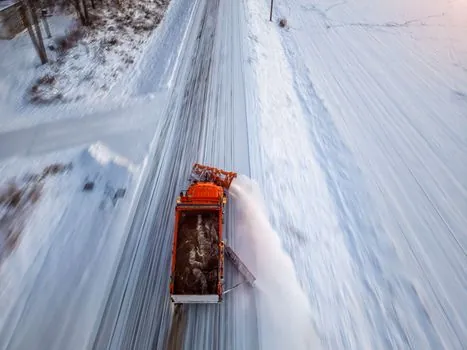
Hard-packed snow and ice require sufficient moldboard strength, mounting strength, and hydraulic control to prevent the blade from riding over the material. Cives identifies its trip-edge mechanism specifically for urban use and hard-ice removal [S4].
A reversible scraper changes the operator’s steering intent, but it does not create unlimited lateral movement: Henderson’s published limit is 45° for both reversing and oscillating models [S1]. The oscillating version adds a much smaller 6° tilt range, but that movement serves a different function, namely surface correction rather than large-angle steering [S1].
Underbody mounting also creates constraints that a broad front plow does not share. The blade must clear the truck’s axles, driveshaft, fuel tank, brakes, and other undercarriage components through the intended angle and trip cycle. Published material does not establish a universal clearance dimension, so installers must verify the manufacturer’s drawings against the selected chassis rather than applying a generic value.
Hydraulics, installation, and service decisions
Hydraulic architecture should be selected around the operating duty rather than reduced to a single pressure number. Henderson’s two double-acting cylinders provide power reversal or oscillation, while its fixed-angle model uses simpler hydraulics and one operating lever [S1]. Falls combines an accumulator with a 500 PSI reducing valve to support consistent pressure under load [S2].
Installation access matters because the equipment sits below the vehicle. Henderson describes easy installation and removal for its lightweight fixed-angle scraper [S1]. Henke specifies a 2.5 in solid hinge shaft, four anchor points, and circle clamps for the mount, which gives an installer defined structural features to inspect during setup [S6].
Municipal procurement should request the model-specific service manual, mounting drawings, hydraulic schematic, blade material specification, and compatibility list. The Falls product page separates its downloadable specification sheet from dealer and service resources, while manufacturer ranges span several mechanisms and lengths [S1][S2].
Procurement specification and operating checklist
A defensible purchase specification states blade type, moldboard length, steel thickness, radius or profile, maximum operating angle, hydraulic-cylinder count, pressure-control provisions, mounting hardware, and the compatible chassis population. Published reference configurations include 10, 11, and 12 ft lengths, 0.5 in and 1 in thicknesses, a 17 in radius, 45° reversing or plowing limits, and 6° oscillation [S1][S2][S5].
Specification comparisons support a clear selection rule. Fixed angle suits fleets prioritizing straightforward controls, reversing suits routes requiring directional steering, oscillating adds crown and shoulder correction, and trip-edge architecture concentrates on hard-ice removal [S1][S4][S7].
Before service begins, inspect the 2.5 in hinge shaft and four hinge-anchor points where applicable, verify the hydraulic pressure-reducing setting, test blade movement through its full published angle, and confirm undercarriage clearance [S1][S2][S6]. For a municipal or industrial fleet manager, the next trackable signal is the number of route vehicles receiving a compatible underbody mount and hydraulic package, not a generic plow-purchasing total.