UHMW-PE dump-truck bed liners from 1/4 to 1/2 in thick combine high abrasion resistance, impact tolerance and material release for rock, sand, gravel and crushed aggregate [S1][S3][S4].
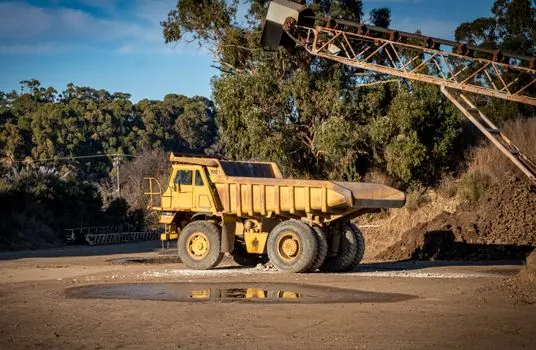
The selection applies to construction and mining dump trucks carrying coal, sharp-edged stone and abrasive fines, where payload, wear life, repairability and unloading performance determine the practical liner specification [S3][S8].
UHMW-PE Fit for Abrasive Rock Hauling
Mentor Dynamics offers Dyna-Flo UHMW dump-truck liners for light- and heavy-duty applications, stating that their surfaces reduce sticking and allow material to flow more efficiently. A rock-focused UHMW-PE product from Dyna-Flo lists rock, dirt, sand and gravel as its intended loads, while the Rockhard range identifies gravel, sand and rocks as constant-impact and sliding service conditions [S3][S7].
UHMW-PE is not merely a generic replacement for steel. These manufacturer claims establish product positioning, not an independent lifetime guarantee, so field wear should be measured against the same rock profile and cycle count.
Operators evaluating body construction and liner integration can use the dump truck reference to distinguish the carrier from the replaceable wear layer.
Thickness and Width Set the Operating Envelope
For abrasive service, the most credible dimension range is 1/4–1/2 in for heavy-impact rock liners, with 3/8 and 1/2 in providing a greater wear allowance than 1/8 or 3/16 in general-purpose products [S4]. RRR Supply's Extra Super Slippery liner is available in 1/8, 3/16, 1/4, 3/8, and 1/2 in thicknesses and 80, 92, 96, and 120 in widths.
Width affects installation around load-contact zones. Ten-foot-wide liners are specifically promoted for eliminating sticky or frozen corners, and For the mining dump truck class, the liner must cover the intended impact and flow path without creating an unsupported transition at the floor, sidewall or tailgate.
Thicker material does not automatically provide the best specification. For moderate impact and abrasive wear, the decision must balance wear life, impact resistance, added body weight, weldability and repair speed [S8]. If a truck carries lighter abrasive loads, a thinner UHMW-PE grade may preserve more payload; if sharp rock repeatedly strikes the floor and sidewalls, the upper end of the thickness range is more defensible.
UHMW-PE, HDPE, Steel and Rubber Compared
UHMW-PE is the preferred starting point for rock, sand and gravel because the cited product family combines abrasion resistance, good impact resistance, low surface adhesion and near-zero water absorption [S3]. HDPE liners are also used where constant impact and sliding from gravel, sand and rocks must be tolerated, but the cited product description does not establish the same wear-life envelope as the rock-focused UHMW-PE products [S7].
Rubber liners provide excellent impact resistance and cushioning while reducing noise and vibration during dumping. UHMW-PE occupies the abrasive-rock middle ground because it targets both wear and impact without accepting steel dead weight.
Service Temperature and Release Properties
Standard rock-duty UHMW-PE should not be specified from asphalt temperature ratings. Linings Inc. lists QuickSilver among its dump-truck liner products. The Rhodes Works High Temperature liner is designed to haul hot asphalt up to 400°F.
Those temperature figures describe specific heat-capable products, not the maximum operating temperature of every rock liner. For rock hauling, material release is still important because fines and damp fragments can compact in corners. Silicone-enhanced UHMW-PE products are documented for sticky-material release, and the QuickSilver formulation combines that function with heat stabilization [S2][S3].
RRR Supply describes its Extra Super Slippery liner as UV stabilized to prevent cracking from the sun. This matters for open beds exposed to sunlight between cycles, but UV resistance does not establish abrasion life or mechanical impact limits.
Repair, Installation and Wear-Life Decisions
Repairability can extend liner economics where the damage is localized. Plastic welding must remain compatible with the installed liner grade, thickness and additive package; a repair procedure designed for one UHMW formulation cannot be assumed for every product.
The useful wear metric is not calendar age. Track cubic metres or tonnes moved, average rock size, maximum retained particle size, moisture, impact frequency and the liner location that fails first. The Rockhard description identifies constant impact and sliding by rocks, sand and gravel as the governing mechanical loads [S7], while the moderate-impact mining guide specifically calls for balancing wear life against payload, weldability and repair speed [S8].
For fleet-level planning, compare liner replacement labour and body repair frequency against the mass added by 1/4, 3/8 or 1/2 in material. No responsible calculation should apply a vendor’s comparative lifetime claim to a different rock profile without site data.
Procurement Specification for Rock Beds
A purchase specification should state the load as rock, gravel, sand, coal or crushed concrete, then define maximum particle size, impact severity, target temperature, moisture, unloading cycle and acceptable repair method. Require the supplier to identify the polymer family and thickness rather than accepting a generic “plastic liner” description. UHMW-PE is the documented default for abrasive service [S1][S3], while HDPE and steel require a more specific justification [S5][S7].
Dimensions should be checked against the body floor, sidewalls, tailgate, corner radii and mounting or welding details. Commercial rock liners span 1/4–1/2 in thickness and 96–144 in widths, while general-purpose polyethylene liners extend from 1/8 in and 80 in widths [S4]. Installation details also matter for aerial work truck bodies only where a service body carries abrasive material, since that platform category is governed by a different load-handling function.
Verification should close the loop on three measurable signals: payload change after installation, liner thickness loss at high-wear points, and repair time per damaged panel. For rock hauling, UHMW-PE at 1/4–1/2 in is the defensible starting range, with 3/8 or 1/2 in favored for aggressive impact duty and UHMW repair included in the maintenance plan [S3][S4][S8].