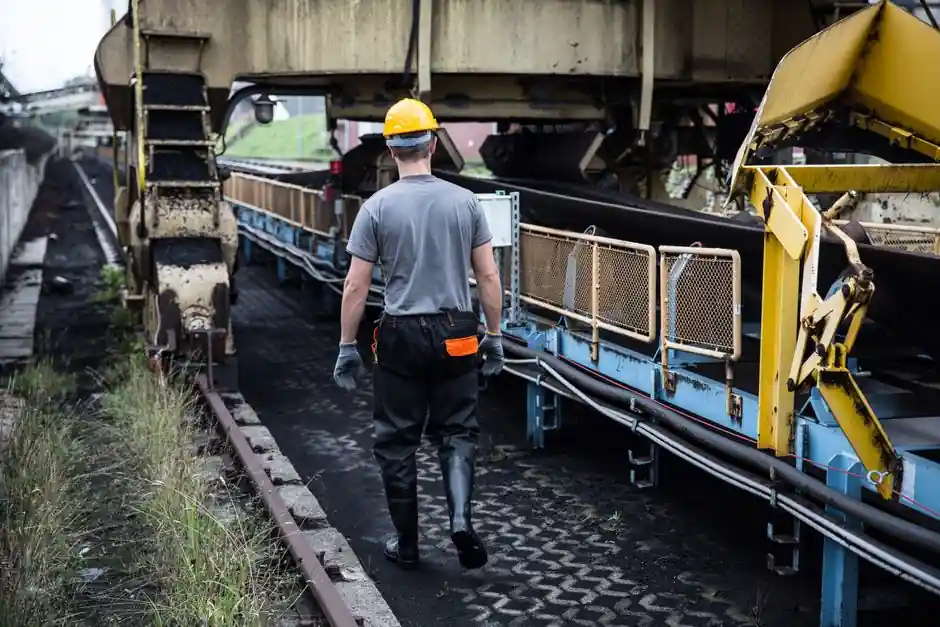
The Ecobelt B conveyor is designed to handle hot, very fine, dusty, and abrasive bulk materials [S1].
The practical selection window covers continuous and short peak temperatures, casting fragments, sand abrasion, moisture carryback, dust, and the temperature at each transfer point [S4].
Define the hot-sand duty at the shakeout discharge
Sand leaving shakeout may contain gates, flash, and casting fragments [S4]. A furnace temperature does not establish the belt rating; measure sand temperature at belt entry during a routine pour and during the hottest casting run, and record peak temperature plus duration [S4].
The load changes along the loop. The shakeout transfer can contain warm or hot sand and metal scrap, screening and cooling can produce a finer and more uniform stream, and the green-sand return can carry binder and moisture that stick to the belt at discharge [S4]. Specify each conveyor position separately instead of applying one belt designation to the entire return system [S4].
The quoted compound must state a continuous temperature, a permissible short-duration peak, and the construction used for that duty [S4]. “Heat resistant” alone is not an acceptance criterion, and an extra top cover provides wear allowance rather than proof of thermal capacity [S4].
Compare rubber compounds, woven belts, and mesh systems
Standard rubber can lose strength, crack, stretch, tear, or melt as heat rises; one industry overview places conventional rubber melting around 250 °F, or 121 °C, while a high-performance heat-resistant belt may handle temperatures above 450 °F, or 232 °C [S3]. These figures describe different grades and cannot be substituted for a supplier’s stated operating limit [S3].
PVC is described as suitable for lower-heat duties, while butyl and EPDM compounds are used for higher-temperature applications [S2]. Synthetic heat-resistant belting can also provide minimal stretch, dimensional stability, low moisture absorption, and resistance to chemicals and acids [S2]. One heat-resistant belt range is rated up to 700 °F, equivalent to approximately 371 °C [S2].
For comparison, a conventional rubber belt is economical for cool, clean service but presents burn, accelerated wear, and sudden-failure concerns at shakeout temperatures above 150 °C [S1]. A heat-resistant synthetic belt adds thermal and dimensional control, but the cover still needs cut and abrasion resistance [S2][S4]. The Ecobelt B design uses steel buckets mounted on a high-tensile mesh and is designed for significantly high inclinations [S1].
Match cover construction to abrasion, cuts, and carryback

Heat resistance does not prevent mechanical damage. Broad, shallow cover loss along the sand path indicates abrasive wear, while a puncture at loading can point to a chute defect or falling casting fragment, and a narrow slash beginning beside a skirt can indicate jammed metal [S4]. These failure patterns require different responses, so inspection evidence should determine whether the belt needs a heavier cover, an impact-resistant loading zone, upstream separation, or all three [S4].
Castings and gates create a combined heat and cut duty at the shakeout transfer. The largest metal piece, drop height, screen bypass condition, magnet performance, and point of impact should be recorded before the cover compound is selected [S4]. Supporting the impact area between idlers can reduce local damage because a heavy belt remains vulnerable when a fragment strikes an unsupported section [S4].
After screening and cooling, the sand becomes finer and more consistent, but dry reclaimed grains continue to abrade the cover [S4]. At the green-sand return, binder and moisture can leave a stuck layer at the head pulley and return idlers, making cleaning access and removed-material discharge part of the belt specification [S4]. A heavy top cover is therefore useful for wear allowance, but thermal rating, impact tolerance, splice design, and cleanability still need separate acceptance criteria [S4].
Control dust, incline limits, and thermal expansion
Hot sand conveying can release fugitive dust and respirable crystalline silica, while vibratory conveyors can spread large dust volumes because their operating principle shakes the material [S1]. A smooth, enclosed belt or bucket system reduces spillage and limits fines generation compared with an open vibratory transfer [S1]. The heat-resistant conveyor belt reference is not a direct substitute for a sand-handling belt specification, because furnace atmospheres and thermal cycling impose different material and service conditions.
Inclination also affects material retention.
Thermal growth must be accommodated because a hot belt changes length during operation and stops. A conventional heat-resistant belt installation needs a compatible take-up travel and splice system, and the supplier’s continuous and peak-temperature limits should be checked against the measured sand duty [S1][S4].
Use the shakeout machine and sand loop as the basis

The upstream shakeout machine determines the released load, including peak sand temperature, gate size, casting fragments, and discharge behavior. Those variables must be measured at the actual belt entry rather than inferred from furnace set points or the appearance of a sample jar of sand [S4].
The wider sand reclamation unit can change the downstream load through screening, cooling, magnetic separation, and dust control. If the sand cooler reduces discharge temperature below the belt’s continuous rating, the thermal duty may change, but abrasive wear and binder carryback remain separate constraints [S4].
A procurement package should include measured temperature at each location, maximum casting or gate dimensions, drop height, sand moisture condition, abrasive particle characteristics, duty-cycle information, and retained belt or cover samples [S4]. The comparison should separate continuous operation from short peaks and identify the compound, cover, carcass, splice, and accessories by the temperatures and loads for which they were selected [S2][S4].
Accept the belt on measured performance, not a label
Inspection points should include the feed chute, loading zone, screen bypass, magnet, head pulley, return idlers, and every splice [S4]. Operators should record cover loss, cracking, lifting, impact punctures, splice condition, and material stuck to the pulley or return side [S4]. A retired cover near the feed zone can provide more useful evidence than its color because transverse checking, a stiff patch, or a lifted splice shows how heat and sand loading affected the compound [S4].
Heat-resistant belting is suited to hot, abrasive loads where ordinary rubber would degrade, and specialist compounds can also provide chemical and acid resistance [S2][S3]. It is not the right shortcut for uncontrolled sharp scrap, poor loading geometry, excessive incline, or unsupported impact. For those conditions, the evidence points toward upstream metal control, a stronger impact zone, improved cleaning access, or a dedicated mesh-belt conveyor or bucket conveyor rather than a heavier belt alone [S1][S4].
The next procurement decision is measurable: approve a belt only when its quoted continuous temperature exceeds the measured sand temperature, its stated short-time peak covers the hottest casting event, and its cut and abrasion construction matches the recorded casting, gate, and sand load [S4].