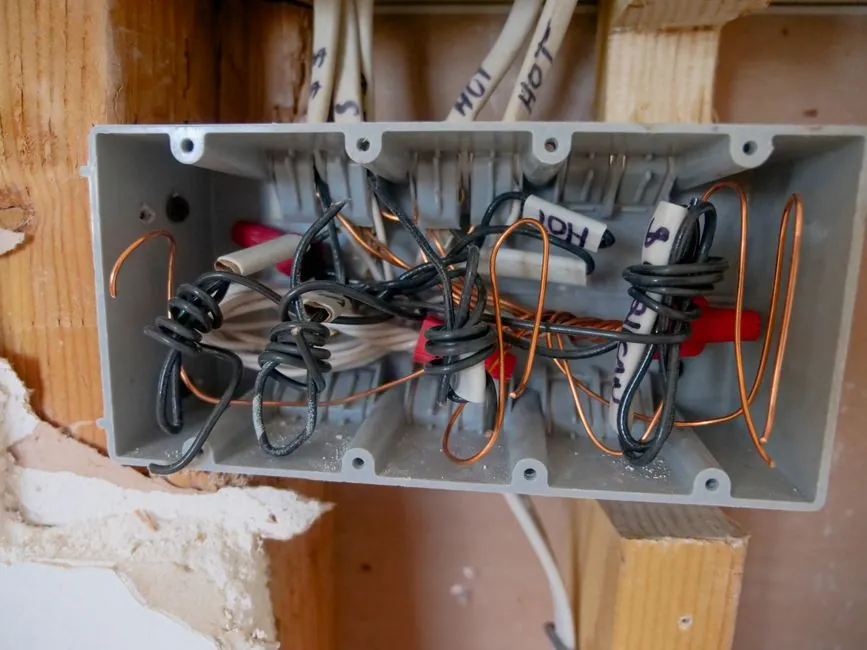
Module-level junction boxes connect PV strings through MC4-compatible outputs, while field junction and combiner boxes terminate, route, protect, and combine multiple module circuits [S2][S3].
Separate module boxes from field combiners
A module junction box is mounted on the solar module and provides the electrical connection for its PV strings; its output cables usually terminate in MC4 connectors [S3]. The enclosure may also contain bypass diodes connected to busbars soldered from the module's cells, creating a defined electrical interface between the panel and field wiring [S7].
A field junction box provides a protected transition or branch point, while a combiner box gathers solar strings before they move toward the inverter, charge controller, or other downstream equipment [S2][S5]. These functions should not be treated as interchangeable because a module box is integrated into the panel assembly, whereas a field box must withstand installation conditions, cable routing, and exposed service areas.
The physical distinction matters for specification. These are examples, not universal ratings.
Match voltage, current, and circuit count
Voltage rating must cover the maximum system voltage, including the selected photovoltaic module's open-circuit voltage and the correction factors applied for cold conditions.
For procurement, the data sheet should state the number of inputs, number of outputs, maximum system voltage, fuse rating, breaker rating, surge-protection arrangement, and cable-entry size. The 4-string example provides a useful baseline for comparison, but it does not establish that every four-string enclosure accepts the same cable gauge, connector family, or breaker type.
Compare the main enclosure options
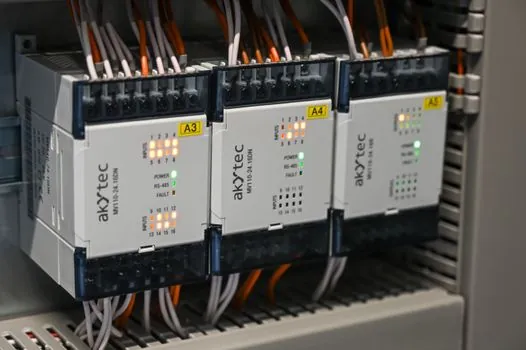
Module junction boxes, field junction boxes, and combiner boxes differ by installation point, circuit role, and protection content. A module box supports the PV strings physically attached to one module and commonly uses MC4-type outputs [S3][S7]. A field junction box manages cable routing and connections [S2]. A combiner box combines strings and may include fuses, breakers, surge protection, and lightning arrestment [S1][S2].
Comparison criteria should therefore include DC voltage capability, usable input and output count, current interruption rating, environmental enclosure rating, connector compatibility, and service access.
Wire-entry design is another differentiator. The available enclosure guidance treats junction boxes as system components for wiring management [S2], while at least one cable-entry enclosure listing is marketed for waterproof wire entry and RV or caravan cable routing at $23.99 to $27.99 [S9]. That price point describes a particular enclosure listing, not the market average, and does not establish suitability for a grid-tied module circuit.
Specify MC4-compatible connections carefully
MC4 connectors are the normal field interface associated with PV module junction-box outputs, but connector acceptance alone does not prove electrical compatibility [S3]. Procurement should verify mating connector type, conductor cross-sectional range, current rating, voltage rating, temperature rating, and the cable diameter accepted by the cable gland.
Panel assembly also requires process control. The wiring guidance identifies four enclosure screws for opening a junction box while warning not to disconnect the mounting and diode-connection screws [S8]. That distinction indicates a controlled assembly process in which enclosure access, busbar or diode connections, and potted or sealed terminations are separate concerns.
For field-built equipment, the enclosure must also protect against moisture and mechanical damage. IP65 appears in the supplied product examples [S1], while the operating guide identifies the rear-of-panel junction box as the single connection point between the cell string and downstream equipment [S6]. A generic MC4-compatible enclosure without the required IP rating, strain relief, or verified cable-entry arrangement should not be accepted as an equivalent substitute.
Apply the right enclosure to the installation

Module junction boxes suit module manufacturers and technicians who need the factory-defined interface between cell strings and field cables [S3][S7]. Field junction boxes suit installers who need to terminate, route, or transition cables without combining the array [S2]. Combiner boxes suit systems that require several PV strings to be gathered and protected before inverter or controller connection [S1][S2].
They are not suitable for every environment. A lightweight cable-entry junction connector listed for RV and caravan applications may address physical cable entry, but its suitability for exposed photovoltaic equipment cannot be established from that description alone [S9]. Likewise, a residential DIY guide may explain the connection sequence, but it does not replace project-specific voltage, current, environmental, and code checks [S6].
Outdoor solar applications require the enclosure rating, connector system, protection components, and installation method to be considered as one assembly. The evidence supports IP65 for the cited combiner examples, 20 A and 63 A protection arrangements, four-string operation in one example, and MC4 outputs for module boxes [S1][S3].
Control failure modes and supplier data
Three failure modes dominate specification disputes: voltage oversizing, connector mismatch, and protection coordination. A 500 V enclosure can be undersized for a system whose cold-condition open-circuit voltage exceeds 500 V [S1]. An enclosure can also be visually similar to an MC4 product while lacking the required conductor range, gland, sealing arrangement, or current rating [S3].
The bypass-diode arrangement is equally important because the module junction box contains the electrical interface to the module busbars and can include the bypass diodes used for cell-string protection [S7]. Supplying a hollow enclosure without the manufacturer-defined diode, busbar, potting, and wiring arrangement is not equivalent to supplying a complete serviceable module junction box.
Buyer qualification should request the enclosure material, ingress rating, UV exposure data, operating-temperature range, cable-entry details, gland specifications, connector drawings, current and voltage ratings, fuse and breaker coordination data, and mounting method. Published examples provide several concrete values, including IP65, 500 V, 20 A, 63 A, four strings, and a 1-in-1-out layout [S1].
For a new module or array order, release the BOM only after matching the enclosure role to the system architecture: module junction box, field junction box, or string combiner. Track three procurement signals on the purchase order, the maximum system voltage, the exact connector and cable-entry schedule, and the fuse-to-breaker coordination. These fields close the main specification gaps identified across the cited module-box, combiner, wiring, and product-listing data [S1][S2][S3][S8].
