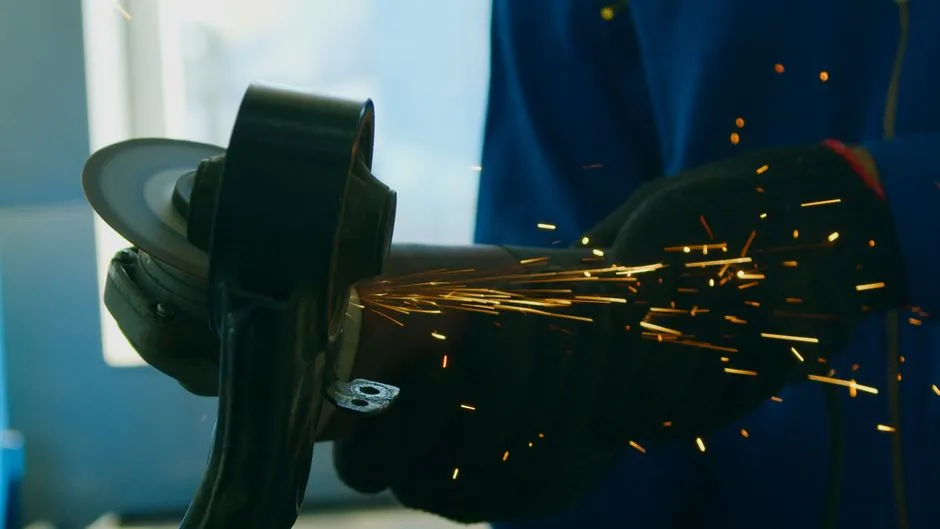
Self-aligning bearings for automotive production are most often double-row ball units with a spherical outer raceway, offered in bores from 10 mm to 160 mm, OD 30-240 mm, and widths 15-73 mm per the CMW catalogue listing on DirectIndustry [S1]. NSK recommends them specifically for applications where shaft-to-housing alignment is difficult or where the shaft itself may bend, naming transmission shafts as a canonical use case [S2]. The defining feature is the spherical outer ring paired with two rows of rolling elements, which lets the inner assembly pivot inside the outer race to accommodate static misalignment, typically up to roughly 1.5 to 3 degrees depending on series [S2].
For automotive plant engineers, the practical implication is that a self-aligning bearing can be installed on long-span shafts, idler pulleys, conveyor rollers, and gearbox input shafts without precision machining of every mounting face, which is why the same NSK catalogue lists manufacturing, pumps, gearboxes, machine tools, and construction equipment as adjacent target industries [S2]. The same construction also tolerates thermal growth of the shaft relative to the housing, a frequent failure initiator in ovens, paint lines, and wash stations where the shaft runs hot while the frame stays cool.
Construction types and how they differ on the line
Three sub-families cover the bulk of automotive-plant use: double-row self-aligning ball bearings, spherical roller bearings, and self-aligning bearing units (insert bearings with a housings) [S1]. CMW catalogues all three under the same self-aligning family, with the ball-bearing variant specified as radial plus axial configuration in steel, and the spherical roller variant as radial plus axial plus double-row, also in steel [S1]. The ball version carries lower load but runs at higher speed and is the typical pick for conveyor idlers, fan shafts, and small gearbox stages; the spherical roller version carries the heavy radial and shock load seen in crusher drives, vibratory feeders, and press flywheel supports.
Self-aligning bearing units add a spheroidal outer OD that mates with a stamped or cast housing, so the entire pillow block or flange unit can pivot to follow shaft position [S1]. In automotive body shops, where weld guns, robotic arms, and overhead conveyors create constant micro-vibration, the unit version is the common choice because the housing can be bolted to a less-than-perfect mounting surface while the bearing still runs true.
Selection criteria that actually decide the part number
Five parameters drive a defensible selection: required dynamic radial load, required axial load, permissible static misalignment in degrees, limiting speed (often expressed as a limiting rpm for grease or oil), and the bore-to-housing fit class. NSK positions self-aligning ball bearings as the default where shaft bending or alignment error is the dominant risk, with the spherical outer ring compensating for misalignment without inducing internal load [S2]. The CMW catalogue listing confirms a steel material, double-row ball, radial plus axial configuration, and explicitly calls out that bearings must be correctly aligned with adjacent components, that static and dynamic load limits plus speed limits must be observed, and that lubrication is mandatory for friction and wear control [S1].
For automotive spec work, the operating envelope is tighter than the catalogue maximums imply. A 160 mm bore unit can carry very high load, but on a body-shop conveyor the limiting factor is usually the grease relubrication interval and the seal choice, not the bearing's static load rating. Specifiers therefore lean on the OEM's published speed factor (often expressed as dmN, the bore in mm times rpm) rather than the headline dynamic load number, because premature grease failure in a paint-shop oven at 180 degC looks exactly like a bearing failure on the teardown bench.
Misalignment, load, and speed: the real trade-offs
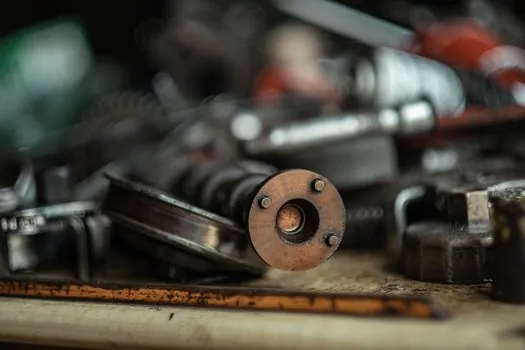
Self-aligning ball bearings are commonly rated to accommodate roughly 1.5 to 3 degrees of static misalignment depending on the series and internal clearance group, which is the core reason they outperform deep-groove ball bearings on long, slender shafts [S2]. The trade-off is reduced load capacity relative to a same-bore spherical roller bearing, because only the two point-contact rows of balls are carrying the radial load. Where the application is a press-flywheel support or a heavy eccentric drive, a spherical roller self-aligning bearing will outlast the ball version by a wide margin, at the cost of a lower permissible speed and a tighter lubrication regime.
Speed-wise, self-aligning ball bearings generally run higher than spherical roller designs but lower than deep-groove ball bearings of the same bore, because the internal geometry generates more heat under combined radial plus axial load. A ball bearing with two contact lines and a true Conrad or max-capacity filling slot is a higher-speed machine when the alignment is good, but the same bearing on a misaligned shaft will fail early from edge loading, which is the niche the self-aligning bearing was designed for.
Standards, lubrication, and the rules the auditor will check
For automotive production, the bearing itself is governed by ISO 15 for boundary dimensions and ISO 492 for radial bearing accuracy, with internal clearance usually selected to CN (normal) or C3 for shaft-thermal-growth cases. SAE AS21154C-2023, the current revision of the plain self-aligning grooved-outer-ring bearing standard, specifies the requirements, materials, dimensions, load ratings, surface treatment, lubrication, and inspection methods for aerospace variants with ball hardness not below HRC 56 and race hardness HRC 27-36, surface roughness 8 Ra on balls and 32 Ra on bores and outer diameters, and a maximum axial clearance of 0.010 inch [S4]. Most automotive-plant uses are commercial-grade and fall back to ISO rather than AS21154, but the same hardness, roughness, and clearance philosophy still applies to incoming inspection.
Lubrication is non-negotiable. CMW's published operating conditions explicitly call for adequate lubrication, observation of static and dynamic load limits, observation of the speed limit, and use within the manufacturer's stated temperature range [S1]. Grease fill is the default in self-aligning unit bearings because the housing acts as a reservoir, but on high-speed or high-temperature lines a circulating oil system with a filtration stage is common, particularly where a self-priming pump feeds the bearing housing loop.
Where it fits and where it does not
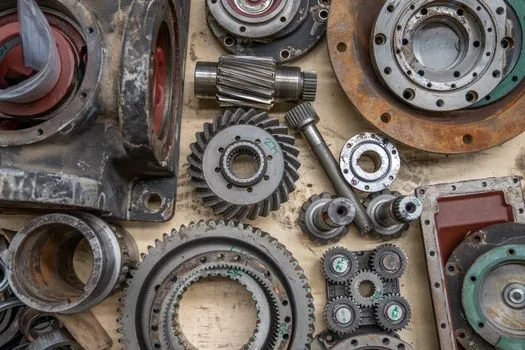
Self-aligning bearings are FOR automotive production drives with shaft-to-housing misalignment above roughly 0.5 degrees, long slender shafts prone to bending, conveyor idlers subject to belt tension side-load, and gearbox stages fed by chains or belts where the input shaft is not perfectly concentric with the driven shaft. They are also the right call in wash-down areas where thermal shock would otherwise preload a deep-groove ball bearing against its housing. They are NOT FOR high-precision spindle service (use angular contact or cylindrical roller bearings), NOT FOR pure thrust-dominated loads (use a dedicated thrust bearing), and NOT FOR applications that need both high speed and high radial load in the same envelope (use a linear bearing or a cylindrical roller on a precision-machined seat instead). [S2]
One common misuse is fitting a self-aligning unit as a cure for a bent shaft. The bearing will mask the symptom for a short time, but the cyclic bending stress will then fail the shaft itself. If the diagnostic is a misaligned housing, fix the housing; if the diagnostic is a bent shaft, replace the shaft. The self-aligning bearing earns its place in the design, not as a field repair.
Reliability signals worth tracking
For specifying engineers, three trackable signals move the needle on automotive-line reliability. First, the published limiting speed at the operating temperature, not the catalogue room-temperature number, because grease life and cage material both derate sharply above 150 degC. Second, the radial internal clearance group, where C3 or C4 is appropriate for shaft-thermal-growth cases and a CN group will preload the bearing once the line warms up. Third, the seal type, with 2RS (rubber seals on both sides) standard for contamination-exposed service and an open or 2Z shielded variant only where relubrication access is guaranteed. With those three nailed, the part will outlast the adjacent drive component and the failure mode will be predictable. For related procurement and spec context in the same automotive-supplier space, see how Romania's OEM-origin spare-parts framework notice 487600-2026 treats sourcing, and review the AC motor maker Putai line overview when sizing a coupled drive. [S1]