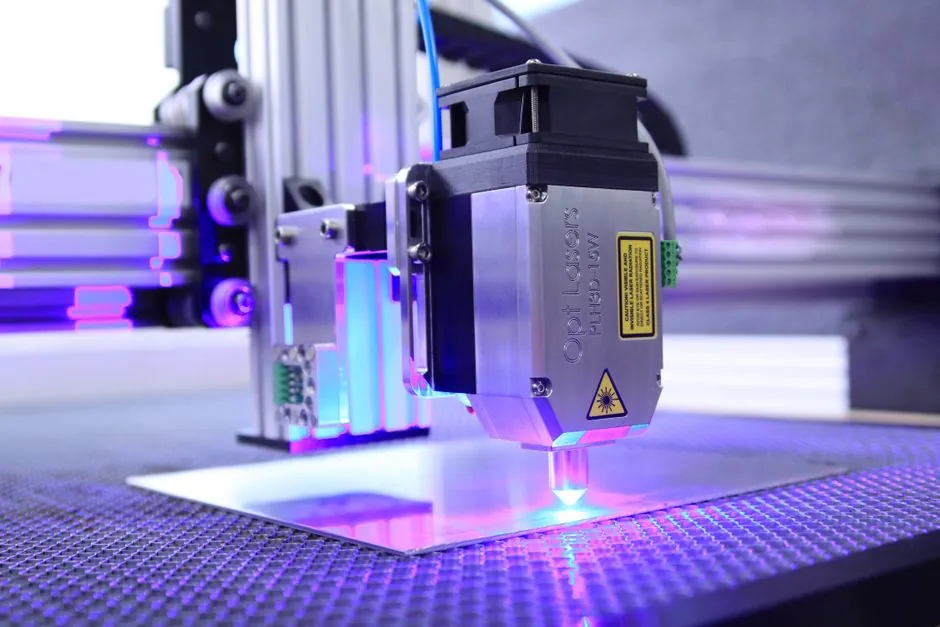
An all-in-one laser displacement sensor integrates the sensor electronics and position indicator, removing the need for a separate controller in single-point applications [S2].
Architecture determines installation and measurement scope
A split architecture separates the optical measurement head from the controller, allowing each head to be positioned at a different point while one controller processes the measurement channels.
An all-in-one architecture places the required measurement functions in one package. MTI Microtrak 3 and 4 sensors include a built-in position indicator and software, so a separate controller is not required [S2]. This configuration reduces the number of assemblies and cable runs when the application needs only one measurement position.
The architecture also affects where optical and signal-processing functions are located. Omron identifies separate sensor-head and controller assemblies in its displacement-sensor system, including the lens set in the head and the white LED light source in the controller [S3].
Selection criteria: channels, accuracy, service and installation
Channel count is the first architectural decision because the split design scales to several measurement positions while the all-in-one design is inherently centered on one compact instrument. MTI's Microtrak 3 and 4 sensors include built-in position indicators and intuitive software, eliminating the need for a separate controller [S2].
Installation effort usually favors the all-in-one package because the head, indicator and associated electronics do not require a dedicated external controller.
Serviceability also changes the maintenance strategy. A separate head can be positioned and adjusted independently of the controller, which is valuable on multi-point fixtures. The KLIPPEL A2 system uses a Driver Stand for sensor-head mounting and adjustment, while dB-Lab provides management for multiple laser heads and permits selection according to measurement demand, including small-signal, large-signal, woofer and tweeter applications [S4].
Final selection must include measurement performance rather than enclosure count. Aerotech states that achieved precision depends on the combined sensor, electronics, signal processing and environmental conditions, while noncontact sensor range generally decreases as required precision increases [S5].
Separate head and controller versus all-in-one
The decisive comparison is channel expansion, installation simplicity, spatial distribution, serviceability and application control. All-in-one systems provide the stronger option when one sensor, one indicator and minimal additional hardware are sufficient, as demonstrated by Microtrak 3 and 4 [S2].
For a laboratory test stand with several noncontact displacement points, choose a split system. The controller can centralize acquisition while each compact head occupies its own measurement position [S1][S4]. For a compact machine or process with one accessible target, choose an all-in-one sensor to avoid an unnecessary controller and simplify wiring [S2].
The split design offers better allocation of sensors for different operating demands. KLIPPEL separates its available laser heads into high-resolution and cost-effective groups and includes type-dependent calibration files for specimen calibration [S4]. That architecture is useful when different points require different ranges, resolutions or beam characteristics. An all-in-one sensor is simpler but does not provide the same demonstrated multi-head management within one controller [S2].
Target surface and measurement principle remain decisive
Optoelectronic packaging does not eliminate target-dependent measurement errors. Omron divides triangulation sensors into PSD and imaging-device methods, with CCD and CMOS receivers detecting light on individual pixels and converting it into distance [S3]. Its regular-reflection model uses direct reflections from glossy or mirror-like targets, while the diffuse-reflection model receives light scattered from a broader target area [S3].
These target modes matter for both architectures. A sensor selected only by housing format may still require calibration or a different head model for a glossy metal, a dark object or a varying surface texture. Imaging receivers can reduce the influence of surface color and texture compared with a PSD-based arrangement, but the controller, signal processing and environment still form part of the final performance chain [S3][S5].
For moving or precision-critical systems, validate the complete head, controller, processing and installation combination in the operating environment [S5]. If the surface cannot be touched or the process requires noncontact measurement, laser triangulation remains one of several applicable technologies, alongside capacitive, confocal and eddy-current alternatives [S5].
Use cases, constraints and failure modes
Multi-point dimensional and motion-control systems favor a separate head and controller when positions are distributed across a fixture. A single controller can accept up to six CL-3000 heads [S1], and the KLIPPEL A2 configuration demonstrates the use of multiple heads for loudspeaker parameter identification and selection by measurement demand [S4].
Single-point inspection, machine positioning and compact OEM equipment favor an all-in-one architecture when the sensor can provide the required range, precision and output without external processing hardware. The built-in position indicator in Microtrak 3 and 4 eliminates the need for a separate controller in that use case [S2].
The principal split-system failure modes are poor head alignment, unsuitable target-surface interaction, miscalibration across multiple positions and excessive wiring or controller-placement constraints. KLIPPEL explicitly identifies direct or reflected human-eye exposure to the beam as a laser-radiation hazard, and specifies visible red Class 1 and Class 2 laser types [S4]. The principal all-in-one failure mode is architectural inflexibility: adding distant measurement points can require additional sensors or a different system design.
Procurement and compliance checks
Specify the sensor head, controller, cables, mounting hardware, calibration method, output interfaces and processing software as one functional package. Omron notes that displacement sensors can provide physical-quantity outputs such as current or voltage, with some models also supporting digital serial communications, but model exclusions apply [S3].
For a multi-head CL-3000 installation, document the required number of heads, its limit of six simultaneous heads per controller, controller location and head-to-target clearances [S1]. For an all-in-one Microtrak 3 or 4 design, document the built-in position indicator, supplied software and available outputs [S2].
For high-precision systems, include range, repeatability, linearity, target material, surface finish, stand-off distance and environmental conditions in the acceptance test. Aerotech cautions that sensor range decreases as required precision increases and that environmental conditions affect the achieved result [S5]. For laser products, record the laser safety class and control reflected-beam exposure, consistent with the Class 1 and Class 2 visible-red configurations identified in the KLIPPEL A2 documentation [S4].
The next engineering check is a side-by-side trial: compare the proposed all-in-one sensor against the split architecture using the same target, stand-off distance, bandwidth and output requirement, then verify channel count, calibration burden and installation space before releasing the purchase specification.