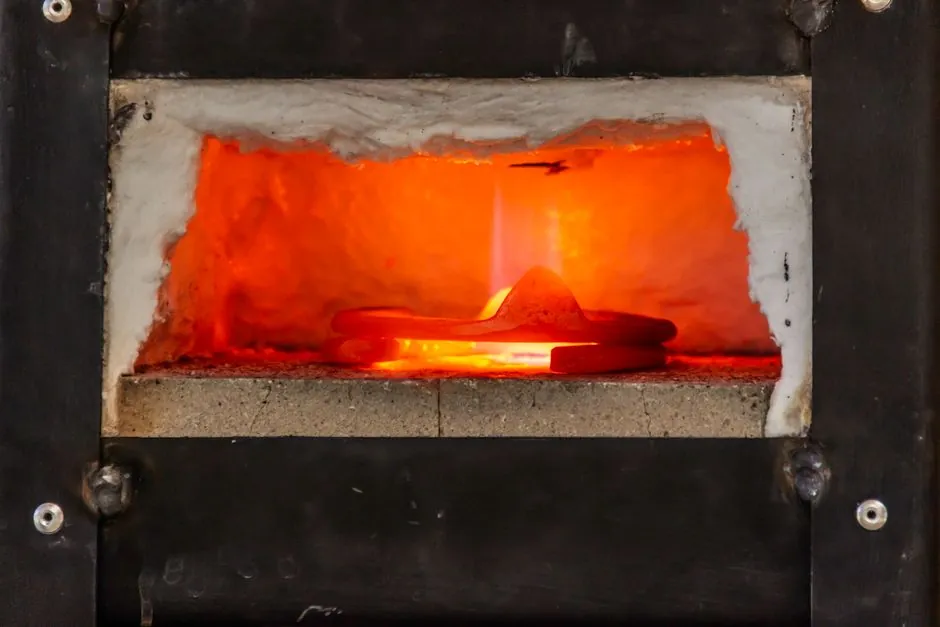
Aluminum age-hardening furnaces should use the temper-specific schedule because strength rises with precipitation up to a peak and then declines during over-aging.
Artificial aging generally operates at 95–205°C, while broader equipment practice spans about 100–260°C for heat-treatable aluminum [S3][S4].
Peak Strength Requires the Alloy-Specific Aging Envelope
Artificial aging accelerates precipitation after solution treatment and quenching by heating the supersaturated aluminum solid solution within approximately 95–205°C [S3]. During natural aging at room temperature, hardening is attributed almost entirely to homogeneous precipitation of solute-rich GP zones and the clustering of vacancies [S3].
Temperature and time cannot be optimized independently without risking either incomplete precipitation or over-aging. For procurement and furnace planning, NASA PRC-2002 Rev I points users to the heat-treatment tables in AMS 2772 for specific temperatures and times [S2].
The practical specification is not a universal oven setpoint. It is the approved alloy-and-product schedule, including the required temper, soak time, quench method, and applicable test criteria.
Artificial and Natural Aging Serve Different Objectives
Natural aging occurs at room temperature after quenching, with solute-rich clusters and vacancy clusters forming as the alloy remains at ambient conditions [S3]. Artificial aging applies controlled elevated heat, normally 95–205°C for aluminum, to accelerate precipitation and develop an identified temper [S3].
An oven should therefore not be selected simply for the highest achievable strength if the component also depends on toughness, corrosion performance, or dimensional control.
Temperature Alone Does Not Define a Successful Aging Cycle
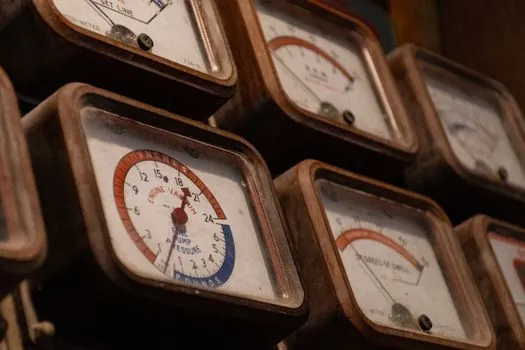
Peak-aged aluminum is the point at which maximum strength has been reached before further aging begins to reduce strength and hardness [S4]. The acceptable cycle must balance temperature against holding time, with controlled cooling after the soak. Aging ovens are described as increasing alloy strength by heating to a suitable temperature, holding it, and cooling at a controlled rate [S7].
For aluminum, the published processing range is approximately 100–260°C, while artificial-aging guidance identifies 95–205°C as typical [S3][S4].
Material and Cycle Data Show Why One Setting Cannot Cover Every Alloy
In a study of Al7075 composites containing 4 wt% tungsten carbide, aging from 150°C to 250°C increased mechanical properties, while aging from 250°C to 350°C decreased them [S1]. The specimen aged at 250°C achieved the maximum tensile strength, and the Brinell hardness number increased by 37.1% and the strength properties by 50.5%, respectively, relative to the non-aged Al7075-WC composite [S1].
At 350°C, the reported reductions in the strength properties were 30.86%, 4.7%, and 24.9% [S1]. Maximum impact energy, 92.2% above the non-aged composite, occurred instead at 450°C [S1]. That contrast shows why peak tensile strength and peak impact energy need not occur at the same aging temperature.
This result applies to a specific Al7075-WC laboratory composite, not every wrought aluminum component. Its value is diagnostic: moving above the peak-strength region can improve one property while degrading others.
Compare Natural Aging, Standard Artificial Aging, and Over-Aging
Natural aging operates at room temperature, requires no controlled elevated-temperature soak, and is associated with T4 material [S3][S4]. Artificial aging operates at approximately 95–205°C, supports T6 and T7 conditions, accelerates precipitation, and delivers higher strength at the cost of lower ductility and toughness [S3][S4].
Over-aging occurs after the peak-strength region. Compared with peak aging, it reduces tensile strength and hardness, increases resistance to stress-corrosion cracking and fatigue-crack growth, and improves dimensional stability [S3][S4]. The decision criteria therefore include target strength, retained toughness, corrosion behavior, dimensional stability, and cycle time rather than a single maximum tensile-strength value.
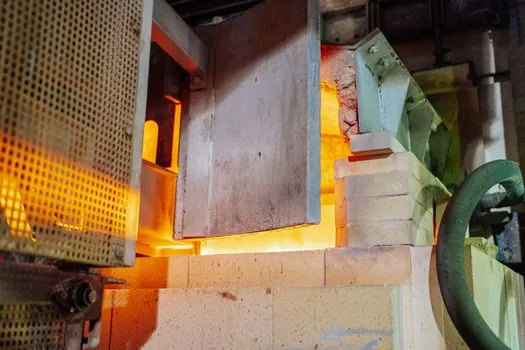
For a heat treatment furnace, the practical choice is equipment capable of stable control over the approved cycle, including forced airflow, uniform soak temperature, controlled heating, and controlled cooling. Vendor examples span aging furnaces with maximum temperatures of 343°C and higher-temperature systems reaching 732°C [S8]. Such ratings describe equipment capability, not permission to raise an aluminum aging setpoint beyond the material specification.
Furnace Selection Must Follow Qualification and Traceability
AMS 2750H is cited for age-hardening oven qualification and class 1 tolerance of ±5°F, while AMS 2770, AMS 2771, and AMS 2772 are associated with precipitation age-hardening requirements for specified material applications [S5]. AMS 2750 covers the furnace-performance framework, but it does not replace the alloy-specific process schedule contained in the applicable material specification [S5].
NASA PRC-2002 Rev I applies to heat treatment of raw stock and fabricated parts in forms including sheet, plate, wire, rod, bar, tubing, forgings, and extrusions [S2]. Its revision history identifies AMS 2772 and ASTM E1004 among the references, and its process tables require users to select the correct heat-treatment table and temper [S2].
Load configuration matters as much as the nominal setpoint. Nonuniform airflow can create temperature gradients across a chamber, while poor load placement or inadequate circulation can cause parts to receive different effective soak conditions [S4][S7]. Qualification records should therefore include furnace class, calibrated temperature-measurement equipment, load pattern, temperature uniformity, ramp behavior, soak time, and cooling conditions rather than only the target temperature.
Specify the Test, Not Just the Peak-Strength Target
Peak strength should be accepted only against the material specification and the required mechanical test. NASA PRC-2002 calls for solution heat-treatment tensile coupons and identifies ASTM B557 for tensile testing in its revision history [S2]. The component drawing must also identify the final temper, such as T6 or T7351, and the heat-treatment process called out under the drawing note [S2].
Three measurable checks should frame the cycle. First, furnace temperature uniformity must meet the specified equipment class, with ±5°F identified for AMS 2750H class 1 [S5]. Second, the load must remain within the qualified work zone, not merely inside the oven shell. Third, parts must meet the temper-specific mechanical and, where applicable, conductivity requirements defined by the governing material specification [S2].
If the process drifts toward shorter time or higher temperature without qualification, the result may remain below peak strength or enter over-aging [S3][S4]. If the cycle is unnecessarily long or the temperature is excessive, strength and hardness can decline. Track furnace class, alloy and product form, required temper, setpoint range, soak time, and qualification status as the first procurement and process-control checklist.