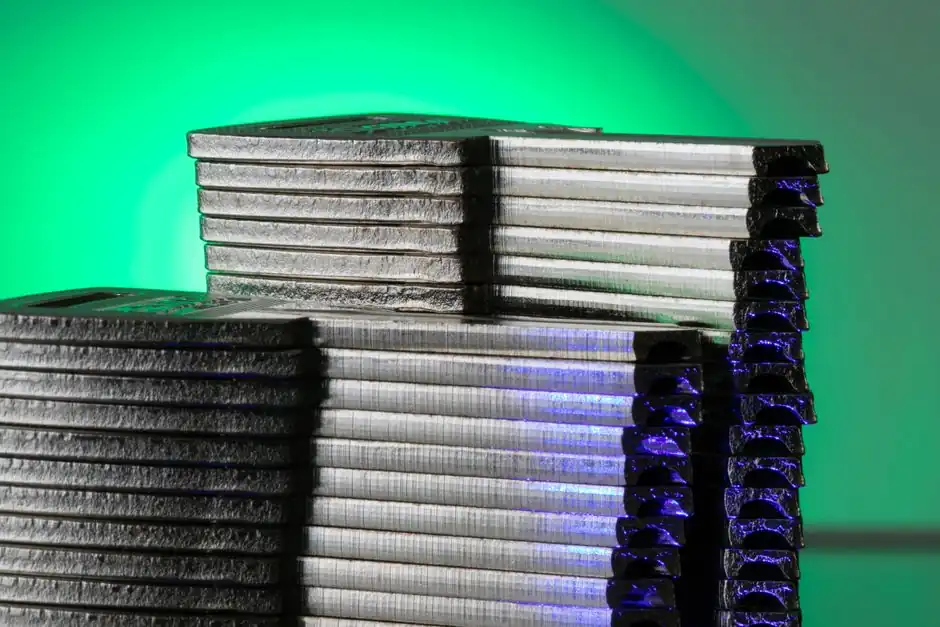
FKM is listed with a nominal hardness range of 70–75 Shore A, and 70 Shore A is identified as the most common general-purpose O-ring rating.
Hardness must be matched to the complete duty cycle, including pressure, gland clearance, compression, motion, temperature and chemical exposure, rather than copied from a material family default [S2][S3].
Hardness Ranges Define the FKM Selection Window
FKM is listed with a nominal hardness range of 70–75 Shore A.
These figures are specification windows, not a guarantee that every compound is suitable for every service. Standard FKM O-ring guidance places the normal dry-air temperature envelope at -15°F to 400°F, equivalent to approximately -26°C to 204°C, while individual formulations can extend beyond that baseline [S1].
The O-ring drawing and compound designation should therefore carry the nominal value, tolerance, material family and any service-specific cure or fluid requirements together.
Compare 60, 70, 75 and 90 Shore A
FKM at 60 Shore A is a soft sealing-ring option, whereas 75 Shore A is widely used for general FKM work and 90 Shore A compounds are used where greater extrusion resistance is needed [S7][S8][S9].
The selection trade-off is mechanical, not chemical. A 70 Shore A NBR, FKM and silicone O-ring can share the same hardness rating while differing in fuel resistance, heat resistance and compression set [S3]. For a fluororubber seal, chemical compatibility and temperature performance still require a separate compound review.
Use Pressure, Motion and Gap as Decision Criteria
These figures are application rules of thumb, not universal component ratings.
Harder elastomers resist extrusion but need greater force to enter a groove and establish sealing contact. That arrangement applies to an O-ring gland, not automatically to a flange gasket, whose load path and geometry differ.
Dynamic service adds friction and wear to the trade-off. For moving seals, the material family, lubricant and compound behavior remain separate from the hardness number [S3].
Static Gaskets and O-Rings Need Different Rules
An O-ring seal relies on controlled compression, while a flat gasket transfers bolt or flange load across its face. A 90 Shore A O-ring may improve gap resistance in a pressurized gland, but the same hardness does not establish suitability for a bolted flange joint or a large-diameter gasket. [S2]
FKM flange-gasket compounds must be assessed for compression set, fluid compatibility and sustained operating temperature, not merely indentation hardness. The related FKM cure selection guide explains why cure selection can change service performance even when nominal hardness stays constant.
For gaskets, record the gasket thickness, flange type, bolt load, operating temperature, pressure and seal geometry alongside the Shore A value. For an O-ring, record cross-section, gland depth, squeeze, gland width, pressure and dynamic motion. The shared 70–75 Shore A FKM range does not make the two component designs interchangeable.
Measure Hardness with the Correct Method

Shore hardness describes an elastomer's resistance to penetration by a standardized test indenter and is usually measured on the Shore A scale for O-rings.
Durometer alone does not establish tensile strength, elongation at break, chemical resistance or compression set [S3]. A 75 Shore A FKM compound, for example, may differ materially from another 75 Shore A compound in low-temperature flexibility, steam exposure and aging resistance, so the full compound datasheet remains the controlling document.
Check Service Limits Before Releasing the Hardness
FKM offers resistance to oils, fuels, lubricants, solvents, ozone, ultraviolet light, and weathering. Its chemical resistance is not uniform across all formulations: standard Viton types A, B and F contain approximately 66–70% fluorine, while GLT and GFLT formulations use fluorinated vinyl ether to retain low-temperature flexibility [S4].
That chemistry choice can matter more than a 5-point hardness adjustment. These examples show why the datasheet must connect hardness, cure, chemical class and temperature range.
For procurement, the traceable specification should state FKM, nominal Shore A hardness, permitted tolerance, measurement method, compound code, temperature range and applicable fluid list. If the seal is part of a larger gasket assembly, also tie the hardness to compression set and flange loading rather than treating Shore A as a standalone material approval.
The next engineering checkpoint is the gland or flange calculation: verify squeeze, gap or bolt load, pressure, motion and surface tolerance against the selected compound before accepting a 70, 75 or 90 Shore A grade.