
Parallel rectangular keys are the workhorse for utility-scale wind turbine drivetrains, covering shaft diameters from roughly 1 to 20 in. (25–500 mm) and rated for unidirectional torque transmission with periodic hub withdrawal [S2][S4].
Wind turbines use a stepped drivetrain of rotor, main bearing, main shaft, gearbox, and generator, with the main shaft typically running at 10–20 rpm and the high-speed shaft stepping up to ~1500–1800 rpm for the generator. Each transition shaft carries a different torque, speed, and accessibility profile, which dictates whether a parallel rectangular, square, Woodruff, feather, or taper key is the correct call [S1][S2].
Drivetrain Layout and Where Keys Live
The geared wind turbine drivetrain on a turbine with a gearbox is comprised of the rotor, main bearing, main shaft, gearbox, and generator, with the gearbox stepping rotor speed up to generator speed through a planetary stage and one or two helical stages [S1]. Shaft keys are therefore required at four classic locations: rotor-to-main-shaft coupling, main-shaft-to-planetary-input coupling, intermediate and high-speed shaft gear hubs, and generator-side coupling.
For a typical 3 MW onshore turbine, the main shaft diameter lands in the 300–500 mm range, the first planetary stage sun gear shaft sits near 150–220 mm, and the high-speed shaft feeding the generator runs 100–180 mm. These diameters all fall in the parallel rectangular key sweet spot of 1–20 in. (25–500 mm) per the standard machinist's key tables [S4].
The pitch and yaw drivetrains are a separate problem. Pitch bearings use internal or external slewing rings driven by small pinions, and the pinion shaft-to-motor coupling is commonly a feather key or parallel key on a 20–40 mm shaft, well below the main drivetrain's torque class. This is one of the few wind-turbine locations where a feather key is genuinely competitive, because the hub must slide axially during blade pitch adjustment [S2][S5].
Key Type Comparison for Wind Turbine Shafts
Parallel keys, also called straight keys, include square and rectangular styles, with square keys normally specified for shafts 0.25–1.0 in. diameter and rectangular keys for shafts 1–20 in. diameter [S4]. Both are sunk keys, meaning roughly half their thickness sits in the shaft keyseat and half in the hub keyway, with side-fitting tolerance and a setscrew or end-cap retainer holding the key in place [S2][S4].
Woodruff keys are semicircular, insert into a curved slot milled in the shaft, are captive when properly installed, but are also relatively short and cannot carry the same load as longer keys, restricting them to shafts 0.25–2.5 in. diameter and light-duty applications such as taper-bored hubs on tapered shaft ends [S4]. For a wind turbine main shaft of 300+ mm, Woodruff keys are out of contention on torque capacity alone.
Feather keys are constructed to permit relative axial movement of the keyed joint, either by being fixed to the hub with a closed groove in the shaft, or fixed to the shaft with a closed groove in the hub [S2][S5]. That sliding behavior is exactly what a pitch-drive pinion or a generator-side slip-sleeve needs, but it is a liability on a fixed main-shaft-to-gearbox coupling where any axial creep indicates a retainer failure.
Plain taper keys and gib-head taper keys use a 1:100 taper to draw the hub onto the shaft, providing a tight frictional grip and positive axial location, but they require hub withdrawal from the rear to remove, which is often impossible in a closed gearbox housing. Where the hub cannot be withdrawn from behind, parallel keys become essential rather than optional [S4].
Sizing the Key for Main Shaft and High-Speed Shaft
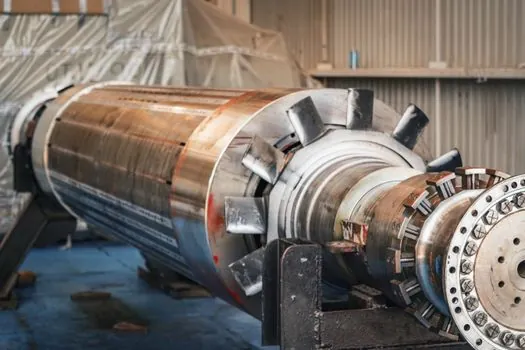
Selection criteria per the standard machinist's key tables start with shaft diameter: for a 300 mm main shaft, a parallel rectangular key of width b = 50 mm, height h = 28 mm, and length L chosen to deliver a working length of roughly 0.8 × shaft diameter (i.e. 240 mm) is typical, before any application factor is applied [S4]. The classic 1:1 width-to-height square key cannot be used because the required key depth would leave the shaft dangerously thin.
Load case matters more than nominal torque. A wind turbine main shaft sees reversals from wind gusts, yaw misalignments, and grid-side torque oscillations during cut-in and cut-out. Parallel keys are recommended for transmitting unidirectional torques not subject to heavy starting loads, and reversing or heavily loaded conditions call for a closer side fit, a higher material grade (typically 42CrMo4 or 40Cr induction-hardened to 45–50 HRC), or a move to an interference fit plus tangential keying [S4].
For the high-speed gearbox-to-generator coupling, shaft diameter drops to 100–180 mm and the duty becomes steady unidirectional, with the addition of a shrink disc or hydraulic mount on the generator hub. In this region, a parallel rectangular key is sized for torque only, since the hub is held axially by the shrink fit, and the key primarily provides the rotational lock and a backup torque path. Generator-side keys are commonly underdesigned because the shrink disc is assumed to carry everything, then fatigue-fail when the shrink disc slips after a thermal cycle.
Failure Modes and What Engineers Get Wrong
Drives that vibrate or reverse directions often loosen setscrews, which often leads to the parallel key walking itself out of the assembly; when a key comes loose, it often falls into the machinery and causes damage while the previously secured component spins free [S4]. In a wind-turbine gearbox, a loose key landing on a high-speed bearing race is a catastrophic event, which is why modern OEM specs call for either a shrouded key (full key in a closed-end keyseat) or a positive axial retainer such as a retaining ring at the key end.
The second common failure is key crushing under impact loads. A wind gust ramp from 5 m/s to 25 m/s in under 10 seconds can transient-load the main shaft above its rated torque, especially in pitch-furling conditions. Sunk keys are sized by compressive bearing stress on the side faces, and a 42CrMo4 key induction-hardened to 50 HRC roughly doubles the allowable bearing pressure of an as-rolled C45 key. Specifying a higher material grade costs a few hundred euros per key and prevents a multi-thousand-euro gearbox teardown.
Woodruff keys fail by rocking in the shaft slot when installed at the wrong rotational orientation; the flat top must run parallel to the shaft, otherwise the key tries to tip under load and either shears the keyseat or fretts the shaft surface. They are unsuitable for transmitting high torques, such as with wide-faced gears or multi-groove V-belt pulleys, and mounting two or more Woodruff keys in line to carry higher loads is expensive and makes installation much more difficult [S4].
Standards, Materials, and Hub-Access Constraints

Key and keyway geometry on ISO-metric wind turbine shafts follows ISO/R773 (rectangular parallel keys) and ISO 2491 (keyway tolerances), with the common square-key table 1101-01 covering 6×6 to 65×65 mm and rectangular tables 1101-02 onward extending to 500×28 mm and beyond. North-American-built turbines and generators built to NEMA frames use the imperial ANSI B17.1 tables, where the same parallel rectangular key covers 1–20 in. shaft diameters [S4].
Material choice splits cleanly by duty. Low-duty hub-to-shaft fits on pitch and yaw drives use cold-drawn C45 (AISI 1045) key stock in the as-rolled or normalized condition, hardness around 170–200 HB, because the loading is low and the cost-per-meter matters on long feeder runs. Main-shaft and high-speed-shaft keys use 42CrMo4 (AISI 4140) quenched and tempered to 28–32 HRC, or 40Cr induction-hardened to 45–50 HRC, to resist crushing and to keep tolerances under the impact load of wind gusts [S3][S4].
Hub access is the silent constraint that overrides every textbook recommendation. The main shaft-to-rotor hub is accessible only from the nacelle end with a hydraulic puller, and the main shaft-to-planetary input coupling sits inside the gearbox nose. In both locations, the keyed joint must use a parallel key with a positive retainer, because a gib-head taper key cannot be removed from the rear [S4]. This is why parallel keys are essential in closed-coupling wind-turbine hubs and not just a default option.
Practical Selection Workflow
Step 1: lock the shaft diameter from the gearbox or coupling drawing. Step 2: classify the load as unidirectional steady, reversing, or impact. Step 3: confirm whether the hub must slide axially (pitch/yaw drives only). Step 4: confirm hub access (front-pull only, or rear-pull available). Step 5: select key type and material from that intersection, then size width and length from ISO/R773 or ANSI B17.1 tables, then check compressive bearing stress on the key side faces against the application factor for wind-turbine reversing loads. [S2]
For the high-speed generator coupling, a parallel rectangular key with a 0.5 mm interference fit on the keyseat sides, plus a retaining ring at each end of the key, is the conservative default. For the pitch-drive pinion, a feather key is genuinely the right call because the hub must slide, and the shaft diameter is small enough that feather-key stress limits are not binding. For the main-shaft rotor hub, a shrouded parallel rectangular key in 42CrMo4, induction-hardened, with a retaining ring at the outboard end, gives the best balance of torque capacity, removal, and field-replaceability.
For wind-turbine drivetrains, the practical rule is: parallel rectangular key as default, square key for shafts under 1 in. (25 mm) and light duty, Woodruff only on small-diameter shaft ends with taper-bored hubs, feather only where axial sliding is required, and taper or gib-head only where rear hub access exists and a positive axial draw is mandatory [S2][S4][S5].
The next signals worth tracking are IEC frame-size standard updates for generator shaft keys (see IEC Motor Shaft End Key and Keyway Dimensions by Frame Size), the 2026 gearbox input shaft sizing method (see Shaft Key Sizing for Gearbox Input Shafts: 2026 Spec Method), and the broader question of when a keyed joint is the wrong choice entirely (see When to Choose a Ball Spline Over a Keyed Shaft).