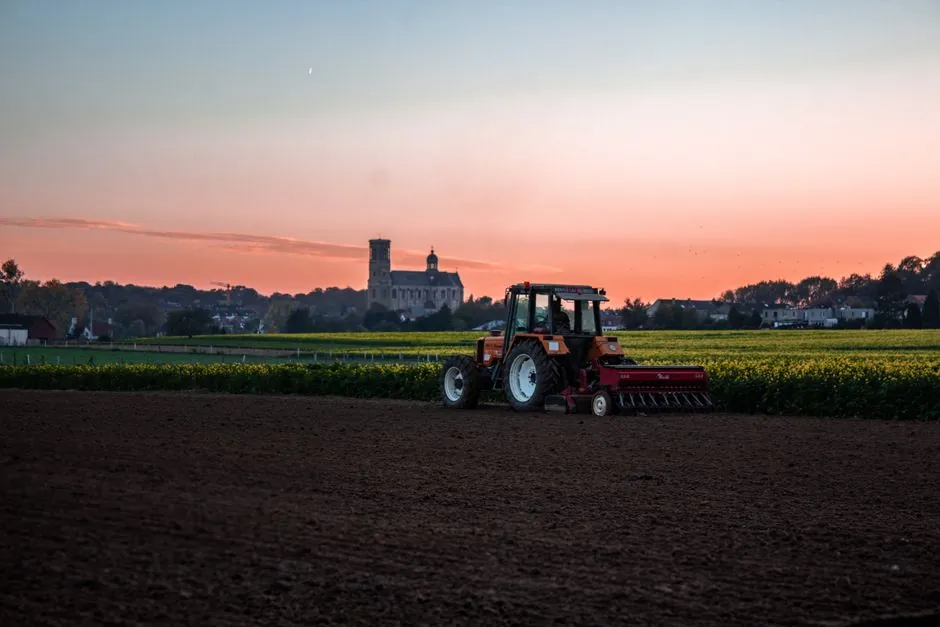
Parallel square and rectangular keys remain the default torque-transfer choice for tractor PTO stubs, rotary cutter jackshafts, and combine feeder shafts because they tolerate side loading, misalignment, and the cyclic shock loads typical of tillage and harvesting work [S1][S2].
Carbon steel dominates the material list for these farm-duty keys, rated for the high strength and wear resistance needed to handle peak loads and impact forces during field operation [S2].
Where Shaft Keys Sit in an Agricultural Driveline
A shaft key is a small metallic component inserted between a shaft and the hub of a mating part to prevent relative rotational movement between the two [S3]. In practical farm equipment, the key is what couples a gear, pulley, sprocket, or coupling hub to a shaft carrying intermittent peak torque from soil engagement, crop load, or sudden PTO clutch engagement.
For a rotary mower blade spindle or a baler crank, the key carries the full driveline torque, so its cross-section is sized to the shaft diameter rather than the hub. The key transmits load through side-surface compression between the shaft keyway, the key, and the hub keyway; the top and bottom of the key sit in clearance and do no load-bearing work [S1][S2].
Replacement parts catalogs reflect that reality: a common ag-spec shaft key listed for mower and implement spindles measures 1 inch long by 3/8 inch wide by 5/16 inch high, a rectangular profile matched to mid-range implement shafts [S4].
Key Type Comparison for Farm Applications
Parallel (flat) keys are the most widely used machine key in agricultural equipment, offered in square cross-section for smaller shaft diameters and rectangular cross-section for larger diameters, with rectangular profiles preferred as the shaft grows to keep the key depth reasonable [S1].
The four key families and their fit in farm machinery line up as follows:
Flat parallel key: easy to manufacture, good shaft-to-hub alignment, simple replacement in the field, but cannot fix axial movement of the mounted component, so a shaft collar or retaining ring is normally added if axial location is needed [S1][S2].
Woodruff (half-moon) key: a half-moon shape that accommodates any taper in the hub, with extra depth in the shaft preventing rollover in the keyway, but the deep keyway weakens the shaft and limits it to light-load connections, which restricts its use on heavy primary drivelines in tractors and combines [S2].
Taper (saddle) key: works on its upper and lower surfaces with a 1:100 taper, used where the hub must be removed and re-seated frequently for service, common on older implement hubs and some gearbox assemblies [S2].
Tangent key: two separate keys set at 120 degrees apart, used for very heavy-duty, reversible, or high-impact drives such as large press equipment and rolling mill drives, and only rarely on agricultural machinery because of the precision required in keyway machining [S2].
Sizing Rules Tied to Shaft Diameter
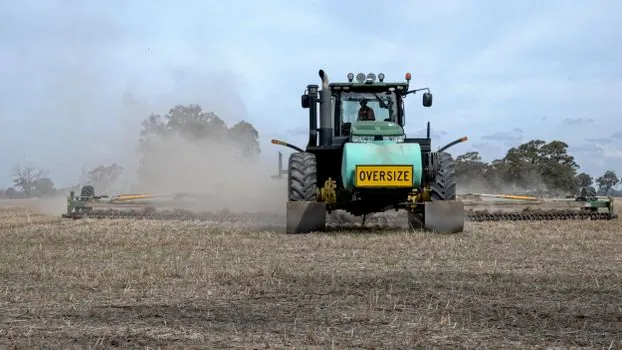
Key width is the primary shaft-driven dimension and follows standard tables: for a 1/2 inch shaft the common parallel key is 1/8 inch wide, for a 3/4 inch shaft roughly 3/16 inch wide, for a 1 inch shaft about 1/4 inch wide, scaling up to 1/2 inch wide keys on 3 inch shafts, with the exact figure pulled from ISO 773 and DIN 6885 tables in the OEM manual [S1][S2].
Key length is set by the hub length and the torque to be transmitted, not the shaft diameter. As a working rule, key length is roughly 0.8 to 1.5 times the shaft diameter for general power transmission, and the key is loaded in shear and compression across that length [S2].
Standard flat keys come in three end geometries: rounded end (Type A) for easy insertion in blind keyways, square end (Type B) for general use, and single rounded end (Type C) where one end is constrained by a shaft shoulder or shaft key seat [S2].
Material Choices for Corrosive and Dirty Field Conditions
Carbon steel is the most common shaft key material in agriculture, offering high strength, wear resistance, and the ability to withstand the impact loads that come from stones, stumps, and clutch spikes [S2]. Plain medium-carbon steel such as C45 or 1045 is typical for implement keys.
For fertilizer spreaders, manure agitators, irrigation pumps, and other wet or chemically aggressive service, stainless steel keys (typically A2/304 or A4/316) extend service life, at the cost of lower shear capacity and higher unit price [S2].
Alloy steels such as 40Cr or 42CrMo appear on heavy-duty tractor and combine driveline keys, where the higher fatigue limit offsets the additional cost when the key is loaded near its design limit cycle after cycle [S2].
Installation and Failure-Mode Pitfalls in the Field

The most common field failure is a sheared key, almost always a sign that the key was undersized for the applied torque, the shaft had an undetected burr or rounded keyway bottom, or the hub was loose and was hammering the key rather than gripping it [S2].
Second on the list is a rolled Woodruff key on tapered implement shafts, caused by deep keyway milling that reduces the local shaft section; replacement with a parallel key, where the shaft geometry allows, removes the failure mode entirely [S2].
For machines where the hub must slide axially on the shaft, such as some feeder slip clutches and shiftable pulleys, a parallel key in a through keyway is specified so the hub can move without binding; this is the standard configuration in reducer-style shaft-hub assemblies [S2].
When axial fixation matters and a key alone cannot supply it, a locking assembly or shaft collar takes the axial load, leaving the key to carry pure torque, a clean split of duties that improves both bearing life and replaceability.
When a Key Is the Wrong Choice on Farm Equipment
Keys are not the right answer for every shaft-hub connection in agriculture. Hollow PTO shafts with frequent engagement, high-speed combine rotors, and any joint that must transmit torque through a flexible element typically use shaft coupling interfaces or splined connections rather than a single key [S2].
For very high torque density on a smooth shaft, taper bushings, locking assemblies, or shrink-fit hubs replace the keyway, removing the stress concentration in the shaft that a milled keyway creates. A key remains the cost-effective, field-serviceable choice for most implement jackshafts, gear hubs, and pulley mounts under roughly mid-range torque, which covers the bulk of farm machinery [S2].
Operators sourcing replacement keys should match the original key's standard callout (DIN 6885, ISO 773, GB/T 1096, or ANSI B17.1) along with width, height, length, and end type, and verify the shaft keyway depth with a depth gauge before pressing the new key in, since an oversize key on an undersize keyway is a guaranteed shearing event [S2].
Track the exact key size, material, and standard on every replaced component, then cross-check against the next service interval; if the same key is failing repeatedly in the same hub, the problem is almost always hub-to-shaft fit, not the key itself.