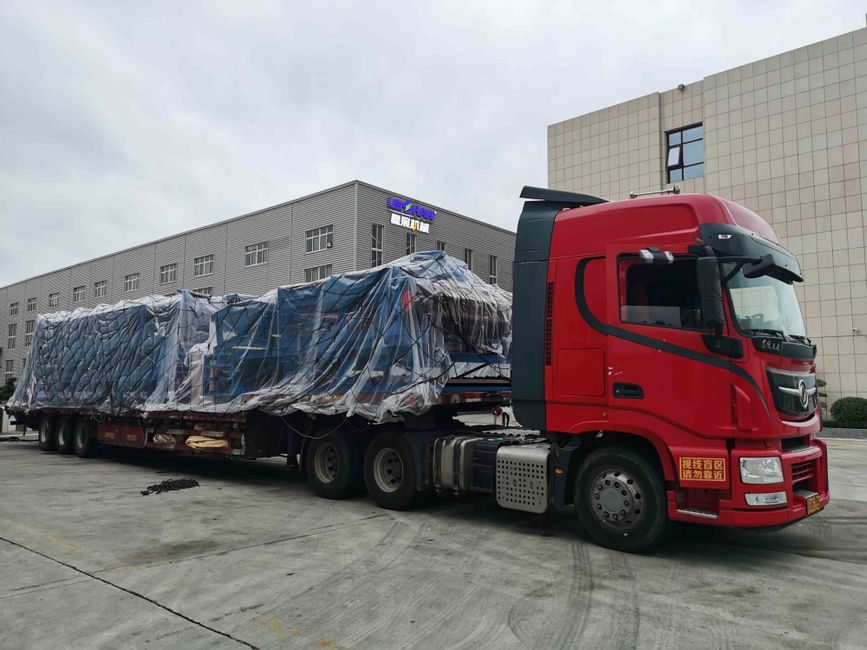
A shield machine (TBM) is specified by ground model, cutterhead type, nominal bore, total installed thrust, torque rating and segment-ring compatibility — and these five parameters must close before any commercial price band is requested.
For metro, utility, sewer and river-crossing tenders in 2026, buyers typically shortlist one of three cutterhead families: slurry pressure-balance (SPB), earth pressure-balance (EPB), and dual-mode convertible machines, with the dual-mode share rising in mixed-face and karst geology. The wrong family choice locks the project into ground-treatment bills, segmental-lining redesigns, and re-mobilisation penalties that dwarf the original machine spread.
Ground Model and Cutterhead Family Decision
Slurry pressure-balance shield machines are specified for soft, water-bearing alluvium, river crossings under high hydrostatic head, and saturated sand-gravel where face support is controlled by a bentonite or polymer suspension in the plenum [S1]. EPB shield machines, by contrast, use conditioned muck as the support medium and are the default for soft clay, silty clay, and stiff cohesive soils with low groundwater inflow, where the conditioned spoil itself can carry face pressure.
Dual-mode convertible TBMs — typically a screw-conveyor + slurry-circuit swap on a common main beam — are increasingly specified on Chinese metro and utility-tunnel jobs where the alignment crosses alternating clay, sand and weak-rock sections in a single drive, because they avoid the second-machine mobilisation cost. Buyers should require the conversion cycle time in hours and the maximum number of mode switches the manufacturer warrants, since field data shows ground variability typically forces 2–6 mode changes on a 2 km mixed-face drive.
Torque, Thrust and Cutterhead Drive Sizing
Shield machine torque and thrust are sized to the bore diameter, the rock or soil unconfined compressive strength (UCS), and the required advance rate. For a 6 m EPB in soft clay, typical installed torque ratings sit in the 4,500–6,500 kNm band with total thrust of 35,000–50,000 kN; for a 15 m mixed-ground slurry machine, torque classes rise into the 25,000–40,000 kNm band and thrust into the 100,000–150,000 kN band. [S1]
Drives are either hydraulic (multi-motor planetary, historically common on EPBs) or electric VFD-driven (now standard on new large-bore slurry TBMs for the lower specific energy consumption and finer torque-ripple control). The shield machine reference page consolidates bore-vs-torque-vs-thrust typical ranges and the corresponding cutterhead speeds. Buyers should ask for the cutterhead speed at nominal torque (rpm) and the cutterhead de-rating curve at high-density ground, because stalled cutters in stiff clay are the leading cause of intervention dives.
Segmental Lining Geometry and Backfill System
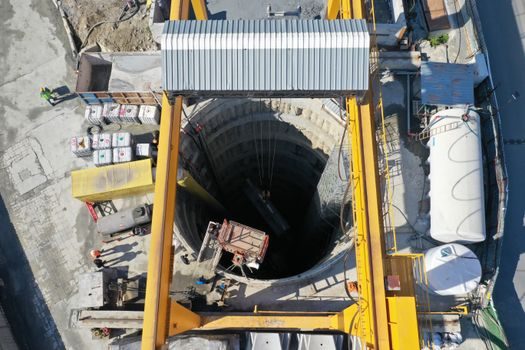
The segment ring outside diameter (OD), ring length, ring width and segment count (commonly 5+1 or 6+1 universal rings) must close against the shield machine's tail-skin inner diameter and segment erector reach. A mismatch of more than 20–30 mm between ring OD and tail-skin ID forces the contractor into pea-gravel or cement-grout backfill volumes that compromise convergence control. [S2]
Backfill is one of three families: pea-gravel (gravel-fluid), cementitious grout (two-component A+B), or mortar + bentonite. Two-component grout has become the default on metro shield jobs in 2026 because the gel time can be dialled in the 6–30 second window, which reduces surface settlement to single-digit millimetres above shallow drives. The [diaphragm wall grab selection](news/diaphragm-wall-grab-selection-4-spec-gates-that-decide-the-build.html) article covers the sister rig class for station and launch-shaft walls, which is a useful cross-reference when a shield launch shaft and the cut-and-cover station are tendered separately.
Slurry Circuit, Separation Plant and EPB Muck Handling
Slurry TBMs carry a 1,000–3,500 m³/h slurry circuit on the back-up, with a separation plant sized in tonnes/hour of cuttings. The plant typically includes a scalping vibrating screen, hydrocyclone desilters, and a centrifuge for fines below 20–40 µm; in 2026 many metro tenders now cap slurry-circuit water consumption and reject direct river discharge, which forces closed-loop clarification. [S3]
EPB machines carry a screw conveyor whose pitch, diameter and discharge gate geometry are sized to the soil's conditioned permeability. A common failure mode is screw wear in abrasive sandy ground — a hardened-flight or replaceable-lining option is worth paying for above 200 m of mixed sand-clay drive. The 2026 buying discipline is to require the wear-rate curve in mm/km and the screw-converter rebuild interval in metres, not just the nominal diameter.
Auxiliary Systems: Segment Erector, Grout Lines and Survey
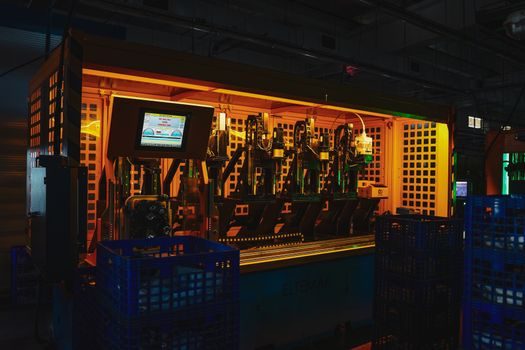
The segment erector is a 6-DoF rotating ring handler with a 50–110 kN pick-and-place rating, sized to the heaviest segment (the key stone in a 1.5 m wide ring is typically 5–8 t on a 6 m bore). Buyers should confirm erector rotation torque, lift stroke, and the segment feeder throughput in rings/hour, because the bottleneck on a 30 mm/min advance is rarely the cutterhead — it is the cycle from muck-out to ring-build. [S4]
Survey guidance on a 2026-spec shield machine combines a laser target on the segment erector with total-station prisms and a fibre-gyro on the shield body, plus a walk-through of the automatic segment-bolt-tightening cycle. The [dynamic compactor buying guide](news/dynamic-compactor-buying-guide-2026-type-force-soil-and-sourcing.html) is not directly relevant to a shield but is useful where a launch-shaft working pad has to be densified before the shield is lowered in.
Common Buyer Mistakes in 2026 Tenders
Three errors repeat across metro and utility-tunnel tenders. First, anchoring the shortlist on cutterhead family alone and ignoring the main-beam length and articulation — a shield too short for the minimum-radius curve in the alignment forces segmental ring-geometry redesigns mid-drive. Second, omitting the slurry-circuit water-consumption cap, which in 2026 is a hard tender line item in most Chinese coastal and Yangtze-crossing projects. Third, treating the back-up gantries as standard — gantry count, width and conveyor geometry decide whether a 1,500 m single-track drive is feasible without a parallel muck-extraction adit. [S1]
A second-tier filter is the OEM's local field-service presence: cutterhead intervention work, main-bearing change-out, and screw-conveyor rebuilds are tied to crew dispatch time, not to machine price. Ask for the average intervention-dive mobilisation window in hours and the regional spares warehouse stock list — the core machine and face shield entries in the encyclopedia cover the related reference terminology used in cutterhead intervention specifications.
Selection Criteria Comparison: SPB vs EPB vs Dual-Mode
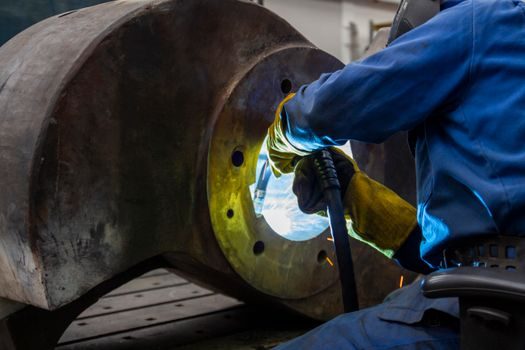
For a clean side-by-side, the three families line up on four decision criteria: ground applicability, groundwater tolerance, conversion cost, and segment-ring build cycle. SPB wins on water-bearing sand and high-head river crossings because the slurry circuit actively supports the face; EPB wins on soft, low-permeability clay because muck conditioning and screw discharge are the simplest, lowest-energy path; dual-mode wins on mixed-face alignments where conversion cost is amortised over 2 km or more of varied ground, but the conversion cycle in hours is the spec to negotiate, not the headline price. [S2]
On segment-ring build cycle all three families converge once the back-up gantry is sized correctly: a well-specified shield of any family will run 8–12 rings/hour in stable ground and 4–6 rings/hour through a mixed-face zone. The shield's torque, thrust and cutterhead speed only set the geological envelope; the ring-build cycle sets the project programme.
Closing note: pin two trackable signals before signing — the cutterhead main-bearing design life in hours (typically 10,000–20,000 h) and the maximum intervention-dive pressure in bar, since these are the two numbers that convert a tender into a project risk register.
For related coverage, see Industrial Coding Machine Buying Guide 2026: CIJ, TTO, Laser Spec Cut.