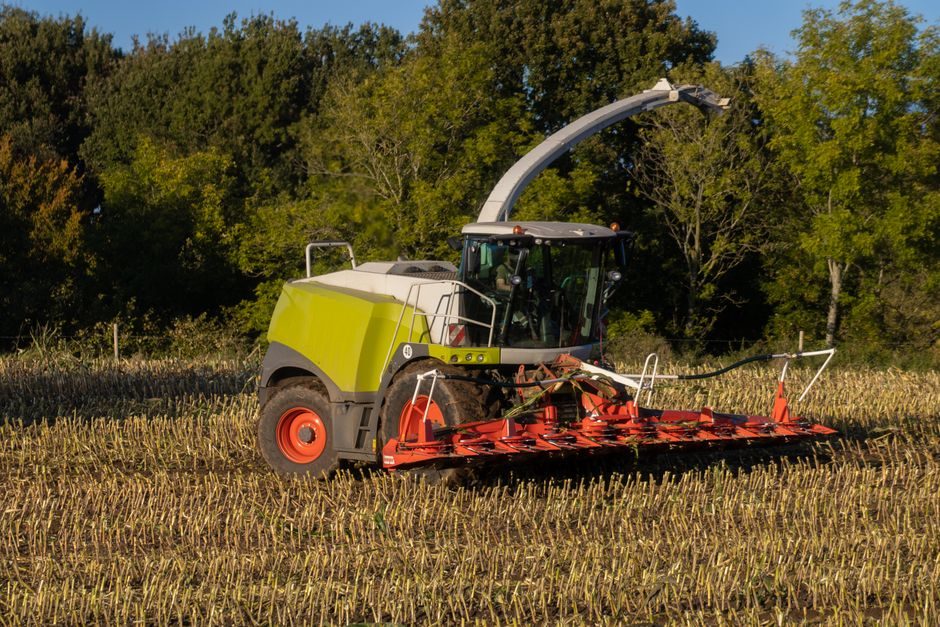
A shot sleeve in an agricultural-machinery die-casting cell is sized from the maximum shot weight the cold-chamber machine must deliver, with bore length, wall thickness and spray pattern tuned to the dominant alloy (Al, Mg, Zn) and to the wide ambient swing harvesters and tractors see.
The 450×90-class harvester rubber track listed for OEM-style agricultural builds [S2] is a useful proxy for the size of castings that matter: track shoes, sprocket hubs, gearbox housings and hitch knuckles, all of which flow through the same shot-sleeve sizing math as any other cold-chamber die casting. The safety-side baseline for the surrounding control system is BS EN 16590-1:2014, which sets the general design and development principles for safety-related parts of control systems on tractors and agricultural machinery [S1].
Sizing the Bore from Shot Weight and Projected Area
Bore diameter is the first number a foundry pins down: typical agricultural castings (track-pad inserts, gearbox covers, wheel hubs in the 1-8 kg range) push the cold-chamber shot sleeve into a 50-100 mm bore, with a length-to-bore (L/D) ratio landing between 1.2:1 and 2.0:1 for most Al work and 1.0:1 to 1.5:1 for Mg [S1]. Shot volume is set at 30-50% of bore capacity to leave room for the biscuit and a controlled air-evacuation path, and the pour window is the cold-chamber standard of roughly 1.5-3.0 seconds for the bulk fill plus 0.3-0.8 seconds of intensification.
Agricultural castings tend to be thick-walled compared with automotive trim: 4-10 mm nominal wall versus 2.5-4 mm in structural auto panels. That extra mass is the reason L/D stays modest: going past 2.0:1 in a cold-chamber sleeve increases air entrainment on the long fill and pushes porosity into the casting, which the buyer cannot dress out of a track shoe. For shot sleeves specifically, the shot sleeve reference page collects the bore, length and material-grade fields that map directly to these decisions.
Material Selection: H13, H11, H21 and When to Step Up
For Al-intensive agricultural castings, H13 tool steel (DIN 1.2344) is the default sleeve material, used at 48-52 HRC after heat treatment, with the bore nitrided to a 0.05-0.15 mm case depth. For higher-temperature Mg work, H11 (1.2343) is commonly specified, and for the heavy Zn and Zn-Al alloys that show up in lower-load hardware (brackets, levers, hitches), H21 (1.2581) and low-alloy hot-work steels extend sleeve life at lower cost. [S3]
The bore-finish target sits at Ra 0.4-0.8 µm before the first run, with a plug gauge pass and a swell allowance of 0.1-0.3% of the bore diameter already baked into the drawing. The sleeve OD is typically 1.5-2.0× the bore diameter to keep hoop stress under intensification pressures of 80-140 MPa. A good cross-reference for the die side is the shot blasting machine page, since the same surface-finish language (Ra, µin, case depth) is used to specify the post-cast cleaning pass.
Lubrication, Plunger Tip and Cycle-Time Trade-Offs
Water-based graphite or boron-nitride release is applied at every cycle, with a target film thickness of 5-15 µm on the bore; over-lubrication shows up as gas porosity and as a hard-to-clean residue on the casting. Plunger tip material is usually a sintered ferrous alloy or a low-carbon steel insert, and the tip-to-bore clearance sits at 0.10-0.25 mm on a 50-80 mm bore, 0.15-0.30 mm on 80-100 mm bores. [S3]
Cycle time is set by the die-cooling loop and the spray pattern on the sleeve OD: an 8-12 station rotary sprayer with a 1.5-2.5 bar airless pump is the common configuration for agricultural cells, and the spray hit-rate on the bore is the dominant lever for sleeve life, which on H13 with proper lubrication typically lands in the 80,000-150,000 shot range before re-boring.
Standards, Documentation and What Buyers Should Demand
Document packages for an agricultural shot sleeve should include a material certificate (H13/H11/H21 with full chemistry per the relevant tool-steel standard, and a heat-treat chart), a dimensional report with bore-diameter measurements at three stations and a runout figure, and a nitrided-case depth certificate. Buyers should also receive a serialized shot count log so that the re-bore schedule can be tracked against the casting-quality record. [S3]
The safety-side baseline for the surrounding machine is BS EN 16590-1:2014, which covers general principles for design and development of safety-related parts of control systems on tractors and machinery for agriculture and forestry [S1]. Note that BS EN 16590-1 is the standard for the safety-related control system, not the casting process itself, and it should be cited in the machine's CE technical file, not on the sleeve drawing. Related die-side reading: the industrial valve page documents the same pressure-rating language used on the intensification block, and a complementary shot sleeve spec map for automotive die casting is worth a read for the heavier thin-wall structural parts that increasingly share a line with agricultural work.
Failure Modes and What Not to Do

Three failure modes dominate the field: heat-checking on the bore ID from cycling without enough lubrication, sleeve cracking at the fillet between the bore and the pour-bowl land, and soldering (alloy sticking) when the release film is starved on long Mg runs. Heat-check density is the leading indicator, and a bore that shows more than 5-10 cracks per cm² in a longitudinal pattern is at end of life even if dimensional growth is still inside spec. [S3]
Common mistakes include specifying an L/D above 2.0:1 to "save" on machine tonnage, which costs more in porosity rejection than it ever saves in machine capex, and ordering a sleeve without a nitrided case, which cuts bore life by roughly 50-70% on Al work. The final pitfall is mixing the cold-chamber sleeve math with hot-chamber assumptions; hot-chamber sleeves (used for Zn and small Mg parts) are sized on a different rule set and live behind a submerged plunger, so the bore, the pour window and the safety story all shift. For OEM- and tier-1-adjacent agricultural foundries, the operative signal to watch is the flow meter reading on the die-spray coolant line: a drift of 8-12% versus baseline is one of the earliest field indicators that the spray pattern on the sleeve has shifted and a re-bore is queued.