
Compatibility with mechanized and robotic spraying systems is the single largest determinant of shotcrete equipment selection in 2026, with the robotic/wet-mix class reinforced by its fit with Asia-Pacific and European tunneling fleets [S2]. A procurement decision that ignores robotic-arm interface, additive dosing skid, and accelerator-line compatibility will fail qualification long before the first nozzle is tested.
Global market sizing illustrates the stakes: the shotcrete machines market reached USD 5.57 billion in 2025 and is forecast at USD 5.95 billion in 2026, compounding at 7.13% to USD 9.02 billion by 2032 [S1]. A second analyst model values the same market at USD 4.53 billion in 2025 with a 4.9% CAGR through 2034 to USD 6.97 billion [S2]. The two figures diverge on segmentation, not on the underlying trend: double-digit infrastructure renewal, metro and hydropower expansion, and the move toward robotic, electric, and low-emission units are all pulling demand upward.
Wet-Mix vs Dry-Mix: Process Fit Dictates Equipment Class
Wet-mix shotcrete equipment pre-mixes water, cement, and aggregate before pumping to the nozzle, while dry-mix equipment conveys dry material with water added at the nozzle, with the selection driven by job size, accessibility, application rate, material availability, air-compressor capacity, and water supply [S4]. Wet-mix dominates because it pairs cleanly with robotic booms; the dominance is reinforced by its compatibility with mechanized and robotic spraying systems, which are widely deployed in Asia-Pacific and European markets [S2].
Dry-mix remains relevant where the repair area is limited in location and availability, such as remote dam faces reached only by cofferdam and crane access, where dry-mix reduces setup time and water logistics [S3]. A spec-side decision matrix should compare the two against rebound rate, dust load, accelerator dosing tolerance, and the ability to feed fiber-reinforced mixes. Wet-mix generally wins on dust and rebound in confined tunneling; dry-mix generally wins on portability and water independence for short-duration remote repair.
Robotic Boom and Project-Control Interoperability
Interoperability with project-control systems, ease of maintenance, and availability of trained technicians are now stated procurement criteria, sitting alongside output rate in the same sentence [S1]. That shift is structural: tunnel and mining owners increasingly demand machine data exports in formats a BIM or tunnel-information-modeling platform can ingest, not a vendor-proprietary log file.
Practical checkpoints on the datasheet include: CAN-bus or Ethernet-based telemetry that the OEM documents publicly, not behind a licence; documented handshake with accelerator dosing skids and admixture pumps; and a published mapping from boom kinematics to layer-thickness control loops. Computer vision and sensor data can assist with stand-off distance, spray angle, layer thickness, and surface coverage, while machine-learning models may identify process deviations from pressure, flow, vibration, or temperature data [S1]. The same vendors typically refuse to publish the raw tag list, which is the single most common reason a unit passes the desk review and fails the site acceptance test.
Availability Constraints: Spare Parts, Skills, and Capital

Availability has at least three distinct meanings in this market, and conflating them is a frequent spec error. The first is spare-parts lead time: pump wear parts, nozzle carriers, and accelerator injection rings on robotic units commonly carry 4-12 week lead times when not stocked regionally. The second is technician availability: the requirement for skilled operators proficient in advanced spraying systems constrains market penetration, as some regions lack the specialized workforce needed to maximize the potential of this equipment [S2].
The third is capital availability for the contractor: advanced shotcrete machines require substantial capital investment, and their ongoing maintenance adds to operational costs, with the constraint binding hardest on small and medium-sized contractors [S2]. High equipment cost and the cost of skilled labor are, together, the binding ceiling on how fast robotic adoption can scale in emerging markets, even where the technical case is strong. A useful pre-spec step is to confirm the OEM's regional warehouse list and the published mean-time-to-repair for the pump group, then write both into the contract as liquidated-damages triggers.
Standards, Repair Specification, and Material Compatibility
On the repair side, ACI 506.2-13 "Specification for Shotcrete" includes mandatory provisions for commonly tested performance characteristics such as compressive strength and flexural strength, and requires any hardened test samples to be produced from sprayed test panels [S3]. That detail matters for compatibility: a project specification written around form-and-pour cube tests will reject sprayed panel results even though both represent the same material. Specifiers should align test-method language with ACI 506.2-13 from the first revision, not retrofit it after bidding.
Material compatibility adds a second layer. The repair material must be compatible with the concrete substrate, durable in the expected exposure conditions, and meet the structural requirements detailed by the design professional [S3]. In practice that means matching elastic modulus, coefficient of thermal expansion, and shrinkage potential, then verifying bond via pulled-test panels on a representative substrate before bulk placement. Skipping this step is the dominant cause of perimeter cracking that admits chlorides and corrodes the embedded reinforcing steel, regardless of the equipment class used to place the material.
Selection Criteria: A Side-by-Side Comparison
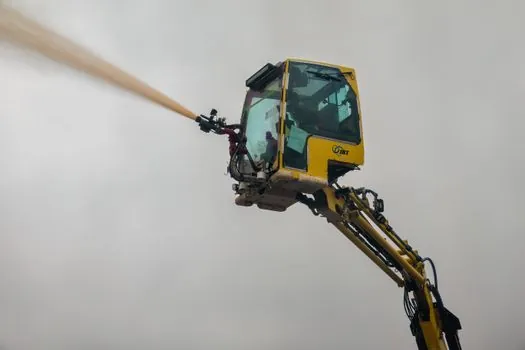
Four criteria separate the realistic shortlist from the marketing deck. Output rate, robotic-arm interface, regional service coverage, and total cost of ownership over a 5-7 year project horizon. Against that grid, large robotic wet-mix units score high on rate and interface, mid on regional service in Africa and parts of Latin America, and high on TCO when utilization exceeds roughly 60%. Compact wet-mix units score mid on rate, high on serviceability, and low on TCO for short-duration urban repair. Dry-mix units score low on rate and interface, very high on portability, and low on capital cost, but they pay a rebound-and-rework penalty on long runs that erodes the upfront saving. [S1]
For an underground or tunneling owner standardizing a fleet, the procurement logic in 2026 tilts decisively toward wet-mix robotic platforms with documented telemetry, ACI 506.2-13-aligned test methods, and a regional warehouse within 24 hours of the major project sites. For a repair contractor bidding on a single dam or bridge, the right answer is often a smaller wet-mix unit or even a dry-mix rig, with the selection driven by access, water supply, and rebound tolerance rather than throughput. Either way, compatibility is a checklist of mechanical mounting, electrical levels, protocol and signal, and materials contact, validated on a sprayed test panel before production starts.
Trackable signals for the next planning cycle: the next published regional shotcrete market regional cut, the next OEM update to its robotic-arm interface documentation, and any ACI 506 committee bulletin on sprayed test-panel procedure revisions. For related equipment RFQ structure, the truck-mounted concrete pump certification checklist for sanitary process line work covers the pump-side envelope, while the sand reclamation unit RFQ covers the aggregate-loop compatibility that surrounds any shotcrete machine on a mechanized jobsite.
Component reference pages worth checking: coding machine, and core machine.