A side shifter moves the fork carriage and load laterally without changing fork spacing, while a fork positioner changes the distance between the two forks to match different pallet widths [S1][S3].
The selection depends on the measured task: lateral movement for alignment correction, adjustable fork spacing for different load widths, or one package that performs both functions [S3][S4].
Decision Criteria: Movement, Load Fit and Capacity
A side shifter is a lateral positioning device: the carriage, forks and load move left or right as one assembly, while the gap between the forks remains constant [S1][S5]. A fork positioner changes the relative spacing of the individual forks, but a standalone unit does not shift the carriage sideways [S1][S5].
The comparison is therefore operational rather than cosmetic. Use a side shifter when the truck can approach the load but the pallet is offset from the forks. Use a fork positioner when the load support width changes between pallets, crates or skids. The most direct comparison is lateral correction, fork-spacing adjustment, capacity effect and hydraulic complexity.
Do not substitute one movement for the other. A side shifter cannot create the support width needed for a narrower pallet, while a standalone positioner may still leave the truck needing a second approach for lateral placement [S3].
Where Each Attachment Earns Its Place
A side shifter is suited to narrow aisles, dense racking, container loading and dock-to-rack insertion where steering movement is restricted and lateral correction is required [S2][S5]. Its practical advantage is micro-adjustment from the operator position, reducing repeated truck movements, cab exits and manual attempts to align a pallet [S2].
A fork positioner is suited to mixed-pallet distribution centres, beverage warehouses and manufacturing operations where 40×48 and 48×48 pallets, odd-sized crates or other changing widths occur during one shift [S2]. That figure is an application result, not a universal productivity guarantee.
A combined side-shifting fork positioner is justified when operators need spacing adjustment and final lateral correction during the same rack or trailer cycle [S3]. The combined package needs separate evidence for lateral travel, minimum and maximum fork spacing, control functions, hydraulic requirements and residual truck capacity [S3].
Hydraulics, Carriage Fit and Installation
Compatibility starts with the carriage class, width, fork section, fork length, locking arrangement and load-backrest interface [S3]. The hydraulic specification must cover valve sections, operating pressure, flow, controls and hoses; proportional controls can improve side-shift modulation on suitable electric trucks, while older mechanical trucks may require added valves or plumbing [S2].
That figure is a planning estimate from the cited guidance, not a universal labour allowance. The acceptance test should demonstrate carriage travel and fork spacing separately, then confirm both controls together where a combined unit is supplied [S2][S3].
Do not judge compatibility from the forklift body size alone. A side shifter adds guide rails, a cylinder, hoses and effective thickness between the carriage and forks. A positioner adds internal rails or chains and requires clean hydraulic oil [S2][S5]. Both alter the geometry used in the truck's load chart.
Capacity, Load Centre and Derating
An attachment can reduce the forklift's net lifting capacity by increasing attachment mass and shifting the effective load centre [S3][S5]. For a side shifter, confirm the resulting load-centre distance on the exact truck and mast load chart. For a fork positioner, also check capacity at the intended fork extension, because per-fork capacity can decrease when the forks are widely spaced [S5].
The working-point check must use the actual lift height and cargo load centre rather than the truck's rated capacity at floor level [S3]. Attachment mass, effective thickness, fork position and the selected working-point chart all belong in the approval record. A nameplate rating for the attachment does not establish that the complete truck-and-attachment combination remains within capacity [S3][S5].
Maintenance and Failure Modes
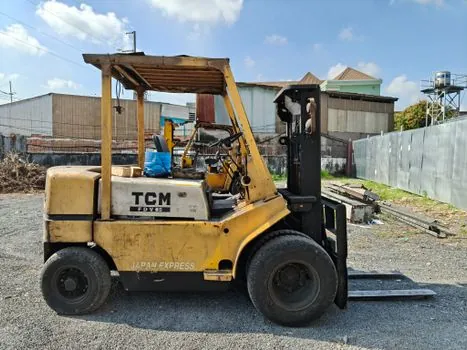
A side shifter's exposed wear points include guide rails, sliding surfaces, cylinder seals, hoses and fittings [S2][S5]. Off-centre loading increases rail and seal wear, while leaks or pressure droop can produce sluggish or uneven movement [S5]. Inspect hoses, fittings, cylinder condition and lubrication points on a defined maintenance interval.
A fork positioner adds wear points at internal rails and chains, and its hydraulic system depends on oil cleanliness [S2][S5]. Chain or rail wear can make fork spacing inconsistent, while contaminated oil can increase the risk of valve or cylinder malfunction. Daily visual checks do not replace periodic measurement of spread accuracy or service of the rails, chains, seals and hoses.
The main safety failure mode is a load becoming unsupported when the forks are too widely spaced for the pallet entry openings or are not seated properly. Measure each load's fork-opening dimensions and support positions rather than using pallet outside width as a substitute [S3].
Purchase Specification and Acceptance Test
Write the specification around the required movement, not the attachment name. For a side shifter, state minimum and maximum lateral travel, carriage interface, hydraulic function and residual capacity. For a fork positioner, state minimum and maximum fork spacing, carriage class, fork section and capacity across the intended opening range [S3].
One published example specifies approximately 100 mm of lateral movement for the side shifter [S4]. Use that figure only if it matches the measured alignment problem; lateral travel beyond the required range adds mass and capacity loss without improving the task. A combined package should list both travel and spacing ranges, plus two control functions unless the specified workflow permits another arrangement [S3][S5].
Before release, record zero-position accuracy, full-travel operation, spread repeatability, hose condition, operator visibility and residual capacity at the duty load centre [S3]. For a positioner, test every standard pallet width; for a side shifter, test the worst offset encountered at the rack, trailer or dock. Select the simpler attachment unless the operating cycle proves that both movements are necessary.
Track two procurement signals before ordering: the share of cycles that require spacing changes and the measured lateral offset left after the truck approaches the load. Choose a positioner when width changes dominate, a side shifter when offset dominates, and a verified side-shifting positioner when both occur in the same handling cycle [S2][S3].