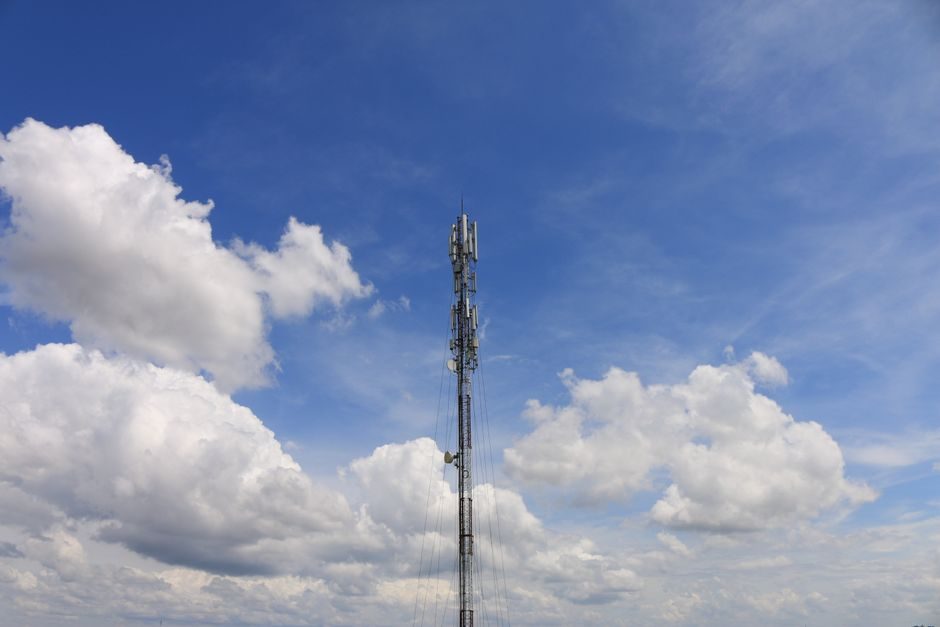
A signal repeater is an OSI Layer 1 device that amplifies and re-times a single-band RF waveform, typically delivering 60-63 dB of gain across a 25 MHz uplink/downlink pair such as GSM 900 (uplink 890-915 MHz, downlink 935-960 MHz) and covering roughly 500 m² of indoor footprint [S1].
An industrial cellular router operates at OSI Layer 3, terminates a cellular IP stack on a SIM, and exposes Ethernet/RS-232/RS-485 to field equipment, with deployment factors dominated by antenna placement, cable loss, and SIM/APN provisioning rather than raw RF gain [S2]. The two products answer different questions: the repeater fixes weak coverage, the router ships data.
Definition and OSI Layer Split
A repeater (RP repeater) works at the physical layer of the OSI model, regenerating and restoring the waveform without interpreting frames, packets, or addressing [S4]. A typical GSM 900 unit specifies uplink gain ≥60 dB, downlink gain 63 dB, pass-band ripple ≤1.8 dB, I/O impedance 50 Ω with N-type connector, noise figure ≤6 dB, and transmission delay ≤0.5 µs [S1].
An industrial cellular router moves up the stack to Layer 3, supporting TCP/IP, NAT, VPN, MQTT, and Modbus TCP gateways over 4G/5G; its antenna choice, mounting height, and cable length directly determine field reliability, while SIM card selection and APN configuration are the recurring commissioning friction points [S2]. For a process engineer, the cleanest mental model is: the repeater is a radio-amplifier with an LED, the router is a Linux box with an antenna.
Selection Criteria, Side by Side
The four criteria that actually drive a buy decision are scope, intelligence, environment, and power. On scope, a 900 MHz GSM booster re-radiates only the band it was tuned for and is unsuitable for multi-operator LTE sites [S1]; an industrial router accepts any cellular band its modem module supports and can fall over between operators via dual-SIM or APN policy [S2].
On intelligence, the repeater's datasheet reports zero application logic — only a power LED and a "export power" LED [S1]; the router runs firewall rules, IPSec/OpenVPN tunnels, and edge protocols. On environment, the entry-level repeater is rated -15°C to +55°C ambient and accepts AC 220 V ±10% at 45-55 Hz or DC 12 V [S1]; industrial routers are typically specified from -30°C to +75°C with 9-36 VDC input and metal DIN-rail housings. On power, a small repeater draws single-digit watts; a router with GPS, dual-SIM, and an active Ethernet switch sits in the 5-15 W band depending on radio duty cycle.
Who Each Box Is For, and Who It Is Not
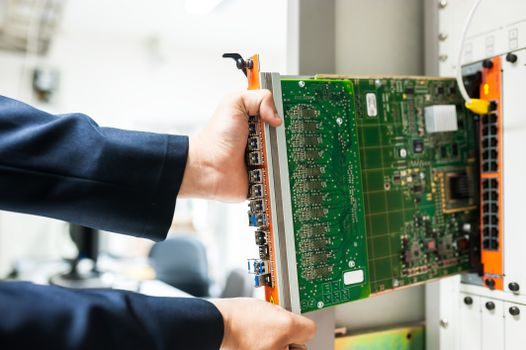
Pick a signal repeater when the failure mode is one weak band inside one building — a warehouse with a single operator, a basement control room with no line of sight to the rooftop antenna, a remote pump skid where only voice-grade GSM matters. The Mini GSM 900 unit's 500 m² coverage figure is the rule of thumb: anything larger or multi-storey needs a powered donor antenna or a fibre-fed DAS instead [S1].
Pick an industrial router when the failure mode is data: SCADA polling, video push, remote PLC programming, MQTT to a cloud broker. The repeater cannot help here because a router needs a routable IP and a SIM, and a passive amplifier does not provide one. Cost-by-cost, a repeater is a fraction of an industrial router's price, but it is also a fraction of the capability — adding LTE to a repeater-equipped site still requires a router downstream.
Real Use Cases and Failure Modes
For a fixed, single-tenant office or shop floor, a dual-band GSM/3G booster such as the 900/2100 MHz ST-92A pattern demonstrates the multi-band ceiling for consumer-grade hardware [S1]. For a metering aggregation cabinet in a metal-clad MV substation, the right call is an industrial 4G router with an external MIMO antenna, not a repeater, because the meter's protocol (Modbus TCP, DLMS/COSEM) needs a routable IP and the cabinet is itself an RF shield.
Common failure modes diverge sharply. A repeater that is poorly isolated from the donor antenna will oscillate, flagged by the "export power" LED saturated red and by dropped calls at the cell tower [S1]. An industrial router fails silently through APN mismatch, locked SIM PIN, or an antenna cable whose loss exceeds the modem's sensitivity budget [S2]. The diagnostic discipline is different too: repeater problems are read on a spectrum analyser, router problems are read on `ifconfig`, route tables, and AT-command logs. The two products are not interchangeable, and no amount of repeater gain turns a router into a coverage tool or vice versa.
Standards, Compliance, and Reliability Anchors
The Mini GSM 900 datasheet anchors reliability to the GB6993-86 standard and EMC to ETS 300 694-4 [S1], which is a reasonable baseline for an indoor consumer-grade booster. Industrial router deployments inherit a wider compliance stack — typically CE-RED, FCC Part 22/24/27, UL 60950-1 or IEC 62368-1, and the IEC 60079 series for hazardous-area cabinets — none of which apply to the consumer repeater.
Power-supply tolerance separates the two products as much as RF does. The repeater accepts AC 220 V ±10% at 45-55 Hz or DC 12 V [S1], adequate for a wall socket; the industrial router expects a wide-range DC bus (commonly 9-36 VDC) and tolerates brownouts that would brown-out a small booster. Engineers who treat both as "RF gear" miss that one is an appliance and the other is industrial infrastructure.
Decision Matrix: Repeater vs Router
Cost (CAPEX): repeater low, router medium-high. Integration effort: repeater plug-and-play (donor antenna + indoor panel), router medium (SIM, APN, VPN certs, firewall). Coverage ceiling: repeater ~500 m² per donor [S1], router inherits the cellular cell footprint. Intelligence: repeater zero, router full IP stack. Environment: repeater -15°C to +55°C [S1], router -30°C to +75°C typical. For comparison, the related decision between an industrial modem (DTU) and a wireless module follows the same cost-versus-integration trade-off, and a structured cost breakdown for the modem side is laid out in the Industrial Modem / DTU 2026 Price & Cost Driver Map.
Interference and Signal-Quality Caveats

Industrial cellular routers degrade predictably: antenna cable loss, SIM band mismatch, MIMO polarisation error, and metal-cabinet shielding are the four cited field factors that move RSSI/RSRQ numbers [S2]. Repeaters have a different set — isolation between donor and service antennas, in-band intermodulation from nearby cells, and pass-band ripple — quantified for the Mini GSM 900 at ≤1.8 dB ripple and ≤6 dB noise figure [S1].
A useful cross-check before specifying either product: run a site survey with a spectrum analyser or a cellular scanner for the router path, and run a walk-test on the band of interest for the repeater path. If the survey shows -90 dBm or worse at the donor antenna location, a repeater will only amplify the noise and is the wrong answer; an external high-gain antenna plus a router is the correct one. If the survey shows clean -70 dBm but poor indoor coverage, the repeater is the cheaper fix. Engineers who conflate the two measurements consistently overspend.
Two trackable signals to watch: (1) operator rollout of 900 MHz GSM refarming into NB-IoT and LTE-M, which will erode the value of single-band 900 MHz boosters over the next 24-36 months; (2) the gradual migration of industrial router firmware to IPv6-first dual-stack, which changes the firewall and VPN configuration discipline. Either shift will move the cost/benefit boundary between a passive amplifier and a routable edge device.
Spec-level background on the components involved: signal calibrator.