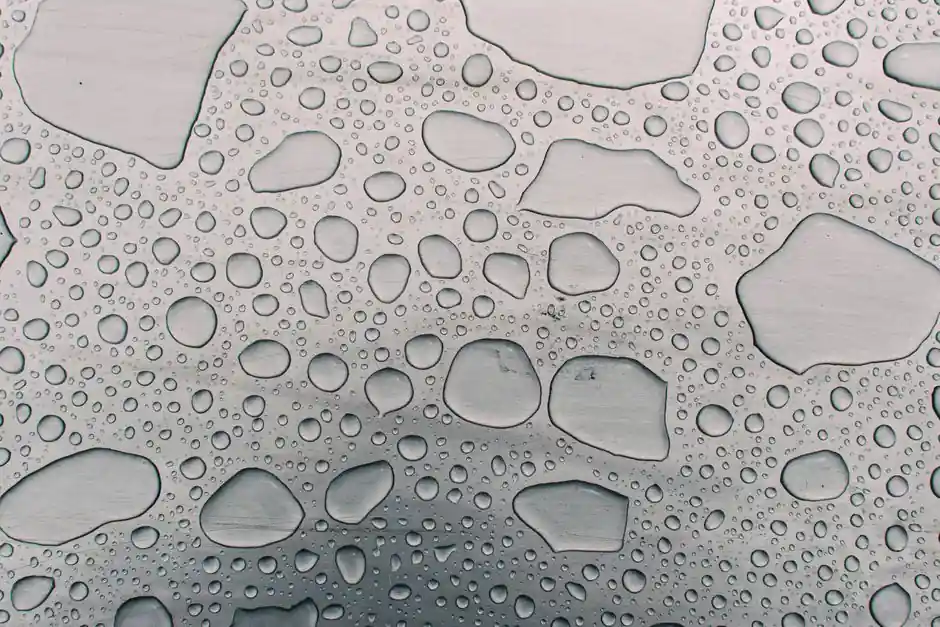
A water-based silane-siloxane repellent penetrates concrete and masonry, reacting below the surface to reduce water and chloride absorption without changing the substrate’s appearance [S1][S4].
Functional Difference Between Repellent and Waterproofing
A penetrating silane-siloxane treatment chemically reacts within the substrate and forms a water-repellent region below the surface [S4]. Sika lists a page titled "Silane Siloxane Coatings" under its repair and protection coatings and water repellents category. This treatment reduces absorption rather than creating a separate waterproof membrane.
By contrast, a continuous waterproofing coating forms a membrane that must bridge surface defects, joints, and penetrations. The practical distinction is water management: a repellent can reduce rain-driven wetting, while a waterproofing system is required when the design objective is to prevent a continuous liquid-water path through the assembly.
This is not a minor wording difference. Silane, siloxane, and siliconate water repellents are formulated to prevent ingress of water and chlorides, but their effectiveness depends on the substrate and exposure condition [S5]. A visible beading result alone is not a reliable measure of long-term protection, particularly when treatment remains concentrated near the surface and is exposed to traffic, weather, or abrasion [S2].
Where a Silane-Siloxane Treatment Can Replace a Coating
Silane-siloxane is appropriate when the concrete or masonry is porous, above grade, and exposed to rain, splashback, snow, or deicing salts. The Armor SX5000 WB is specified as a professional-grade, water-based silane-siloxane concrete sealer for concrete, brick, and masonry, and it forms its water-repellent barrier below the surface [S3][S4].
Penetrating concrete sealers are offered for a natural, matte finish [S4].
The treatment is not a good match for a substrate that is already nonporous, densely filled, coated, or badly deteriorated without repair. It is also unsuitable as the sole strategy where groundwater, drainage failures, rising damp, ponding, or saturated ground continuously drive water toward the structure.
Conditions That Rule Out a Simple Replacement
Negative-side water pressure is the clearest exclusion. Conventional penetrating silane-siloxane products are widely presented for exterior concrete, pavers, and masonry, but a specialty product marketed as Ion-Bond Armor claims resistance to negative-side pressure in basement walls and floors, along with penetrating capability through latex paint [S2]. That product-specific claim establishes the distinction: ordinary silane-siloxane treatment should not be assumed to perform as a pressure-resistant waterproofing system.
Continuous vapor and capillary seepage also requires a different specification. Ion-Bond Armor is described for slab-on-grade concrete, basements, and crawlspaces, with reduced infiltration of water vapor and capillary seepage while allowing the concrete to breathe [S2]. The more general point is that a surface repellent is not automatically a below-grade waterproofing assembly.
The assembly condition remains decisive. In basement and crawlspace work, location of the water source, drainage design, foundation-wall construction, joint treatment, and coating continuity govern performance. For that application, the distinction between positive- and negative-side waterproofing is more important than the chemistry label on a pail.
Penetration, Appearance, and Durability Compared
The main options are conventional silane-siloxane, a deeper-penetrating specialty treatment, and a film-forming waterproofing coating. Conventional silane-siloxane offers a water-based, breathable treatment for porous masonry and penetrates below the surface [S1][S4]. Ion-Bond Armor is absorbed deeper into concrete, reacts within its microscopic pores, and forms a subsurface elastomeric waterproofing barrier [S2].
Penetrating treatments preserve the masonry appearance and can be paintable, while visible beading may be weaker even when water repellency remains effective [S2][S4]. In terms of liquid-water exclusion under pressure, a specialty penetrating system may claim more capability than ordinary silane-siloxane, but only the named product and its documented performance should be specified [S2].
This comparison also explains why cosmetic acceptance and hydrological performance must be evaluated separately.
Substrate Preparation Determines the Substitution
Substrate condition is the deciding technical variable. Armor SX5000 WB must chemically react below the surface, so the concrete must accept penetration and the treated area must be prepared accordingly [S3][S4]. Organic films, laitance, dirt, dense sealers, and incompatible coatings can block contact between the treatment and the mineral substrate.
Concrete defects also need correction before either system is installed. A repellent will reduce absorption by porous sound concrete, but it does not restore structurally damaged material, close moving cracks, or replace proper treatment of expansion and construction joints. A waterproofing coating also requires a sound and prepared substrate, while adding a continuous membrane over untreated defects.
Application conditions affect both options. Water-based products avoid the solvent odor associated with solvent-based systems, while the manufacturer comparison notes that solvent odor can persist for up to a week after application as solvents dissipate [S4]. Coverage, cure conditions, temperature limits, substrate moisture, and repaint interval should be taken from the selected product’s technical data sheet rather than inferred from the generic chemistry.
Specification Checklist for Substitution
Substitution should be approved only after four checks are documented. First, confirm that the substrate is porous concrete or masonry and that its condition is suitable for penetration [S1][S4]. Second, establish whether water acts on the positive side as rain or splashback, or arrives from the negative side through soil and groundwater. Third, specify the required performance, including reduced absorption, chloride resistance, appearance retention, or exclusion of liquid water.
Fourth, require product-specific evidence for any exceptional claim. Armor SX5000 WB is documented as a penetrating, reactive water-based treatment for concrete, brick, and masonry [S3][S4]. By contrast, Ion-Bond Armor’s claimed ability to withstand negative-side pressure, seal through latex paint, and remain paintable belongs to that proprietary elastomeric product, not to silane-siloxane chemistry in general [S2].
For sourcing, use the project’s water-exposure classification, substrate composition, test or listing requirements, and the manufacturer’s current technical data sheet. No universal substitution ratio, coverage rate, service life, or standard can be assigned without those inputs; values for penetration depth, water absorption reduction, chloride resistance, vapor permeability, adhesion, and crack bridging are product- and substrate-specific.
The practical decision is straightforward: specify silane-siloxane instead of a waterproofing coating when the objective is to repel surface moisture from sound, porous masonry; retain a dedicated waterproofing system when the objective is to stop liquid water, handle pressure, bridge the assembly, or protect occupied or storage spaces.