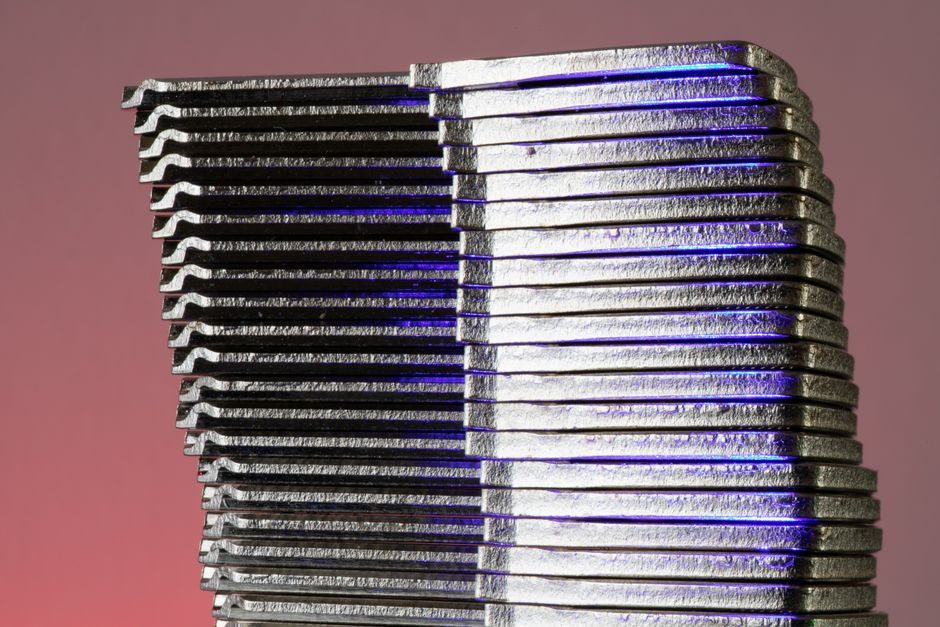
For drives that need to run quieter and faster than a stock roller chain without slipping like a belt, silent chain (SC series, GB/T 10855-2003) is the default shortlist candidate, with industrial pitches of 9.525 mm and 12.7 mm and tensile capacities quoted in the HV/HPC/RPV families on Chinese catalogues [S4][S10].
The selection problem is not whether silent chain works — at glass lines, motorcycle primary drives, and high-ratio timing gearboxes it is already the workhorse [S3][S4][S10] — it is which guide form, which pitch, and which construction fits the actual speed, load, temperature, and contamination profile of the driven machine.
What a Silent Chain Actually Is, and How It Differs from a Roller Chain
A silent chain is an articulated stack of tooth-shaped link plates pinned together, where each pair of plates engages a matching sprocket tooth; the meshing is progressive rather than the chordal rise-and-fall impact that gives a roller chain its characteristic mesh frequency and noise [S4].
GB/T 10855-2003 governs silent chain and sprocket geometry in China, with the chain number prefix moving from the older "CL" series to the current "SC" (Silent Chain) series; the revision kept pitch and minimum crotch height as fixed parameters but relaxed plate height and shape, giving designers and foundries more latitude on the rest of the link profile [S5].
Three guide forms are standard: outer guide (外导式), inner guide (内导式), and double inner guide (双内导), and the choice is not cosmetic — the guide controls lateral stiffness and which sprocket flange the chain rides against under reversing or misaligned loads [S4].
Where Silent Chain Earns Its Slot — and Where It Should Not Be Specified
Silent chain drives transmit power at loads and speeds that exceed the practical capabilities of belts and conventional roller chains, which is why they are specified for motorcycle primary drives, glass-bottle cross conveyors on IS machines, overhead timing drives, and oil-pump drives on small industrial engines [S3][S4][S10].
On a glass line, the chain indexes hot ware at line speeds that would fret a roller chain and would smear a polyurethane belt; the catalogue product line "HV / HPC / HDL" at 9.525 mm and 12.7 mm pitch is purpose-built for that environment, with inner and outer guide options so the conveyor designer can pick the lateral-stiffness profile the cross conveyor needs [S10].
Silent chain is the wrong call where the drive needs shock absorption (silent chain has very low elasticity and will transmit torque spikes to the shaft), where contamination is heavy and oiling is impossible (the multi-plate stack packs grit), or where absolute lowest cost matters more than noise and speed (a basic roller chain is cheaper per metre and easier to field-splice) [S3].
The Four Decision Criteria That Actually Pick the Chain
Pitch: the catalogue universe concentrates on 9.525 mm (3/8") and 12.7 mm (1/2") for industrial use, with motorcycle powersports chains stepping up to larger widths — e.g. Team part 970421 is a 106-link, 13-wide silent chain, and 970423 is the same 13-wide body in a 90-link configuration [S8][S9].
Guide form: outer guide suits uni-directional drives with clean alignment; inner guide is the default for reversing drives and where the sprocket has no flanges to ride; double inner guide is the stiffest stack, used on long centres or where lateral wander must be killed [S4].
Working load and tensile rating: catalogue plates list a family code that encodes pitch and width, e.g. HV416 in the Hava/Rongda catalogue at 12.7 mm pitch, with quoted tensile and width combinations that the buyer must match to design power and service factor [S10].
Environment: temperature, lubricant access, and contamination drive material and coating choices; the same catalogue offers the chain in inner-guide and outer-guide variants for the IS-machine duty, because glass lines run hot and wet [S10].
Silent Chain vs Roller Chain vs Synchronous Belt — A Criteria Comparison
For a given kW at a given rpm, silent chain sits between roller chain and synchronous belt on the three axes that usually matter at the spec stage: top speed, noise, and shock tolerance. Silent chain runs faster and quieter than roller chain, but tolerates far less torsional shock than either a roller chain or a rubber-backed timing belt [S3].
The pattern that falls out of the table: pick silent chain for high-speed, high-load, low-noise, well-lubricated, clean-side drives; pick roller chain for low-cost, rugged, splicing-friendly general power transmission; pick synchronous belt where shock absorption and zero-lube operation matter, as covered in the V-belt vs sprocket synchronous drive comparison.
Reading the Chain Number, Reading the Catalogue Page
The chain number carries the spec: under the older CL scheme the number encoded pitch, plate count and width, and the SC revision retained pitch and minimum crotch height as the binding parameters but left plate profile freer, so a buyer matching an SC chain to an existing installation must confirm pitch, minimum crotch height, and total width rather than expecting a like-for-like plate outline [S5].
On a real catalogue entry, e.g. "HV416 RPV RP HPC KH HDL silent chain 9.525 12.7" from a Dezhou, Shandong manufacturer, the family code and the two pitches are read together: the chain is offered in both 9.525 mm and 12.7 mm pitch, with HV/RPV/RP/HPC/KH/HDL denoting the width / plate-count variants in that manufacturer's line, and the unit price quote is per strand at MOQ 1 [S10].
Two practical reading rules: first, pitch and crotch height must match the sprocket exactly, because the new standard relaxed plate shape — a sprocket cut for an old CL plate will not necessarily back a new SC plate of the same pitch [S5]; second, width is the variable that scales capacity, so if the design kW is moving up you usually add width (i.e. add plates) before you change pitch.
Installation, Lubrication, and the Failure Modes That Catch Buyers Out
Silent chain drives need positive lubrication — oil bath, oil disc, or forced spray — and a misaligned or dry installation will pit the pin joints inside the link stack long before the sprocket teeth show wear; this is the most common field failure and the one the catalogue guidance and the standard are both built around [S3][S5].
Sprocket alignment and tension matter more than for a roller chain: the multi-plate stack has little compliance, so a small angular error shows up as edge loading on one plate and accelerated pin wear; take-up must be smooth and centred.
Contamination is the silent killer: dust and glass fines pack into the crotch between guide plates, act as grinding paste, and accelerate pin and bushing wear; in glass-plant duty the chain is normally paired with guarding and a wash-down regime for exactly this reason [S10].
Standards, Sourcing, and What to Verify Before You Sign the PO
The governing standard for silent chain and sprocket geometry in China is GB/T 10855 (current revision 2003, with the SC numbering series and a relaxed plate-profile rule versus the original CL series) [S4][S5].
International equivalents and OEM specifications: ISO 606 covers chain pitch and dimensions in the roller-chain family and is often referenced as the dimensional baseline even when the silent-chain profile is proprietary; for North American powersports use, the Team / Morse aftermarket channel (e.g. part 970421, 106 links, 13 wide; and 970423, 90 links, 13 wide) is the typical replacement pipeline, with US$152.50 and US$151.04 list pricing on the channels sampled in mid-2025 [S8][S9].
Before signing the PO, confirm four numbers against the spec sheet: pitch (9.525 mm or 12.7 mm in most industrial lines), minimum crotch height (per GB/T 10855-2003), total width (matches the kW and service factor calculation), and the guide form (inner / outer / double-inner per the drive layout) [S4][S5][S10]. For longer-centre, high-ratio drives the same selection logic also informs chain conveyor drivetrains, where the same chain families and sprocket standards apply.
Trackable next signals: GB/T 10855 revision activity (the 2003 edition is the current public reference, and any new revision will reshape how SC numbers map to plate profiles) [S5]; OEM catalogue updates from Ramsey and the Dezhou-area Chinese makers for higher-pitch industrial SC lines, since the 9.525 / 12.7 mm pair dominates current offerings but higher-pitch industrial duty is the next capacity frontier [S3][S10].
For component-level specifications, see silent chain.