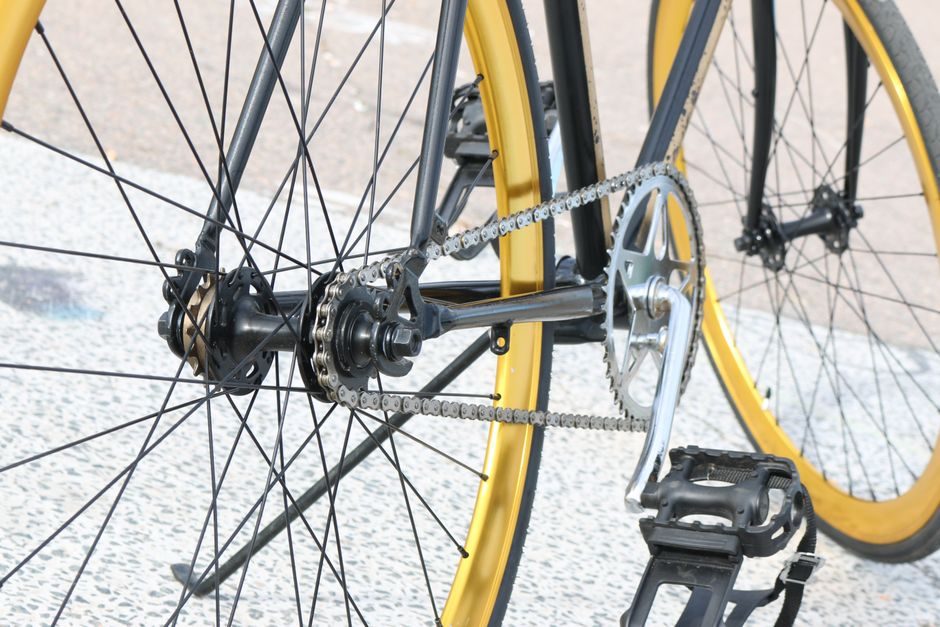
A silent chain drive is not a drop-in replacement for a roller-chain drive: it meshes on the flanks of involute-form sprocket teeth rather than on the tip diameter, which is why Cross & Morse (UK) offers dedicated HV and SC series sprockets for inverted-tooth chain and explicitly states a minimum 25-tooth pinion for best efficiency [S1].
The peer-reviewed geometry of silent chain is still treated as an open problem: a 2018 MATEC Web of Conferences paper from Transilvania University of Brasov notes that silent chains are "not standardized yet" and varies involute-sprocket parameters to study contact-point shift [S2]. Specifiers in 2026 therefore lean on a three-layer reference stack: an OEM catalogue (Cross & Morse HV/SC), a research geometry baseline (Jurj, Velicu, Săulescu 2018), and a process-engineering rule-of-thumb (≥25-tooth pinion, odd counts preferred) [S1][S2].
What the sprocket actually does in a silent chain vs a roller chain
In a roller chain, the sprocket presents teeth whose tip diameter acts as the pitch surface; the roller chain rollers engage on the tooth flanks with a quasi-rolling contact, and the sprocket is in essence a stamped or machined pitch-diameter wheel. In a silent chain, the chain itself is built from stacked link plates with cut teeth on each plate's leading edge; those teeth mesh with an involute-profile sprocket much like miniature gear teeth, sliding on the sprocket flank rather than rolling on a roller sleeve [S1][S2]. That is why Cross & Morse classify the HV and SC product line as "inverted-tooth" chain drives, and why the part is sold as a dedicated gear, not a generic chain-sprocket assembly [S1].
Because the contact is a sliding gear meshing rather than a roller-on-tip engagement, the load is spread over many teeth in mesh simultaneously — Jurj et al. model the theoretical contact point between the chain's toothed plate and the involute sprocket and show that small changes in plate-pitch and tooth-modulus shift the contact point and the resultant flank pressure [S2]. In practice that translates to lower specific sliding velocity per tooth and noticeably lower acoustic emission at the same pitch line speed, which is the property that gives the "silent" chain its name [S2][S3].
Tooth count, material and heat-treatment gates
Cross & Morse specify a 25-tooth minimum pinion for smooth, low-noise HV/SC drives, and confirm that any chain size will physically mesh down to a 19-tooth pinion but that such designs should be referred back to the maker [S1]. For 1:1 ratio drives, even-tooth pinions are preferred; non-1:1 drives are best with odd-tooth pinions to maximise chain life — a wear-indexing rule that comes from the fact that every tooth pair on the chain sees a different engagement point over each revolution when the tooth counts are coprime [S1].
On material, the same catalogue splits the range: up to 30 teeth the pinion is usually a low-carbon alloy steel with case-carburised and hardened teeth for high surface hardness plus a tough core, while larger pinions switch to medium-carbon steel with induction-hardened teeth or to meehanite castings [S1]. The Dacromet-coated, OEM-custom replacement sprocket offerings in the Chinese supply market — typically FOB US$2.00/piece at bulk-quantity tiers — apply a zinc-flake / Dacromet topcoat to carbon-steel blanks to push corrosion life up in wash-down or coastal conveyor service, which sits inside the same material envelope as the European catalogue parts [S5]. For full drive-geometry context the related chain conveyor and cable drag chain reference pages give the wider system constraints a drive engineer usually pulls from first.
Comparison: silent chain + involute sprocket vs roller chain + tip sprocket
Side-by-side against the four selection criteria that actually drive a 2026 spec, the two systems diverge sharply: [S1]
1) Noise and vibration: silent chain with involute sprocket scores lower at the same linear speed, because the many-teeth simultaneous mesh smooths the input pulse; the roller-chain/sprocket pair generates a discrete click per tooth entry.
2) Speed and power density: silent chain can run at higher pitch-line speeds and transmit more power per unit width than a roller chain of the same pitch, which is why automotive timing and balance-shaft systems migrated to it.
3) Standardisation and sourcing: the roller chain/sprocket pair is covered by ISO 606 (and the parallel ANSI B29.1) so off-the-shelf parts inter-source freely; silent-chain geometry is still treated as a non-standard product with each OEM publishing its own tooth-profile constants, exactly the limitation Jurj et al. flag in 2018 and which the 2026 sourcing market has not closed [S2].
4) Tolerancing and replacement parts: replacement roller sprockets are commodity-stock items (including the Dacromet-coated blanks shown at ~US$2.00/piece on bulk channels [S5]), while an HV/SC silent-chain sprocket — e.g. the RAMSEY 404-25 listed aftermarket at US$26.39 [S4] — must be cross-checked against the matching chain-maker's profile drawing before purchase.
Net of those four, the silent-chain drive wins where noise, speed, and packaging are tight, and the roller-chain drive wins where spare-part logistics, standards compliance, and low unit cost dominate. A pure conveyor chain application in bulk-material handling, in contrast, is sized against ISO 1977 chain attachments and slat geometry — an entirely different decision tree that should not be confused with a silent-chain timing drive.
Failure modes and process limits engineers actually see
Because the silent chain is a sliding gear mesh, the dominant wear mode is plate-tooth flank wear rather than roller-bushing wear; Jurj et al. show that small changes in plate pitch, sprocket modulus, and pressure angle shift the theoretical contact point and therefore the local Hertzian pressure, which directly drives pitting and scuffing risk on the sprocket flank [S2]. The OEM countermeasure is a case-hardened pinion tooth surface on a low-carbon core — a metallurgical choice Cross & Morse document explicitly for ≤30-tooth pinions and then switch to induction-hardened medium-carbon steel for larger wheels [S1].
Other limits that show up in service: chain elongation drives chordal-action noise, so silent-chain drives are more sensitive than roller-chain drives to running past their elongation limit; a missing or mis-pitched plate throws the contact pattern immediately, while a stretched roller chain will still engage; and the anti-resonance requirement is stricter, so drives that have worked for years as roller chain can become noisy when retrofitted to silent chain without a stiffness recheck. For a 25-tooth minimum pinion and 19-tooth absolute minimum, designers should also keep a 1:8 ratio ceiling in mind for the standard HV/SC family, beyond which the small pinion wraps too few teeth and chordal action becomes audible [S1].
Who silent chain is for, and who should stay on roller chain

Silent chain with an HV/SC-type involute sprocket is the right call where the spec is noise-sensitive (automotive timing and balance shafts, office-machine drives, indoor conveyor transfer stations near occupied workstations), where the pitch-line speed is high enough that roller-chain click is a problem, or where the drive envelope is constrained and the higher power density per unit width matters. Cross & Morse's HV and SC product lines are built exactly for those cases, with full material and heat-treatment documentation per tooth-count class [S1].
It is the wrong call where a single harmonised standard is required, where spare parts must be commodity-sourced, or where the drive is exposed to heavy contamination and shock loads: the lack of standardisation flagged in 2018 still means a silent-chain sprocket is a matched pair with the chain-maker's profile, not a generic replacement, and aftermarket parts such as the RAMSEY 404-25 must be verified against the specific chain OEM's drawing before installation [S2][S4]. Conveyor applications, agricultural drives, and general industrial machinery are still better served by the roller chain and standard sprocket pair, with the option of Dacromet or zinc-flake coated blanks when corrosion is the dominant life limiter [S5].
Trackable signals for the next 6–12 months
Two signals are worth watching. First, a movement of any major standards body (ISO TC 100 or the ANSI B29 committee) to publish an involute-profile envelope for silent-chain sprockets would close the "not standardised yet" gap that Jurj et al. flagged in 2018 and is still quoted in 2026 OEM literature; absence of such a publication by mid-2027 keeps the situation unchanged [S2]. Second, watch the commodity price spread between a generic Dacromet-coated blank sprocket (~US$2.00/piece bulk [S5]) and a branded silent-chain sprocket such as the RAMSEY 404-25 aftermarket listing at US$26.39 [S4] — a narrowing spread would indicate that profile interchangeability is finally arriving on the aftermarket; a stable or widening spread would confirm that silent-chain sprockets remain a matched-component market, not a commodity one.
For related coverage, see Electrolyzer Supply Chain 2026: Choke Points, Sourcing Levers and Spec Gates.